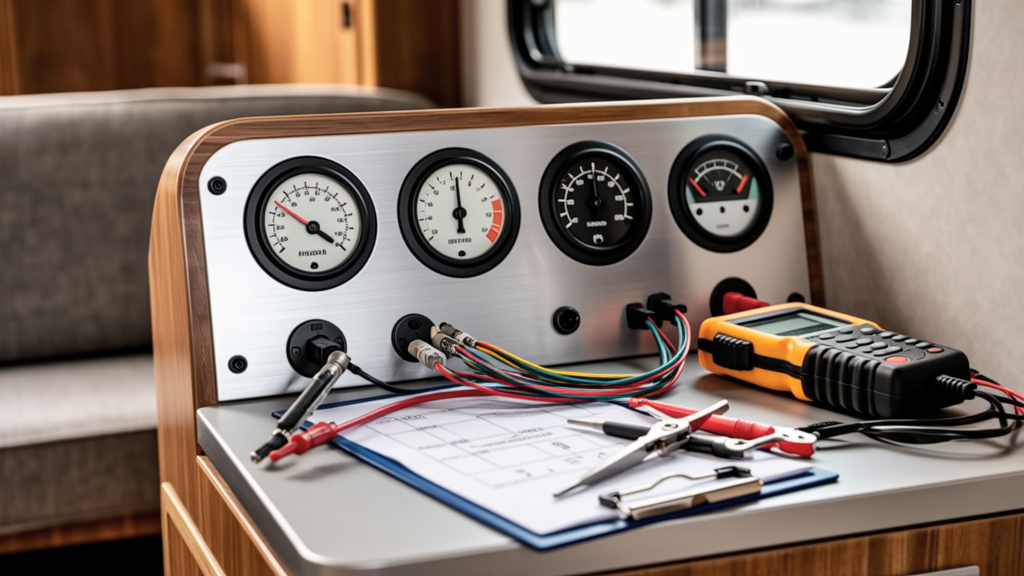
A gauge reference for RV diagrams is the visual key that translates a tank, battery, propane, or pressure reading into usable information. A good diagram shows scale, units, color zones, sensor type, and model-specific quirks so you can compare the gauge with a known target. The best gauge reference is not one universal chart. It must match the panel you use, whether it is a Mor-Flo tank monitor, a Suburban propane gauge, a Victron battery meter, or a Dometic control display. This article explains how to choose, read, and build a reference diagram that helps you camp with less guesswork and fewer surprises.
Why Gauge Reference Matters in RV Diagrams
RV systems are designed around limited capacity. A 20 pound propane cylinder holds about 4.7 gallons when full, but a safe fill is only 80 percent, or 16 pounds. A 30 gallon fresh tank may look adequate for two nights of dishwashing, showering, and drinking, but actual use can be 2.5 to 4 gallons per person per day. A 12 volt lead acid battery is considered near full at 12.6 volts, while a 13.4 to 13.6 volt reading on a lithium iron phosphate bank can still represent a healthy charge. These numbers only become useful when a diagram places them on the same scale as the gauge.
A gauge reference also reduces risk. Propane pressure, water pump pressure, and black tank venting are not cosmetic issues. If your diagram says normal water pump pressure is 40 to 60 psi, you can spot a failed pump or clogged filter. If your propane reference says a gauge reading near the red zone can be misleading after a hot day, you know to check temperature and tank age before trusting it. Diagrams work best when they include the why, not just the mark.
For leveling jacks, a reference diagram can show where a gauge should sit after retraction, not only the extended position. Lippert leveling systems and manual jacks often need a visual check for pad placement and load shift. A diagram that maps 1/4 inch scale marks to actual jack extension can help you avoid overloading a landing leg or leaving a stabilizer pad under tension.
The Best Gauge Reference for Diagrams by Use Case
The best reference depends on what you are measuring. A percentage gauge reference is ideal for holding tanks because many RV monitors only provide a rough fill level. A volume reference is better for fresh water planning, especially when you know tank capacity in gallons. A voltage reference is essential for electrical systems, because state of charge can vary by battery chemistry. A pressure reference is required for propane, water, and tire monitoring, where the number alone is not enough without the safe operating range.
- Propane: Use a weight and fill percentage reference. A 20 pound cylinder has a practical safe maximum of 16 pounds, about 80 percent.
- Fresh water: Use gallons and days of camping. A 40 gallon tank for two adults may last two to three days with moderate use.
- Gray and black tanks: Use a percentage plus a dump reminder. Many RV sensors are within 10 to 20 percent accuracy.
- Battery: Use voltage ranges for lead acid, AGM, and LiFePO4, plus an amp hour target.
- Water heater: Use pressure and temperature ranges, often 50 to 100 degrees Fahrenheit and up to 50 psi with a relief valve such as a Camco model.
| Use Case | Best Gauge Reference | Typical Scale | Best Practice |
|---|---|---|---|
| Propane tank | Weight plus percentage | 0 to 20 pounds, 0 to 100 percent | Mark 80 percent safe maximum |
| Fresh water | Gallons plus days | 0 to 120 gallons | Label 25 percent refill soon |
| Black tank | Percentage plus dump trigger | 0 to 100 percent | Calibrate after a full rinse |
| 12 volt battery | Voltage plus chemistry | 12.0 to 14.7 volts | Read at rest for accuracy |
| Water pump | Pressure range | 0 to 60 psi | Check regulator and relief valve |
For diagram design, the most useful reference is one that converts the gauge into a decision. Instead of only marking a needle position, add labels such as refill soon, safe maximum, low voltage caution, or dump recommended. That makes the diagram practical on a campsite, not just an owner manual copy.
Reading a Propane, Water, and Electrical Gauge Reference
Propane Gauge Reference
Propane gauge reference diagrams need to handle a tricky problem: tank temperature changes vapor pressure. A Suburban or Mor-Flo propane gauge may show a stable needle while the tank is only partially full if the cylinder is warm. For a 20 pound cylinder, the safe fill target is 16 pounds. If your diagram shows a gauge scale, mark the 80 percent line clearly and label it as the maximum safe fill point. A common error is assuming the gauge reads liquid volume directly. It does not. The gauge reflects pressure, which is affected by temperature, tank age, and valve condition.
When building a propane reference, include the tare weight and fill weight. A typical 20 pound propane cylinder has a tare weight around 17 to 18 pounds, so a full scale reading of 37 to 38 pounds corresponds to a safe propane fill. For on-board tanks, check the manufacturer label. An RV with a 40 gallon propane tank has a maximum safe fill near 80 percent, about 32 gallons. Diagrams should show the vent limit, the overfill prevention valve point, and the expected gauge position after a hot afternoon.
Fresh Water and Black Tank Gauge Reference
Holding tank gauge reference diagrams benefit from calibration notes. Many RV tank sensors are magnetic paddles or float switches. They can read high after a partial dump or low after detergent buildup. A fresh tank may hold 30, 40, 50, 60, 80, or 120 gallons, but the gauge may not be linear. A black tank with a 40 gallon capacity and a macerator or sloped floor can give misleading readings when solids settle near the sensor.
The best diagram for tanks uses a simple scale: 0 percent empty, 25 percent caution, 50 percent plan, 75 percent dump soon, and 100 percent maximum. Add the actual gallons next to each mark. For a 50 gallon fresh tank, 25 percent equals 12.5 gallons, 50 percent equals 25 gallons, and 75 percent equals 37.5 gallons. If you use a Dometic or Atwood water heater, include the bypass position and the expected tank fill behavior during winterizing. A gauge reference that ignores bypass can make a winterization diagram inaccurate.
Electrical and Battery Gauge Reference
Electrical gauge reference diagrams should distinguish between voltage, current, and state of charge. A 12 volt lead acid or AGM battery can be near full at 12.6 to 12.8 volts at rest. A lithium iron phosphate bank may show 13.4 to 13.6 volts while full, and a sagging reading under load can confuse older monitors. For a Renogy, Victron, or Progressive Dynamics setup, include a note that voltage is not always state of charge unless the battery is at rest for several hours.
Add the amp hour capacity to the diagram. A 100 amp hour lead acid battery should not be discharged below 50 percent if you want to preserve life, so your reference should mark 50 amp hours as a caution point. A 200 amp hour LiFePO4 bank can tolerate deeper discharge, but the inverter and charger still need voltage limits. For solar setups, include expected panel output in watts, such as a 200 watt array producing roughly 60 to 100 watts in partial shade, so the gauge reference can be compared against realistic charging conditions.
Common Gauge Reference Formats for RV Owners
There are several formats for a gauge reference, and each has strengths. An analog color band is easy to see in low light. A percentage scale is simple for tank monitors. A digital voltage chart is precise but requires more explanation. A pressure gauge diagram is best for safety-critical systems. The right format depends on where the diagram will live and who will read it.
- Color band reference: Green, yellow, red zones. Good for propane, battery, and tank monitors. Use high contrast and avoid relying on color alone.
- Percentage reference: 0, 25, 50, 75, 100. Best for holding tanks and solar charge controllers.
- Volume reference: Gallons or liters. Best for fresh water and propane on-board tanks.
- Voltage reference: Volts per chemistry. Best for 12 volt, 24 volt, and 48 volt systems.
- Pressure reference: psi or bar. Best for water pumps, tire monitoring, propane regulators, and water heaters.
A hybrid format often works best. For example, a black tank diagram can show 100 percent, 30 gallons, and dump recommended. A battery diagram can show 12.6 volts, 50 percent, and rest test. A propane diagram can show 80 percent, 16 pounds, and do not overfill. This gives you multiple ways to interpret the same gauge.
How to Build a Custom Gauge Reference Diagram
A custom diagram should be built for the exact gauge, panel, and tank configuration in your RV. Start by recording the manufacturer model, the capacity, the sensor type, and the normal readings. If you have a Mor-Flo tank monitor, note the number of tanks and whether it uses a single display or a multi tank panel. If you have a Victron battery monitor, note the shunt amperage and the voltage range displayed.
- Measure the gauge face: Record the outer diameter, scale divisions, needle rest position, and backlight color. A 2 inch face with 1/4 inch divisions is common on simple RV gauges.
- Choose the reference units: Use pounds for propane, gallons for water, percent for tanks, volts for batteries, and psi for pressure.
- Mark safe zones: Add a maximum safe fill line at 80 percent for propane and a caution line at 25 percent for fresh water.
- Add model notes: Label whether the gauge reads pressure, voltage, or a sensor approximation. Include the manufacturer, such as Dometic, Atwood, Suburban, or Renogy.
- Test the diagram: Compare it with a known condition, such as a freshly filled 20 pound propane cylinder or a resting 12.6 volt battery.
- Protect it: Laminate the sheet or print it on 8.5 by 11 inch cardstock. Keep it near the control panel, not only in a drawer.
When designing the layout, use at least 1/8 inch text height for labels and 1/4 inch spacing between major scale marks. If the diagram will be read at night, choose a high contrast layout and avoid tiny percentage marks. A practical RV diagram should be readable from a few feet away while standing in a dark basement compartment.
Brand-Specific Notes for Popular RV Gauge Panels
Brand context matters because each manufacturer uses different assumptions. Lippert components, including leveling systems and some electrical panels, benefit from a diagram that includes jack extension limits and pad support notes. Dometic refrigerators and water heater controls often need a reference that explains bypass mode, gas ignition, and thermostat settings. Atwood water heaters and furnaces use pressure and temperature limits that should be labeled clearly on any service diagram.
Mor-Flo tank monitors are common in Class A, Class C, and travel trailers. Their gauge reference is most useful when it includes the exact tank sizes and a warning that partial dumps can leave sensors stuck. Suburban propane appliances, furnaces, and water heaters should be paired with a propane pressure reference that shows the expected regulator output, often around 11 to 13 inches water column for low pressure residential style propane systems.
Renogy, Victron, and Progressive Dynamics are frequently used in solar and power upgrades. A Renogy battery monitor or Victron smartshunt can show amp hours, voltage, and state of charge, but the numbers are only as accurate as the shunt calibration and the battery profile. A diagram for these panels should include the battery capacity, the low voltage disconnect point, and the charge acceptance voltage. For example, a 100 amp hour LiFePO4 bank may show 13.6 volts while full, while an AGM bank may need 14.4 to 14.7 volts during charging.
Troubleshooting Mismatched Readings on Your Gauge Reference
If your gauge and reference diagram disagree, do not immediately assume the gauge is broken. First check whether the reading was taken under load. A battery monitor may show 12.1 volts while an inverter is running, then recover to 12.7 volts after the load stops. A fresh water gauge may jump after driving because the sensor paddle shifts. A black tank gauge may read full after toilet paper clings to the paddle. A propane gauge may look normal when cold but show a different range after sun exposure.
Use a comparison test. For propane, weigh the cylinder on a shipping scale and compare it to the tare weight stamped on the collar. For water tanks, fill the tank from a known measured supply, such as a 5 gallon container repeated four times, and mark the gauge position. For batteries, use a calibrated multimeter and check voltage at rest. For pressure, use a separate gauge at the service port. These tests turn a vague diagram into a verified reference.
Common mismatch causes include fouled sensors, tank slope, temperature, ground straps, and calibration. Magnetic tank sensors can lose accuracy after 10 to 20 percent error if buildup forms. Electrical voltage readings can be off by 0.1 to 0.3 volts due to cable resistance or a dirty ground. Propane vapor pressure can change significantly with temperature, so a diagram should include a note for hot days and cold mornings. Tire pressure gauges can drift if the valve core is damaged or if the gauge is not calibrated.
A well-built gauge reference diagram becomes part of your RV operating procedure, not just a reference sheet. Keep it updated when you add a 200 watt Renogy panel, replace a 6 gallon water heater, or install a Victron shunt. The most valuable diagram is the one that matches your current setup, explains the safe range, and gives you a quick way to act when the reading looks wrong.