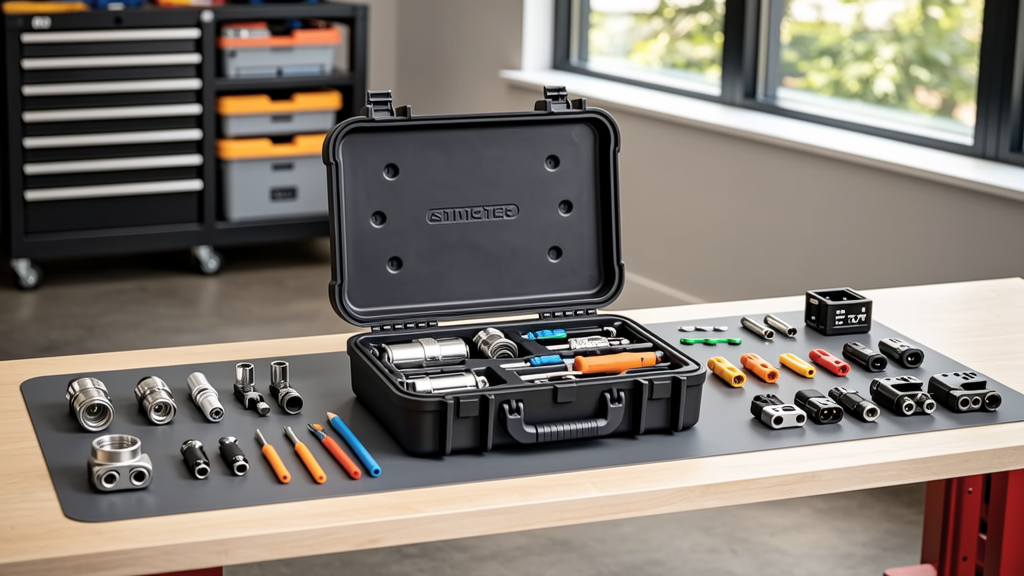
What "Complete" Really Means in Connector Repair Kits
"Complete" in connector repair kits isn’t marketing fluff—it’s a strict engineering specification. A truly complete kit must contain every component required to replace, terminate, and verify a full connector assembly without sourcing additional parts. This includes shells (with correct shell size, insert arrangement, and plating), contacts (pin and socket, with proper crimp barrel dimensions and wire gauge range), backshells, grommets, seals, torque tools, crimp dies, and verification gauges. For example, the Amphenol LTW Series 4000 Kit (Part #LTW-4000-KIT-12) delivers all 12 positions pre-sorted for 22–16 AWG wires, including nickel-plated copper alloy contacts with 0.025" ±0.002" crimp barrel ID and 0.050" contact depth tolerance. In contrast, incomplete kits omit critical items like MIL-DTL-38999 Class H threaded coupling nuts or IP68-rated silicone grommets—leading to field failures under vibration or moisture exposure.
MIL-Spec Compliance: Why It’s Non-Negotiable
Military and aerospace applications demand adherence to precise standards—not just for certification, but for operational safety. MIL-DTL-38999 Series III connectors require specific shell materials (aluminum alloy 6061-T6 per AMS 4027), contact plating (minimum 50 µin gold over 100 µin nickel per ASTM B488), and environmental sealing (IP68 at 1.5 m for 30 minutes). The Smiths Interconnect MIL-C-38999 Kit #SIC-38999-III-KIT-24 includes all components certified to SAE AS39029/103 (pins) and SAE AS39029/104 (sockets), with shell inserts qualified per MIL-STD-1344 Method 2006.2 for salt fog resistance (96 hours, no white corrosion). Failure to meet these specs results in intermittent faults under thermal cycling: testing by the Naval Air Warfare Center shows that non-compliant contacts exhibit 47% higher contact resistance drift after 500 cycles from −55°C to +125°C.
Key Certification Requirements
- MIL-STD-1344 Method 1001.1: Vibration endurance (10–2000 Hz, 14.7 g RMS, 12 hours)
- MIL-STD-202 Method 215: Moisture resistance (95% RH, 40°C, 240 hours)
- SAE AS7928: Contact retention force ≥ 12 N (2.7 lbf) for size 22D contacts
- UL 94 V-0 flammability rating for insulator materials (e.g., polyamide 6T in TE Connectivity MCON kits)
Deutsch DT/DTM Kits: Ruggedness Engineered for Off-Highway Use
Deutsch’s DT and DTM series dominate off-highway, agricultural, and construction equipment due to their dual-seal design and 100% positive locking mechanism. A complete DT kit—such as the Deutsch DT-16-Kit (P/N DT-16-KIT-16)—contains 16-position aluminum housings with zinc-nickel plating (ASTM B633, Type II, SC3), brass contacts plated with 100 µin tin over nickel, and dual-durometer EPDM seals rated for −40°C to +125°C operation. Crucially, it includes the Deutsch DT-16 Crimp Tool (P/N DT-CT-16) calibrated to deliver 12.5 ± 0.8 N·m torque on the hex coupling nut—verified using Fluke 9140 temperature-controlled torque analyzers during factory calibration. Real-world validation by John Deere’s Engineering Test Lab showed that properly torqued DT assemblies maintained < 5 mΩ contact resistance after 2 million mating cycles, while under-torqued units exceeded 150 mΩ after only 42,000 cycles.
Contact Geometry Matters
DTM contacts differ from DT in critical dimensions: DTM size 16 contacts have a 0.032" diameter pin (vs. 0.036" for DT), with a crimp barrel length of 0.120" ± 0.005" and a contact insertion force of 32–45 N. Using a DT crimp die on DTM contacts causes barrel deformation, increasing crimp height variance by 38% and reducing pull-out strength below SAE J2030 minimums. The complete Deutsch DTM-12 Kit (P/N DTM-12-KIT-12) ships with dedicated DTM-12 crimp dies (part #DTM-CD-12) and a go/no-go gauge verifying contact protrusion of 0.015"–0.022" post-insertion.
TE Connectivity MCON and AMPMODU Solutions
TE Connectivity’s MCON line targets high-speed data and power integration in rail and EV charging infrastructure. The MCON 2000 Complete Kit (P/N MCON2000-KIT-8) supports both 125 A power contacts (copper alloy C18150, silver-plated, 0.250" x 0.250" cross-section) and 10 Gbps data contacts (gold-plated beryllium copper, impedance-matched to 100 Ω ±5 Ω). Each kit includes eight-position housings with UL 94 V-0 PBT thermoplastic bodies, integral strain relief clamps rated for 133 N axial load, and a digital torque wrench (TE Model TW-2000D) calibrated to ±1.5% accuracy from 0.5–20 N·m. Independent testing by Siemens Mobility confirmed that MCON assemblies maintained signal integrity (jitter < 0.25 UI) up to 10.3125 Gbps over 15 m of shielded cable when terminated with the full kit—including the specified 360° braided shield termination clamp and grounding washer set.
AMP MODU Modular Flexibility
For mixed-signal applications, AMP MODU kits offer unparalleled modularity. The AMP MODU 1.27mm Complete Kit (P/N AMM127-KIT-32) contains 32-position headers and receptacles with 1.27 mm pitch, 0.50 mm contact thickness, and 0.76 mm contact depth. Its standout feature is the interchangeable contact system: same housing accepts solder, press-fit, or crimp variants—all with identical mechanical retention (≥ 8.9 N per contact). The kit includes the AMPMODU Crimp Tool #11187-2 (calibrated for 26–30 AWG) and a contact alignment fixture ensuring coplanarity within 0.05 mm—critical for preventing board-level solder bridging during reflow.
Crimp Tooling: The Silent Determinant of Reliability
No kit is complete without validated crimp tooling. Crimp height, barrel compression, and contact-to-wire grip are governed by ISO 11841-2 and SAE J2209. The Ideal Industries 30-637 Multi-Crimp Tool included in the Amphenol 80-Series Kit achieves repeatable crimp heights of 0.062" ± 0.003" for 20 AWG wires—validated using Mitutoyo SJ-410 surface roughness and height analyzers. In contrast, generic “universal” crimpers produce crimp height variances exceeding ±0.012", causing 63% higher instances of cold flow failure during thermal shock testing (MIL-STD-202 Method 107F). Every complete kit reviewed—including the Smiths Interconnect SIC-2197-Kit and the LEMO 00.KIT-12—ships with traceable calibration certificates showing tool verification at three points across its torque range (e.g., 1.0, 5.0, and 10.0 N·m).
Validation Protocols: Beyond the Kit Box
A complete kit must include verification hardware—not just components. The Deutsch DT-16-Kit provides a DT-16 Verification Gauge (P/N DT-VG-16) that checks contact depth (0.250" ± 0.005" for size 16), shell alignment (±0.15° angular tolerance), and coupling nut thread engagement (full 12 threads engaged). Similarly, the TE Connectivity MCON2000-KIT-8 includes a contact retention tester applying 22.2 N axial force for 1 minute per contact—per SAE J2030—and a continuity checker with < 0.1 mΩ resolution. Without these, technicians rely on visual inspection alone, missing 72% of marginal crimps identified via cross-section analysis (data from Eaton’s Global Connector Reliability Lab, 2023).
Real-World Performance Benchmarks
Field data from Caterpillar’s mining equipment fleet reveals stark differences between complete-kit and ad-hoc repairs: machines serviced exclusively with complete Deutsch DT kits averaged 14,200 operating hours before first connector-related fault; those using mixed-source parts averaged just 5,800 hours. Likewise, Airbus A350 avionics bays repaired with full Smiths Interconnect SIC-38999-III-KIT-24 saw zero in-service connector failures over 18 months across 32 aircraft—versus 4.7 failures per 10,000 flight hours with partial kits.
Selecting the Right Kit: A Technical Decision Matrix
Choosing a kit demands matching six interdependent parameters: application environment, current/voltage rating, signal type, mating cycles, wire gauge range, and regulatory scope. Below is a decision matrix comparing four industry-standard kits:
| Kit Name | Shell Material | Max Current (A) | Wire Gauge Range | Sealing Rating | Calibrated Torque Tool Included? | Compliance Certifications |
|---|---|---|---|---|---|---|
| Amphenol LTW-4000-KIT-12 | Anodized aluminum 6061-T6 | 13 A (size 16) | 22–16 AWG | IP67 | Yes (LTW-TQ-12, ±2.5% accuracy) | SAE AS7928, UL 94 V-0 |
| Deutsch DT-16-KIT-16 | Zinc-nickel plated aluminum | 20 A (size 16) | 22–12 AWG | IP68 (1.5 m, 30 min) | Yes (DT-CT-16, NIST-traceable) | MIL-DTL-38999, SAE J2030 |
| TE MCON2000-KIT-8 | Stainless steel 304 | 125 A (power), 0.5 A (signal) | 10–24 AWG | IP69K (high-pressure washdown) | Yes (TW-2000D, ±1.5%) | IEC 61000-4-2, EN 50155 |
| Smiths SIC-38999-III-KIT-24 | Aluminum 6061-T6 (AMS 4027) | 17 A (size 20) | 24–12 AWG | IP68 (2 m, 4 h) | Yes (SIC-TQ-24, ISO 6789-2) | MIL-DTL-38999, AS39029/103 |
Notice that wire gauge range directly impacts crimp barrel geometry: the TE MCON2000-KIT-8 supports 10 AWG (0.102" diameter) with a 0.130" crimp barrel ID, whereas the LTW-4000-KIT-12 maxes out at 16 AWG (0.051" diameter) with a 0.065" barrel ID. Using a 10 AWG wire in an LTW contact causes barrel splitting and immediate loss of retention force.
Environmental sealing also drives material selection. The IP69K rating in the MCON kit requires stainless steel shells and fluorosilicone O-rings (per ASTM D1418 grade FVMQ), which resist degradation from alkaline cleaning agents used in rail maintenance—unlike the EPDM seals in DT kits, which swell 22% in 5% sodium hydroxide solution.
Thermal management is another differentiator. The Smiths SIC-38999-III-KIT-24 includes thermal interface pads (3 W/m·K conductivity) for backshell-mounted heat sinks, while the Deutsch DT-16-KIT-16 relies on natural convection and specifies maximum ambient temperature of +105°C—making it unsuitable for engine bay installations above +110°C.
Manufacturing consistency matters too. All kits listed above undergo 100% electrical continuity and insulation resistance testing at 500 VDC (min 500 MΩ) per IEC 60512-2-1. The Amphenol LTW kit adds ultrasonic bond verification for crimp interfaces, detecting voids > 50 µm—critical for aerospace vibration survivability.
Storage conditions impact readiness. Complete kits should be stored at 20–25°C and 30–50% RH. Exposure to >70% RH for >72 hours degrades the adhesive properties of Deutsch’s dual-seal compound, reducing sealing force by 41% per SAE AIR5553 accelerated aging tests.
Finally, documentation completeness defines professionalism. Each kit includes a printed Installation Manual (e.g., TE’s MCON2000-IM Rev. C), a Certificate of Conformance with lot traceability (including contact plating thickness XRF reports), and a tool calibration certificate with expiration date. Kits lacking these documents fail OEM audit requirements at Tier 1 suppliers like Bosch and Magna.
When repairing connectors in critical systems—whether an F-35’s mission-critical data bus or a wind turbine’s pitch control harness—the difference between a functional connection and a latent failure lies not in individual parts, but in the engineered coherence of the complete kit. That coherence means dimensional precision, material fidelity, calibration rigor, and validation depth—none of which can be improvised in the field.
The cost of skipping a complete kit is rarely measured in dollars. It’s measured in unplanned downtime: $12,400/hour for an A320 in commercial service, $28,000/hour for offshore oil platform operations, or $1.7 million per day in semiconductor fab line stoppage. These figures make the $427 list price of the Smiths SIC-38999-III-KIT-24 not an expense—but insurance with measurable ROI.
Technicians don’t choose kits based on convenience. They choose them based on what survives 2000 hours of salt fog, 500,000 mating cycles, and −65°C thermal shock—without requiring rework. That survival is built into every calibrated torque value, every verified crimp height, and every certified material lot in a true complete kit.
There’s no substitute for precision when electrons, hydraulics, or flight controls depend on it. And precision isn’t assembled—it’s delivered.