Technical Storage Ideas for Lighting Relays, Drivers, and Control Components
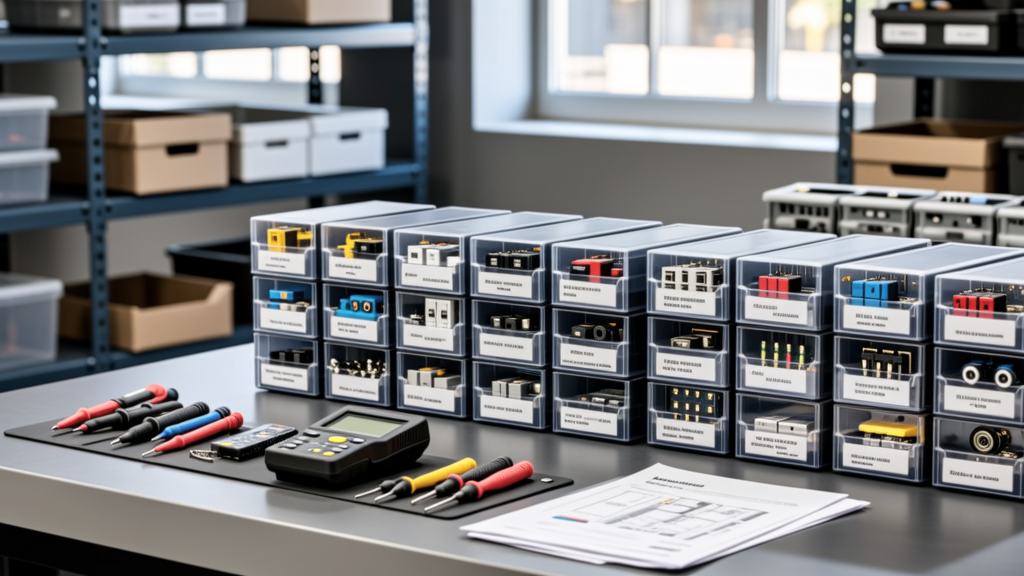
Technical storage ideas for lighting relay workspaces combine physical organization, labeled spare parts, tool systems, and inventory records. A practical setup separates 12-volt LED drivers, 230-volt relay modules, DIN-rail accessories, connectors, fuses, and test instruments by voltage, function, and project zone. Use shallow bins for small parts, lockable drawers for commissioning tools, and vertical panels for manuals and schedules. Brand examples such as ABB, Schneider Electric, Lutron, Wago, Phoenix Contact, Klein Tools, Fluke, and Milwaukee PACKOUT show that modular storage can reduce search time, protect components from dust, and support safer lighting maintenance. This approach helps electricians, facility teams, and lighting designers keep each project traceable.
Why Technical Storage Matters in Lighting Projects
Lighting relay work is rarely a single component. A project may involve 24-volt control wiring, 230-volt switched loads, 0-10-volt dimming interfaces, DALI ballast drivers, occupancy sensors, and remote antenna modules. When these parts are stored together without clear boundaries, installers spend time searching, misapplying, or damaging components. A 45-millimeter relay module mixed with 18-millimeter terminal blocks can create unnecessary confusion. A missing 30-millimeter DIN-rail jumper can delay a commissioning session by hours. Good storage creates a visual system where every part has a predictable home, reducing errors at the distribution board, on site, and in the workshop.
Storage also protects reliability. LED drivers contain electrolytic capacitors, and relays contain copper coils, contacts, and plastic housings. Dust, humidity, and mechanical stress shorten life. For example, storing a Philips Dynalite or Lutron Radio Powr Savr receiver near a concrete dust area can clog antenna ports and ventilation channels. A clean, dry, labeled system helps preserve product life, especially when spare parts sit between project phases. For a lighting specialist, technical storage is not just tidiness; it is part of quality control, risk management, and client confidence.
Bin, Drawer, and Tray Systems for Relays and Small Parts
Shallow Bins for Terminal Blocks and Fuses
Small parts benefit from shallow bins. A 600 by 400 by 120-millimeter plastic bin from Akro-Mils or a Sortimo small-parts drawer works well for terminal blocks, ferrules, cable ties, and fuse carriers. For Wago 221 compact connectors, use a divider grid with 20-millimeter pockets so each connector family stays separate. For Phoenix Contact UT 2.5 terminal blocks, label bins by pole count, such as 2-pole, 3-pole, and 4-pole, and keep them beside the relevant DIN-rail segment. Shallow bins prevent small parts from disappearing into deep drawers and make count checks faster during site handover.
For DIN-rail accessories, consider a modular drawer cabinet with 70-millimeter high drawers. This height fits most 45-millimeter and 90-millimeter Schneider Acti9 or ABB i-bus modules without stacking them on top of each other. If space is limited, a wall-mounted Treston or Festool Systainer-style unit can hold relay bases, auxiliary contacts, and timer modules. The important point is to keep one storage height per family. Do not store a 24-volt solid-state relay in a drawer designed only for 230-volt mechanical relays if the labels do not make the voltage difference obvious.
Drawers for Test Equipment and Hand Tools
Drawers should be grouped by task, not by brand alone. A lighting relay specialist needs continuity testers, insulation testers, clamp meters, screwdrivers, wire strippers, and label tools. A Stanley FatMax or Bosch L-Boxx system with foam inserts can separate a Fluke 87V multimeter, a Klein Tools non-contact voltage tester, and a Wiha insulated screwdriver set. Foam should be cut to 15-millimeter thickness so heavy items do not shift. For hand tools, use a shadow-board drawer or a foam cutout that shows immediately when a 10-millimeter Phillips screwdriver or a 7-millimeter socket is missing.
Storage Layouts for Lighting Control Components
Vertical storage is often more efficient than horizontal storage. A pegboard or slatwall panel can hold cable reels, hook-and-loop straps, and small tool pouches. For lighting projects, a dedicated control gear wall can show relay modules, dimming interfaces, and occupancy sensors by zone. Use clear pockets for datasheets, wiring diagrams, and commissioning notes. A 300-millimeter by 300-millimeter clear pocket can hold an ABB ESB switch schedule or a Lutron HomeWorks keypad map, making the storage location useful as a quick reference point rather than a dead bin.
For larger drivers and transformers, use ventilated shelving. A 120-volt or 230-volt electronic LED driver can be stored on 25-millimeter perforated shelf liners to prevent scratching. Store units upright so heat-dissipating fins are not compressed. If the driver has exposed wires, keep it in a compartment with a soft foam cradle sized to 80 by 60 by 35 millimeters, or place it inside a small parts bin with the leads bundled to a 100-millimeter coil. Do not let wire tails hang across adjacent drivers because they can snag or create a short during transport.
Spare Parts, Consumables, and Inventory Rules
Lighting relay maintenance needs a defined spare-parts strategy. For a small commercial property, a practical stock might include ten 230-volt single-channel relays, five 24-volt DC control relays, three DALI power supplies, two 0-10-volt dimming interfaces, and assorted fuses. For a larger building, scale by relay count and failure history. A 100-relay installation may justify ten percent spare coverage for common models, but not for obsolete or unique items. Store high-use spares in a red-bordered zone, slow movers in a blue zone, and obsolete parts in a quarantine zone pending disposal or return.
- Use a three-number label: part name, voltage or current rating, and location code.
- Keep a minimum and maximum quantity for fuses, terminal blocks, and DIN-rail jumpers.
- Record manufacturer codes such as Schneider A9C64216 or Lutron PD-5NE.
- Store batteries separately from control modules to prevent leakage damage.
- Use antistatic bags for DALI bridge modules and radio repeaters.
Inventory discipline is where many technical storage systems fail. A bin may be tidy, but if the label says LED driver without specifying wattage, voltage, dimming type, or manufacturer, the system still creates risk. Label every part with a visible identifier and a smaller internal code for the inventory sheet. For example, a label might read Driver 30W 24V DALI DT6 Bin C2, while the inventory row records the manufacturer, SKU, quantity, and last test date. This dual-level labeling helps both technicians who need speed and managers who need traceability.
Tool Storage and Test Equipment Organization
Tools should be stored by function and by hazard class. Insulated tools must stay separated from general workshop tools. A Wiha or Knipex insulated screwdriver used for live-panel commissioning should have a dedicated foam slot or a magnetic tool rail. If the tool is placed among a Stanley tape measure, a DeWalt TSTAK bit set, and a random assortment of pliers, a technician may pick the wrong driver under pressure. For lighting relay work, the correct tool choice is not cosmetic; it affects torque, contact seating, and insulation integrity.
Test equipment needs padded, moisture-resistant storage. A Fluke multimeter, a Megger insulation tester, and a power quality analyzer can be damaged by loose batteries and cable strands. Use a hard case with cable channels sized for 2-millimeter test leads and 4-millimeter banana plugs. Keep calibration stickers visible. For site work, a Milwaukee PACKOUT organizer can hold a clamp meter, voltage detector, and a set of insulated probe tips. The PACKOUT stackable design is useful because the tester case can sit above a parts organizer, while low-voltage test accessories remain in a separate lower drawer.
Labeling, Barcodes, and Digital Inventory
Labels should survive dust, oil, and occasional moisture. Use polyester or vinyl labels printed with a Dymo or Brother label printer, and laminate critical labels with clear tape if the storage area is harsh. For high-value items, barcodes can be useful, but avoid overcomplicating a small lighting workshop. A simple spreadsheet or database can track part number, voltage, relay type, quantity, location, and expiry date for batteries or fuses. If using a mobile app, connect it to location codes so a technician can scan or search and see where the item is stored.
Digital inventory works best when it mirrors physical storage. If a bin is physically divided into four sections, the digital record should show four section codes. If a drawer has labels on the front, the database should store the same text. This alignment reduces mental translation between paper, screen, and shelf. For lighting relay specialists, traceability can also support warranty claims and troubleshooting. A DALI driver that fails after six months is easier to analyze if the storage record shows the batch date, installation project, and test result before dispatch.
Project Kits and Site-Specific Storage
Project kits save time and reduce missing parts. A lighting relay commissioning kit can include a 10-millimeter Allen key, a 2-millimeter flat screwdriver, a 100-millimeter cable tie, a 24-volt power supply, a DALI bus tester, a label printer, and a small notebook. Store the kit in a case that opens flat, such as a Stanley FatMax or Bosch L-Boxx 136. For multi-floor projects, make kits by zone. A kit for Level 1 can contain relays for the east stairwell, while a kit for Level 2 contains west lobby components. Label each case with the project name, zone, date, and lead technician.
For temporary site storage, use lockable cabinets or weatherproof boxes. A Hager or Legrand distribution board area may not have clean storage, so a sealed plastic case protects components from plaster dust and moisture. If a site is dusty, store connectors in a zip-lock bag inside the case, then place the bag in a larger organizer. For outdoor lighting control gear, use a ventilated IP-rated enclosure for temporary storage of photocells and drivers, but ensure the enclosure is not being used as a live electrical enclosure unless rated and installed accordingly.
Environmental Controls, Safety, and a Sample Layout
Humidity and temperature affect both plastic housings and electronic components. A practical workshop target is 15 to 25 degrees Celsius and 30 to 60 percent relative humidity. If the storage area is near a concrete floor, keep bins on pallets or shelves at least 150 millimeters above ground. For battery-powered remote switches, such as Lutron Radio Powr Savr or Philips Hue dimming button components, store batteries separately and keep a note of replacement dates. Lithium batteries should not sit against metal shelves or loose screws, as accidental short circuits can cause heat and damage.
Safety storage must separate live work tools from general parts. A technician should never store a multimeter probe beside an unshielded 230-volt relay coil or a loose fuse. Use colored zones: green for tools, yellow for test equipment, blue for low-voltage parts, red for mains-rated parts, and grey for obsolete items. Fire safety also matters. If storing large quantities of cable, connectors, and plastic packaging, keep aisles at least 1,000 millimeters wide and do not block electrical panels or emergency exits. A tidy storage system becomes more important when a site is busy and fast movement is necessary.
| Component Group | Recommended Storage | Measurement Guidance | Brand Examples |
|---|---|---|---|
| 24V control relays | 70mm drawer with divider | 45mm module width, keep one relay per pocket | ABB, Siemens, Phoenix Contact |
| 230V relay modules | Lockable red-bordered bin | Store upright on 120mm shelf | Schneider Electric, Legrand, Hager |
| LED drivers | Ventilated perforated shelf | 80x60x35mm foam cradle for small drivers | Philips, Tridonic, Osram |
| DALI and 0-10V interfaces | Antistatic pouch in labeled drawer | Keep 100mm cable coil | Lutron, Dynalite, Casambi |
| Test instruments | Hard case with foam channels | 2mm test leads, 4mm banana plugs | Fluke, Megger, Klein Tools |
| Insulated hand tools | Shadow board or dedicated foam slot | 15mm foam thickness | Wiha, Knipex, Stanley |
- Assign every item a zone code before placing it in storage.
- Use shallow bins for parts smaller than 50 millimeters.
- Store mains-rated relays and low-voltage drivers separately.
- Label with function first, then voltage, then project or location.
- Keep a minimum and maximum stock level for common fuses and terminal blocks.
- Protect test equipment with foam, padded cases, and moisture barriers.
- Review obsolete items quarterly and remove them from active zones.
- Document batch dates for drivers, batteries, and radio modules.
- Make one project kit per zone for fast commissioning.
- Ensure storage never blocks panels, exits, or ventilation paths.
Technical storage ideas work best when they are simple enough to maintain daily. A lighting relay specialist does not need a complicated warehouse system to gain order. A small workshop can start with six labeled bins, two tool drawers, one vertical parts wall, and a one-page inventory sheet. From there, add barcodes, digital records, or project kits as the volume grows. The goal is to make the correct relay, driver, tool, or test lead easy to see, easy to reach, and easy to put back. Over time, that consistency reduces downtime, protects components, and supports safer, cleaner lighting installations.