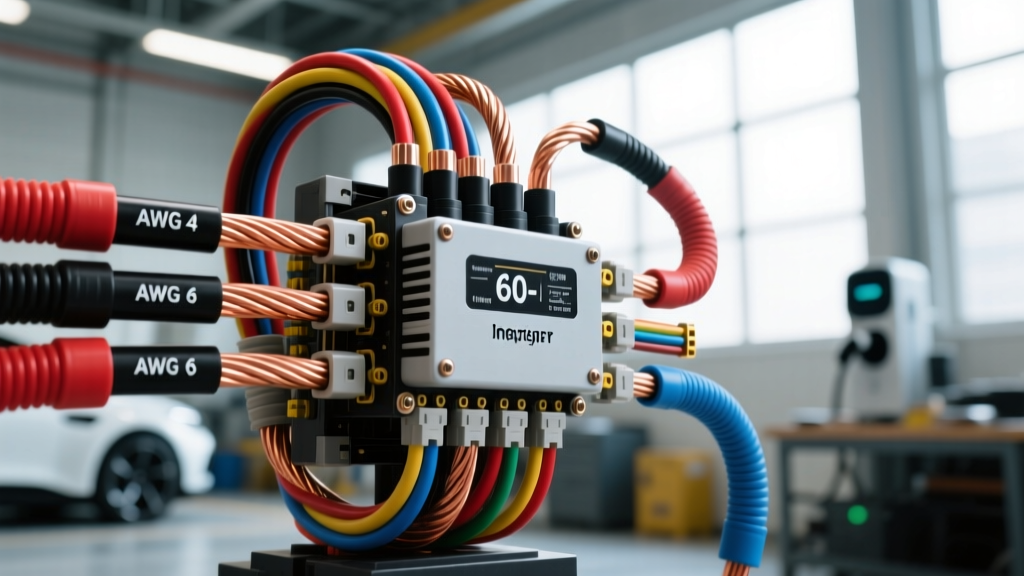
The Core Question: What Wire Gauge for 60 Amps in Automotive Systems?
When engineering a 12V or 24V automotive electrical system, determining the correct wire gauge for a 60-amp continuous load is a critical safety and performance calculation. Whether you are wiring a 2000W power inverter, an auxiliary air suspension compressor, a heavy-duty electric cooling fan array, or an EV charging accessory circuit, a 60A draw generates significant thermal energy. The short answer to 'what wire gauge for 60 amps' depends entirely on the routing environment and run length. According to SAE J1128 Low Tension Primary Cable Standards, 6 AWG wire is nominally rated for up to 75 amps in a free-air, 20°C environment. However, automotive environments are rarely 20°C, and wires are almost never routed in perfect free air. Therefore, the industry-standard engineering answer is to use 4 AWG wire for any 60-amp continuous load exceeding 5 feet in length, or any run routed through the engine bay. For ultra-short chassis ground straps (under 2 feet) outside the engine bay, 6 AWG is acceptable, but 4 AWG remains the best practice for minimizing voltage drop and thermal degradation.
SAE J1128 vs. NEC Table 310: Why Building Codes Fail in Vehicles
A common and dangerous mistake made by amateur automotive electricians is applying National Electrical Code (NEC) Table 310 ampacity charts to vehicle wiring. The NEC is designed for stationary, 120V/240V AC building wiring using THHN/THWN insulation. Automotive systems operate on low-voltage DC, which requires vastly different physical properties from the wire insulation and copper stranding. Automotive wire must withstand extreme under-hood temperatures (up to 125°C or 150°C), constant high-frequency vibration, and exposure to hydrocarbons like oil, brake fluid, and battery acid.
Automotive primary wire utilizes cross-linked polyethylene (XLPE) insulation, categorized as GXL, TXL, or SXL. This insulation allows for a thinner jacket while maintaining high thermal resistance, meaning a 4 AWG automotive wire has a smaller overall diameter than a 4 AWG THHN building wire, but contains the same amount of copper and handles much higher ambient heat. Always specify SAE J1128 or ISO 6722 compliant wire for 60A automotive circuits.
| Wire Gauge (AWG) | Cross-Section (mm²) | SAE J1128 Ampacity (Free Air 20°C) | SAE J1128 Ampacity (Engine Bay 125°C) | Typical Stranding (SAE) |
|---|---|---|---|---|
| 6 AWG | 13.30 | 75 Amps | ~45 Amps (Derated) | 133 x 0.254 mm |
| 4 AWG | 21.15 | 100 Amps | ~65 Amps (Derated) | 133 x 0.320 mm |
| 2 AWG | 33.63 | 130 Amps | ~85 Amps (Derated) | 259 x 0.320 mm |
Voltage Drop: The Hidden 60A Killer in 12V Systems
In a 120V AC household system, a 2-volt drop is negligible (less than 2%). In a 12V DC automotive system, a 2-volt drop is catastrophic, representing a nearly 17% loss of system voltage. This is why voltage drop, not just thermal melting point, dictates what wire gauge for 60 amps you must choose. The Society of Automotive Engineers (SAE) and the Blue Sea Systems Circuit Sizing Guidelines recommend a maximum voltage drop of 3% for critical electronics and 10% for non-critical resistive loads (like heaters or incandescent lights). For a 12V system, a 3% drop equates to a maximum allowable loss of just 0.36 volts.
Let us calculate the voltage drop for a 60-amp continuous load (such as a high-amperage electric power steering pump or an inverter) over a 10-foot cable run (20 feet total round-trip distance including the ground path).
- 6 AWG Copper Resistance: 0.3951 ohms per 1,000 ft.
- 6 AWG Voltage Drop: (20 ft × 60A × 0.3951) / 1000 = 0.474 Volts (3.95% Drop) - Fails the 3% SAE standard.
- 4 AWG Copper Resistance: 0.2485 ohms per 1,000 ft.
- 4 AWG Voltage Drop: (20 ft × 60A × 0.2485) / 1000 = 0.298 Volts (2.48% Drop) - Passes the 3% SAE standard.
This mathematical reality proves that while 6 AWG might not melt at 60 amps, it will starve sensitive automotive electronics of the voltage they require to operate efficiently, leading to premature component failure.
Thermal Derating and Bundling Factors
When asking what wire gauge for 60 amps is appropriate, you must account for thermal derating. Ampacity charts assume a single wire suspended in free air. In reality, automotive wiring harnesses are bundled together and wrapped in corrugated loom or Tesa tape. When multiple current-carrying conductors are bundled, they cannot dissipate heat effectively. If you are running a 60A positive cable alongside a 20A accessory wire and a CAN-bus data cable inside a 1/2-inch split loom, the ambient temperature inside that loom will rise significantly above the under-hood ambient temperature. SAE derating curves dictate that a bundle of 3 to 6 wires requires a 20% to 30% reduction in total ampacity. This bundling penalty is another primary reason why stepping up from 6 AWG to 4 AWG is mandatory for 60A loads routed in engine bays or tight chassis channels.
Overcurrent Protection and Termination Hardware
Selecting the correct wire gauge is only half the battle; terminating a 4 AWG or 6 AWG wire for a 60A circuit requires specialized hardware. Standard ATC or MAXI blade fuses are entirely inadequate for 60A continuous loads. You must utilize a MEGA or Class T fuse. According to Littelfuse MEGA Fuse specifications, these bolt-down fuses require precise torque values (typically 12 Nm or 106 in-lbs) to ensure a gas-tight connection. Under-torquing a MEGA fuse on a 60A circuit will result in micro-arcing, localized heating, and eventual melting of the fuse block terminals.
For wire terminations, avoid cheap, stamped-metal ring terminals. Use heavy-duty, tinned copper ring terminals with adhesive-lined, dual-wall heat shrink (such as 3M or Ancor marine-grade heat shrink). The adhesive lining melts during the heating process and seals the copper stranding against moisture and capillary action, which is vital for preventing green corrosion (copper oxide) that increases resistance over time. Furthermore, crimping 4 AWG wire requires a dedicated hex-crimp or indent-crimp die press. Never use hammer-style crimpers or pliers on a 60A circuit; an improper crimp will introduce a high-resistance bottleneck that will generate intense heat right at the terminal junction.
Real-World Failure Modes: The 60A Thermal Runaway Loop
Consider a real-world scenario involving a 12V auxiliary air compressor used for onboard air systems or air suspension. The compressor is rated for a 50A continuous draw, but under heavy load or when starting against back-pressure, it pulls 60A. If an installer uses 6 AWG wire over a 15-foot run to save money, the excessive voltage drop (nearly 0.6V) means the compressor motor only receives 11.4V instead of 12.0V. Because DC motors draw more current when voltage drops to maintain their wattage output, the compressor will now pull 65A to compensate. This increased current draw creates exponentially more heat in the undersized 6 AWG wire (Heat = I²R), which further increases the wire's electrical resistance, dropping the voltage even more. This thermal runaway loop will eventually melt the 6 AWG insulation, short to the chassis, and potentially cause an electrical fire before the 70A breaker has time to trip. Sizing up to 4 AWG or 2 AWG breaks this loop by maintaining system voltage and keeping resistance exceptionally low.
Summary: The 60A Automotive Wiring Checklist
- Wire Gauge: 4 AWG for runs over 5 feet or engine bay routing; 6 AWG strictly for short, un-bundled chassis grounds.
- Wire Type: SAE J1128 compliant GXL, TXL, or SXL (Cross-linked polyethylene insulation).
- Stranding: Fine-strand copper (minimum 133 strands for 4 AWG) for high-vibration flexibility.
- Fusing: Class T or MEGA fuse, bolted and torqued to manufacturer specifications (12 Nm).
- Termination: Adhesive-lined heat shrink ring terminals, applied with a dedicated hex-crimp tool.
- Routing: Keep away from exhaust manifolds and sharp chassis edges; use split loom and Tesa harness tape to prevent chafing.
By respecting the physics of low-voltage DC systems and adhering strictly to SAE standards rather than residential building codes, you ensure that your 60-amp automotive circuits operate safely, efficiently, and reliably for the life of the vehicle.