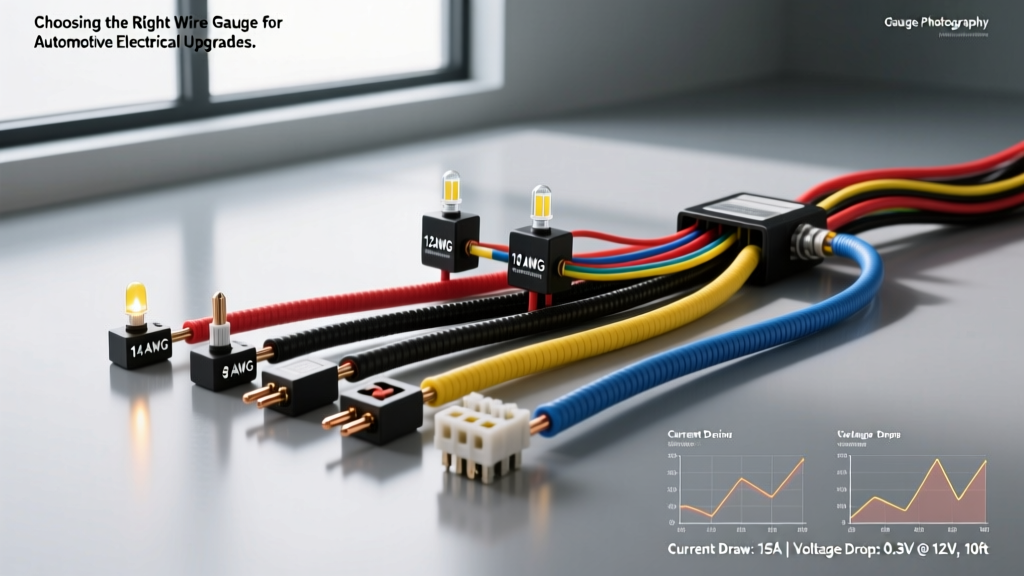
The Critical Role of SAE Standards in Automotive Wiring
When performing electrical upgrades, selecting the correct wire gauge for automotive applications is not merely a suggestion; it is a fundamental safety and performance requirement. Unlike residential wiring, automotive electrical systems operate in a harsh environment characterized by extreme temperature fluctuations, constant vibration, and exposure to corrosive chemicals like oil, brake fluid, and road salt. The Society of Automotive Engineers (SAE) establishes the baseline for these requirements under the SAE J1128 standard, which dictates the physical, electrical, and thermal properties of low-tension primary cables used in vehicles.
Using undersized wire leads to excessive voltage drop, which can cause fuel pumps to cavitate, ECUs to reset during cranking, and lighting to dim. Conversely, oversized wire adds unnecessary weight, makes routing through tight firewall grommets difficult, and can prevent proper crimping in standard automotive connectors. This guide provides a comprehensive product comparison and selection framework to help you choose the exact American Wire Gauge (AWG) for your specific automotive load.
Insulation Chemistry: GXL vs. TXL vs. SXL
Before selecting an AWG size, you must choose the correct insulation type. Standard PVC (Polyvinyl Chloride) wire found in hardware stores melts at relatively low temperatures and becomes brittle in freezing conditions. Automotive environments require Cross-Linked Polyethylene (XLPE) insulation, which is chemically bonded to withstand higher heat and abrasion.
- GXL (General Cross-Linked): The standard for most OEM and aftermarket harnesses. Features a thin wall, rated for 125°C, and offers excellent flexibility.
- TXL (Thin Cross-Linked): Features an extra-thin wall, making it ideal for tight spaces and high-pin-count ECU connectors. Rated for 125°C but slightly less resistant to physical abrasion than GXL.
- SXL (Special Cross-Linked): Features a thick wall for maximum abrasion and heat resistance. Typically used in heavy-duty truck applications or high-heat areas near exhaust manifolds.
Wire Gauge for Automotive Current Loads (AWG Comparison Chart)
The chart below compares standard AWG sizes against maximum current capacity. Note that automotive wire is highly stranded (e.g., 18 AWG TXL contains 16 strands of 30 AWG copper) to resist vibration-induced metal fatigue. The ampacities listed assume a 12V-14V system and are derated for long runs to account for voltage drop.
| AWG Size | Max Amps (Short Run < 10 ft) | Max Amps (Long Run > 10 ft) | Typical Automotive Application |
|---|---|---|---|
| 22 AWG | 3A | 1.5A | ECU sensor signals, CAN bus lines, airbag clocksprings |
| 18 AWG | 10A | 6A | Interior lighting, radio memory, horn relays, gauge illumination |
| 16 AWG | 13A | 10A | Cigarette lighter sockets, power windows, HVAC blower motors |
| 14 AWG | 15A | 12A | Headlight power feeds, fuel injectors, ABS module power |
| 12 AWG | 20A | 16A | High-flow fuel pumps (e.g., Bosch 044), radiator cooling fans |
| 10 AWG | 30A | 24A | Main ECU power feeds, high-amperage off-road light bars |
| 8 AWG | 45A | 35A | Alternator output (stock), heavy-duty winch solenoid triggers |
| 4 AWG | 120A | 100A | Upgraded alternator charging cables, main battery relocation |
| 1/0 AWG | 250A | 200A | Starter motor cables, high-output competition alternators |
Calculating Voltage Drop in 12V Systems
One of the most frequent mistakes in automotive wiring is sizing wire solely based on its ability to carry current without melting, ignoring voltage drop. In a 12V system, even a 1-volt drop (8.3%) can severely impact component performance. According to resources from Delcity Wire and Technical Resources, sensitive electronics like Engine Control Units (ECUs) require voltage to remain above 11.5V during cranking to prevent resetting.
The Voltage Drop Formula:
VD = (2 × L × I × R) / 1000
Where L = one-way length in feet, I = current in amps, and R = resistance per 1,000 feet of the specific AWG wire.
Real-World Example: Upgrading to a Bosch 044 Fuel Pump
The Bosch 044 inline fuel pump draws approximately 13 amps at 43 PSI. If you mount the pump in the rear of a long-wheelbase truck (15 feet of wire from the front-mounted relay), the total circuit length (power + ground) is 30 feet. Using 14 AWG wire (Resistance = 2.525 ohms/1000ft), the voltage drop calculates to roughly 0.98 volts. This leaves only 13.0V at the pump on a running 14V system, which is acceptable. However, if you use 16 AWG wire, the drop increases to 1.56 volts, reducing pump speed and potentially causing fuel starvation under wide-open throttle. For this application, 12 AWG GXL is the optimal choice to ensure maximum flow rate and longevity.
Application-Specific Selection Guide
ECU, Sensors, and Low-Current Signals (18-22 AWG)
Modern engine management systems rely on precise 5V reference signals and millivolt AC waveforms. For Variable Reluctance (VR) crankshaft and camshaft position sensors, you must use 20 AWG or 22 AWG TXL twisted-pair wire. Twisting the wires (at least 3 twists per inch) cancels out electromagnetic interference (EMI) from ignition coils and alternators. Never use shielded cable for VR sensors unless the ECU manufacturer specifically mandates it, as improper shield grounding can create an antenna effect that introduces noise into the signal.
High-Current Accessories and Relays (10-14 AWG)
When wiring relays for cooling fans or auxiliary lights, the control side of the relay (pins 85 and 86) only requires 16 AWG or 18 AWG wire, as the coil typically draws less than 150mA. However, the switched load side (pins 30 and 87) must be sized for the accessory. Always use a ratcheting crimper for open-barrel terminals on these connections. A proper crimp should result in a 'bellmouth' on the wire side of the terminal, ensuring the strands are fully compressed without being cut by the terminal edges.
Main Power and Alternator Upgrades (1/0 to 4 AWG)
Upgrading to a 200-amp alternator for car audio or off-road lighting requires stepping up from the factory 8 AWG or 4 AWG wire to 1/0 AWG or 2 AWG fine-strand battery cable. At this gauge, soldering is generally discouraged for high-vibration areas because solder wicks into the wire strands, creating a rigid, brittle point that will eventually snap under engine movement. Instead, use heavy-duty closed-barrel copper lugs, crimped with a hydraulic or hex-crimping tool, and sealed with adhesive-lined dual-wall heat shrink to prevent acid corrosion from the battery terminals.
Common Wiring Mistakes and Failure Modes
- Using THHN Building Wire: THHN is solid or coarse-strand wire designed for static, indoor environments. In a vehicle, engine harmonics and chassis flex will cause coarse strands to work-harden and snap, leading to intermittent shorts or total power loss.
- Ignoring the Ground Path: A circuit is only as good as its ground. Running a heavy 10 AWG power wire to a fuel pump but grounding it through a thin 18 AWG OEM chassis wire creates a bottleneck. Always run a dedicated ground wire of the same AWG as the power wire back to the battery negative terminal or a verified clean chassis stud.
- Over-crimping Terminals: Using non-ratcheting pliers to crush open-barrel terminals often deforms the metal, reducing the cross-sectional area of the copper. This creates a high-resistance hotspot that will melt the connector under continuous load.
Summary
Selecting the proper wire gauge for automotive applications requires balancing current capacity, physical routing constraints, and voltage drop limitations. By adhering to SAE J1128 standards, utilizing cross-linked insulation (GXL/TXL), and referencing accurate AWG current charts, you ensure that your vehicle's electrical system remains reliable, safe, and capable of supporting modern high-draw accessories. Always verify your specific component's amperage draw and calculate the total round-trip circuit length before cutting your first length of wire.