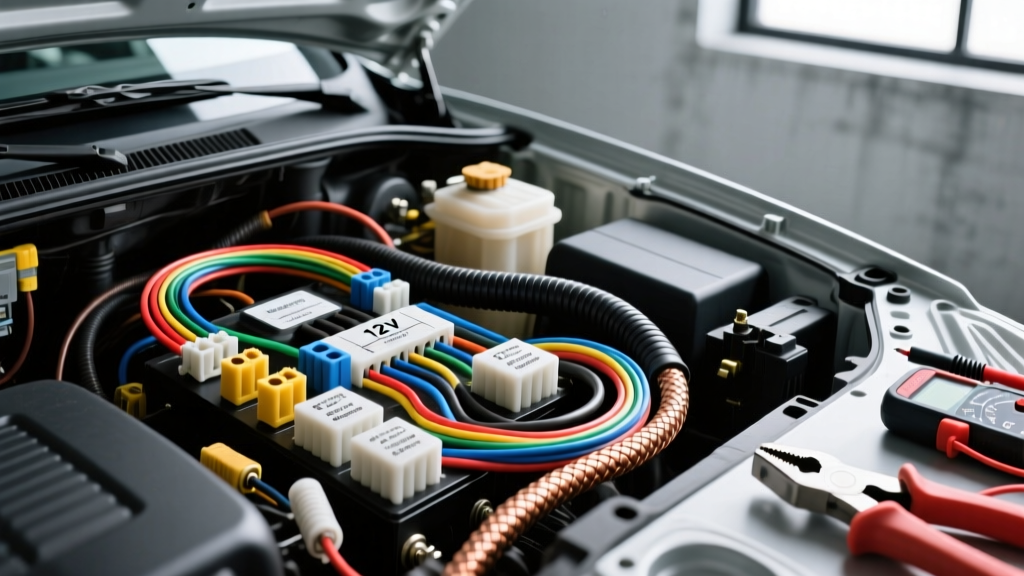
The Big Box Store Trap: AC vs. DC Requirements
When DIYers, overlanders, and amateur car audio installers search for the correct wire gauge for residential electrical runs, they are often met with incredibly low prices on THHN (Thermoplastic High Heat-resistant Nylon-coated) or solid-core Romex at local hardware stores. The temptation to use these cheap, readily available cables for 12V automotive applications—such as dual-battery setups, winch power feeds, or high-wattage amplifiers—is high. However, applying residential AC standards to automotive DC systems is a critical engineering failure. The National Electrical Code (NEC) and the NFPA 70 guidelines are designed for 120V/240V alternating current in static, climate-controlled environments. Automotive 12V DC systems operate in high-vibration, extreme-temperature chassis environments where voltage drop is unforgiving. This analysis breaks down the true cost and tooling requirements of using residential wire in vehicles, and why SAE J1128 automotive standards must dictate your build.
Cost Analysis: Automotive GXL/SGX vs. Residential THHN
At first glance, residential wire appears vastly cheaper. However, a proper cost analysis must factor in the hidden expenses of termination, specialized tooling, and the catastrophic cost of electrical failure. Below is a comparative cost breakdown for a standard 4 AWG battery-to-inverter run (20 feet total).
| Cost Factor | Residential 4 AWG THHN | Automotive 4 AWG SGX/GXL |
|---|---|---|
| Wire Material (per ft) | $1.85 / ft | $4.25 / ft |
| Total Wire Cost (20 ft) | $37.00 | $85.00 |
| Termination Hardware | $2.00 (Lugs + Tape) | $14.00 (Adhesive Heat Shrink + Copper Lugs) |
| Tooling Required | $25.00 (Basic Crimper) | $110.00 (Ratcheting Hydraulic Crimper) |
| Failure Risk Cost | High (Melted insulation, fire) | Negligible |
| True Project Cost | $64.00 + Risk | $209.00 (Permanent Fix) |
While the initial material cost of residential wire is roughly 55% lower, the cost of replacing melted fuse holders, damaged inverter terminals, or repairing a chassis fire quickly eclipses the $48 saved on copper. Furthermore, residential wire lacks the anti-oxidant strand treatments found in marine and high-end automotive cables, leading to galvanic corrosion at the battery terminal within 12 to 18 months.
Tool Requirements: Why Residential Tools Destroy Automotive Terminals
The most significant divergence between residential and automotive wiring lies in the tooling required for safe termination. Residential wiring relies on solid-core wire twisting, wire nuts (like the Ideal Twister), and basic insulation-displacement connectors. Automotive wiring demands high-strand-count flexible wire, requiring precise, high-pressure crimping.
The Cold Crimp Phenomenon
If you attempt to crimp a 12 AWG automotive PIDG (Pre-Insulated Diamond Grip) ring terminal onto 12 AWG residential wire using a standard hardware store pair of pliers or a non-ratcheting crimper, you will create a "cold crimp." A cold crimp fails to deform the copper strands into a solid, gas-tight mass. Under a 15A continuous load (such as a radiator fan relay circuit), this high-resistance joint will generate immense heat, melting the PVC insulation and throwing a P0691 Fan 1 Control Circuit Low code when the ECU detects the voltage anomaly.
Required Automotive Tooling
- Wire Strippers: Residential Klein 11063W strippers will nick and sever the fine 30 AWG strands of automotive GXL wire. You must use precision cavity strippers calibrated for fine-strand AWG.
- Ratcheting Crimpers: Tools like the Knipex 97 53 14 or TE Connectivity CERTI-CRIMP dies ensure the exact compression ratio required for automotive open-barrel and closed-barrel terminals.
- Heat Sources: Automotive terminations require dual-wall, adhesive-lined marine heat shrink (3M FP-301 or equivalent) to seal out moisture. A standard butane lighter will scorch the shrink; a variable-temperature heat gun set to 250°C is mandatory.
Technical Deep Dive: Stranding, Insulation, and Vibration
The physical construction of residential wire makes it entirely unsuited for the dynamic environment of a vehicle chassis. Engine vibration, suspension articulation, and thermal cycling will rapidly destroy THHN and Romex.
| Specification | Residential (THHN / Romex) | Automotive (SAE J1128 GXL/SGX) |
|---|---|---|
| Conductor Stranding (8 AWG) | 7 Strands (Coarse) or Solid | 168 Strands of 30 AWG Copper |
| Insulation Material | PVC with Nylon Jacket | Cross-Linked Polyethylene (XLPE) |
| Continuous Temp Rating | 90°C (Dry) / 75°C (Wet) | 125°C (GXL) to 150°C (SGX) |
| Flexibility & Memory | Low (Retains bends, snaps) | High (Routes through tight chassis grommets) |
| Chemical Resistance | Poor (Degrades with oil/gas) | Excellent (Resists automotive fluids) |
The Vibration Fracture Failure Mode
Residential solid-core or 7-strand wire suffers from work-hardening. When routed through a vehicle firewall or attached to an engine block, the constant micro-vibrations cause the stiff copper to work-harden and eventually snap inside the insulation. This results in an intermittent open circuit that is notoriously difficult to diagnose with a standard digital multimeter, as the wire may only reconnect when the chassis is stationary.
Connector Compatibility: Why Residential Wire Won't Fit Sealed Harnesses
Modern automotive electrical systems rely on sealed connector housings to prevent water and salt ingress. Popular systems like the Deutsch DT series or Molex MX150 are engineered to exacting outer diameter (OD) tolerances.
Take the Deutsch DT size 12 socket (part number 0462-201-1231). The rear silicone grommet is designed to seal tightly around the specific OD of 12 AWG GXL wire and its stamped contact barrel. Residential 12 AWG THHN features a thick, extruded nylon outer jacket that increases the wire OD beyond the grommet's expansion limit. If you force it, the silicone tears. If you peel back the nylon jacket to make it fit, you expose raw PVC to moisture, guaranteeing green copper oxide corrosion and a short circuit within the connector cavity within six months of driving in wet conditions.
The Voltage Drop Penalty in 12V DC Systems
When calculating wire gauge for residential AC circuits, electricians use NEC Table 310.16, which prioritizes thermal limits (preventing the wire from melting) over voltage drop, because a 5% drop on a 120V circuit still leaves 114V—perfectly adequate for household appliances.
In a 12V automotive DC system, a 5% voltage drop equates to a loss of 0.6V. If your alternator is outputting 14.2V, your ECU or high-draw fuel pump is only seeing 13.6V. Under heavy load (e.g., a 150A winch pull or a 2000W inverter spike), using undersized or high-resistance residential wire can cause voltage at the load to drop below 9.0V, triggering ECU brownouts, stalling the engine, or destroying sensitive CAN-bus transceivers. Automotive GXL wire, with its ultra-fine stranding, offers superior DC conductivity and minimizes the skin effect, ensuring maximum current delivery to the load.
Conclusion: Stop Compromising on Automotive Wire
Using residential wire in a vehicle is a false economy. The upfront savings of a few dollars per foot are entirely negated by the need for specialized ratcheting crimpers, the physical incompatibility with sealed automotive connectors, and the severe risk of DC voltage drop and chassis fires. For any 12V or 24V automotive application, always source SAE J1128 compliant GXL or SGX wire, invest in proper ratcheting termination tools, and respect the extreme environmental demands of the automotive chassis.