The Golden Rule of AWG: Why Smaller Numbers Mean Bigger Wire
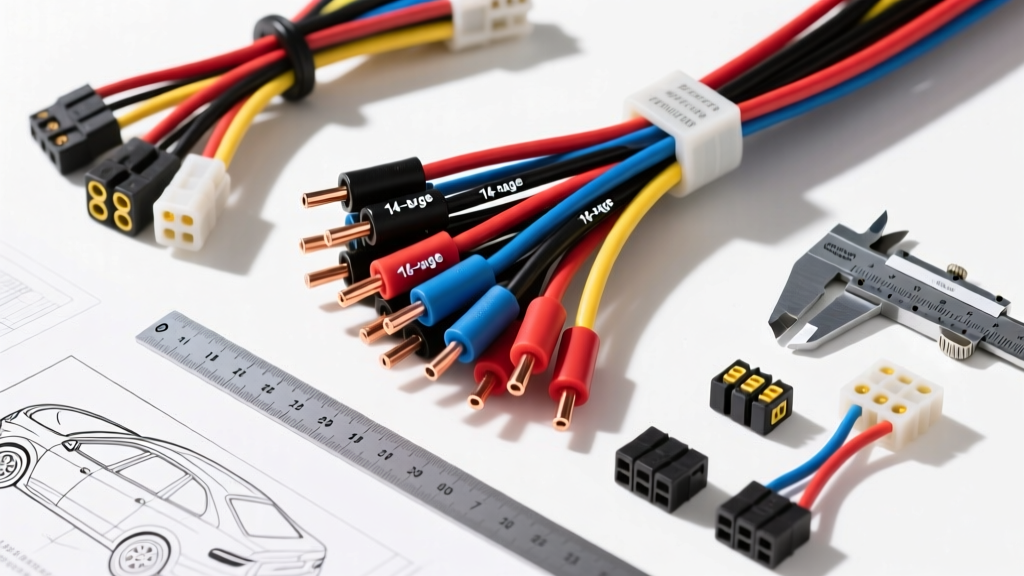
When beginners dive into automotive electrical repair or custom harness building, the most common question they ask is: what is bigger, 14 or 16 gauge wire? The short answer is that 14 gauge wire is bigger than 16 gauge wire. In the American Wire Gauge (AWG) system, the smaller the numerical value, the thicker the copper conductor. Therefore, a 14 AWG wire has a larger diameter, a greater cross-sectional area, and a higher current-carrying capacity (ampacity) than a 16 AWG wire.
This inverse relationship often trips up DIY mechanics who are used to standard measurements where a higher number equals a larger size. The AWG system dates back to the 19th century and is based on the manufacturing process of drawing copper through a series of dies. A 14 AWG wire is pulled through fewer drawing dies than a 16 AWG wire, leaving it thicker and heavier. Understanding this fundamental difference is critical for preventing voltage drop, melted insulation, and catastrophic electrical fires in your vehicle.
14 Gauge vs. 16 Gauge Wire: Core Specifications
To properly select wire for automotive circuits, you must look beyond just the gauge number and understand the physical and electrical properties of the copper conductor. Below is a direct comparison of bare copper specifications for standard stranded automotive primary wire.
| Specification | 14 AWG Wire | 16 AWG Wire |
|---|---|---|
| Conductor Diameter | 0.0641 inches (1.63 mm) | 0.0508 inches (1.29 mm) |
| Cross-Sectional Area | 2.08 mm² (4,110 Circular Mils) | 1.31 mm² (2,580 Circular Mils) |
| Resistance per 1,000 ft (at 20°C) | 2.525 Ohms | 4.016 Ohms |
| Weight per 1,000 ft (Copper only) | 12.4 lbs | 7.8 lbs |
Note: These specifications apply to the copper conductor. The outer diameter of the wire will vary depending on the insulation type. For example, SAE J1128 GXL wire has thicker insulation than TXL (thin-wall) wire, but the copper cross-section remains identical.
Automotive Ampacity and SAE Standards
Ampacity refers to the maximum amount of electric current a conductor can carry before its insulation begins to melt or degrade. In a 12V to 14.4V automotive environment, ambient temperature plays a massive role. An engine bay can easily exceed 100°C (212°F) on a hot summer day, which drastically reduces the current a wire can safely handle compared to a wire routed inside a climate-controlled cabin.
According to the SAE J1128 standard for automotive primary wire, and general chassis wiring guidelines outlined by the Powerstream Wire Size Guide, the safe continuous ampacity ratings for these gauges in a vehicle are as follows:
- 14 AWG: Safe for 15 to 20 Amps in short chassis runs (under 10 feet). Ideal for circuits protected by 15A or 20A fuses.
- 16 AWG: Safe for 10 to 13 Amps in short chassis runs. Ideal for circuits protected by 10A or 15A fuses.
Critical Warning: Fuses are designed to protect the wire, not the component. If you use 16 AWG wire for a circuit but install a 20A fuse, a short circuit will cause the 16 AWG wire to overheat and potentially catch fire before the fuse blows. Always match your fuse size to the lowest ampacity rating of the wire used in the circuit.
Real-World Vehicle Circuit Mapping
Knowing the theory is helpful, but applying it to actual vehicle harnesses is where the real work happens. Automotive manufacturers use specific wire colors and gauges to standardize repairs. Here is how 14 AWG and 16 AWG wires are typically deployed in passenger vehicles and light trucks:
| Circuit Application | Recommended Gauge | Typical Wire Color (GM/Ford/Chrysler) | Standard Fuse Size |
|---|---|---|---|
| Tail Lights / Parking Lights | 16 AWG | Brown (GM/Chrysler), Black/White (Ford) | 10A - 15A |
| Turn Signals / Hazard Flashers | 16 AWG | Dark Green (Right), Yellow (Left) | 10A - 15A |
| Horn Relay Trigger / Coil | 16 AWG | Dark Green or Black/Yellow | 10A |
| Headlight Low Beams (Halogen) | 14 AWG | Red/Green or Tan/White | 15A - 20A |
| Power Window Motors | 14 AWG | Dark Blue / Light Blue | 20A - 30A (Breaker) |
| Blower Motor Resistor (Low/Med) | 14 AWG | Purple / Yellow | 15A - 20A |
Voltage Drop: The Hidden Factor in Wire Sizing
When deciding between 14 and 16 gauge wire, length is just as important as amperage. Voltage drop occurs because copper wire has inherent resistance. As the wire gets longer, resistance increases, causing the voltage at the load (e.g., a tail light bulb) to drop below the optimal 12V-14V range. A severe voltage drop will cause lights to dim, motors to run sluggishly, and ECUs to throw low-voltage diagnostic trouble codes (DTCs).
Calculating the Difference
Imagine you are wiring a rear taillight assembly that draws 4 Amps, and the wire run from the fuse box to the rear bumper is 20 feet (40 feet total for power and ground).
- Using 16 AWG: 40 ft × 0.004016 Ohms/ft = 0.160 Ohms total resistance. At 4 Amps, the voltage drop is 0.64 Volts. (Acceptable).
- Using 16 AWG for a 10 Amp Load: The voltage jump to 1.60 Volts. Your 12V bulb is now only receiving 10.4V, resulting in noticeably dim illumination and excess heat generated in the wire.
- Using 14 AWG for a 10 Amp Load: 40 ft × 0.002525 Ohms/ft = 0.101 Ohms. At 10 Amps, the drop is only 1.01 Volts, keeping the circuit much cooler and more efficient.
For any circuit exceeding 10 Amps, or for runs longer than 15 feet carrying more than 5 Amps, always step up to 14 AWG (or larger) to minimize voltage drop.
Connector Types and Crimping Best Practices
Selecting the right wire gauge is only half the battle; terminating it correctly is where most beginners fail. Both 14 AWG and 16 AWG wires often share the same vinyl-insulated ring terminal barrel size (typically the Blue 16-14 AWG range), but they require different approaches when dealing with sealed automotive connectors.
Delphi Weather-Pack and Metri-Pack Terminals
When repairing an engine harness or external sensor pigtail, you will likely use Delphi Weather-Pack or Metri-Pack terminals. These systems use silicone weather seals to prevent moisture intrusion.
- 16 AWG Wire: Requires the standard green or yellow ribbed silicone seal. The terminal crimp wings are designed to bite into the 1.29mm copper strands without crushing them.
- 14 AWG Wire: Often requires stepping up to a red or blue silicone seal, depending on the exact insulation thickness (GXL vs. TXL). If you try to force a 14 AWG wire with thick GXL insulation into a 16 AWG seal, you will strip the insulation or fail to achieve a watertight seal.
Crimping Tip: Never use standard pliers to crimp Weather-Pack terminals. You must use a dedicated open-barrel crimping tool (like the Delphi packard crimp tool or a high-quality ratcheting equivalent). A proper crimp will yield a pull-test strength of over 30 lbs for 16 AWG and over 40 lbs for 14 AWG.
Common Beginner Mistakes and Failure Modes
As an automotive electrical diagnostic technician, I see the same wiring mistakes repeatedly when inspecting modified or repaired vehicles. Avoid these critical errors:
- Over-Fusing 16 AWG Wire: A common failure mode is a melted harness near the fuse box. This happens when a previous owner spliced in a 16 AWG jumper wire for an accessory (like a fog light relay trigger) but left the factory 20A fuse in place. Under a sustained 18A load, the 16 AWG wire acts as a heater, melting the XLPE insulation and shorting to the chassis.
- Using 14 AWG for Low-Draw LED Circuits: While 14 AWG is safer from a fire perspective, using it for a 2-Amp LED light bar trigger wire is overkill. The thicker wire is stiffer, making it incredibly difficult to route through tight firewall grommets or behind dash panels. Use 16 AWG or even 18 AWG for low-current signal and LED circuits to maintain harness flexibility.
- Soldering Instead of Crimping in High-Vibration Areas: Solder wicks into the copper strands and creates a rigid point. In an engine bay, vibration will cause the wire to fatigue and snap exactly at the edge of the solder joint. Always use mechanical crimps for 14 and 16 AWG wires in automotive applications, reserving solder only for sealed, low-vibration connections.
Summary: Which Should You Choose?
To summarize the answer to what is bigger, 14 or 16 gauge wire: 14 AWG is physically larger, electrically superior for higher loads, and necessary for circuits drawing between 10 and 20 Amps. 16 AWG is smaller, more flexible, and perfectly suited for standard lighting, ECU triggers, and low-draw accessories under 10 Amps. Always consult a wiring diagram, verify your circuit's maximum amperage draw, and calculate your voltage drop based on the total length of the wire run before cutting your first spool of copper.