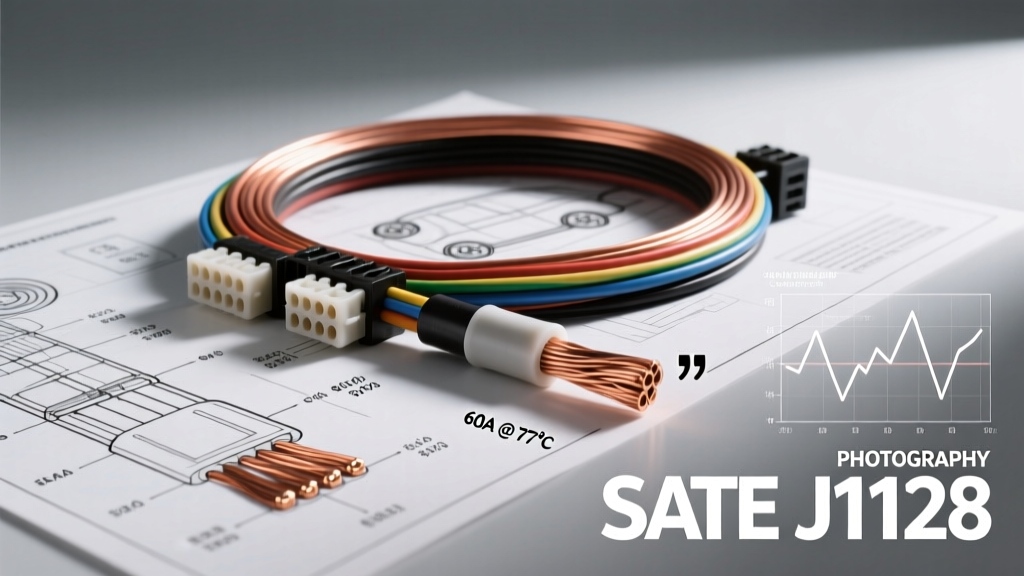
Defining the Amp Capacity of 8 Gauge Wire in Automotive Systems
When evaluating the amp capacity of 8 gauge wire for automotive electrical systems, technicians and engineers must distinguish between residential building wire standards (NEC) and automotive chassis wiring standards (SAE). In a vehicle, wiring is subjected to extreme under-hood temperatures, vibration, and chemical exposure, which drastically alters current-carrying capabilities compared to static, climate-controlled building environments. For automotive applications, 8 AWG (American Wire Gauge) wire is a heavy-duty conductor primarily used for high-amperage charging circuits, performance audio power feeds, winch relays, and electric vehicle (EV) battery interconnects.
The nominal diameter of 8 AWG bare copper is 0.1285 inches (3.26 mm), yielding a cross-sectional area of approximately 8.37 mm². However, the true ampacity depends entirely on the insulation material's thermal rating and the wire's routing environment. At SAE International, the standard for low-tension primary cable (SAE J1128) dictates that wire must withstand specific thermal aging, flame resistance, and fluid compatibility tests before being certified for automotive use.
SAE J1128 vs. NEC Ampacity Ratings
A common mistake in automotive wiring is using National Electrical Code (NEC) ampacity charts to size vehicle wiring. The NEC rates 8 AWG copper wire at roughly 40 to 50 amps for power transmission in bundled conduit. However, automotive chassis wiring often runs in free air or short, isolated harnesses, allowing for higher thermal dissipation. Furthermore, automotive wire utilizes cross-linked polyethylene (XLPE) insulation, which withstands much higher ambient temperatures than standard PVC.
| Wire Type (SAE J1128) | Insulation Material | Max Temp Rating | Continuous Ampacity (Free Air) | Continuous Ampacity (Bundled Harness) |
|---|---|---|---|---|
| GPT (General Purpose) | PVC / Thermoplastic | 105°C | 65 Amps | 45 Amps |
| SXL (Specialty Cross-Linked) | XLPE | 125°C | 85 Amps | 55 Amps |
| SGX (Standard Cross-Linked) | XLPE (Thick Wall) | 150°C | 105 Amps | 73 Amps |
Note: Ampacity ratings assume a 12V-14V DC system with standard ambient under-hood temperatures of 60°C. If routing near exhaust manifolds where ambient temps exceed 100°C, thermal derating must be applied.
Voltage Drop Calculations for 12V and 14V Charging Systems
While the amp capacity of 8 gauge wire dictates how much current it can carry before the insulation melts, voltage drop dictates how efficiently it delivers that power. In modern vehicles equipped with ECU-controlled alternators (such as GM's RVC system or Ford's Smart Charging), a voltage drop of even 0.3V between the alternator output post and the battery positive terminal can cause the ECU to incorrectly regulate the field coil, leading to overcharging or undercharging.
Standard 8 AWG Oxygen-Free Copper (OFC) has a DC resistance of 0.6282 ohms per 1,000 feet at 20°C. To maintain a maximum 3% voltage drop (0.36V on a 12V system, or 0.42V on a 14V charging system), the total round-trip circuit length must be strictly managed.
| Current Draw (Amps) | Max 1-Way Length for 3% Drop (12V Nominal) | Max 1-Way Length for 3% Drop (14V Charging) |
|---|---|---|
| 20A (Standard Audio Amp) | 14.3 feet | 16.7 feet |
| 50A (EFI / Ignition Feed) | 5.7 feet | 6.6 feet |
| 80A (High-Output Lighting) | 3.5 feet | 4.1 feet |
| 120A (Alternator Upgrade) | 2.3 feet | 2.7 feet |
For a detailed breakdown of circuit lengths and real-world resistance variables, the Madsen Wire Voltage Drop Calculator remains an industry-standard reference for automotive electricians.
Wire Construction: Stranding and Metallurgy
Not all 8 AWG wire is created equal. The metallurgy and stranding profile directly impact flexibility, vibration resistance, and actual ampacity.
- OFC (Oxygen-Free Copper): The standard for automotive electrical work. 99.99% pure copper offers the lowest resistance and highest thermal conductivity.
- CCA (Copper-Clad Aluminum): Frequently sold in budget automotive audio kits. CCA wire has an aluminum core coated with a thin layer of copper. Because aluminum has roughly 61% higher electrical resistance than copper, 8 AWG CCA wire performs electrically like 10 AWG OFC wire. It should never be used for critical engine management or alternator charging circuits.
- Strand Count (SAE J1128 SGX): A genuine SAE-compliant 8 AWG SGX wire typically features 133 strands of 0.254mm (0.010 inch) tinned copper. This fine stranding allows the wire to flex continuously under hood vibration without suffering from metal fatigue and internal strand breakage, which is a common failure mode in solid-core or coarse-strand building wire.
Routing, Thermal Derating, and EMI Shielding
The amp capacity of 8 gauge wire must be derated based on the routing environment. According to Delphi Automotive connection system guidelines, bundling multiple current-carrying conductors together traps heat. If you bundle four 8 AWG wires together in a corrugated loom, the ampacity of each wire must be derated by approximately 40%.
Furthermore, 8 AWG power wires carrying high-amperage pulsed loads (such as those feeding a high-pressure fuel pump in a direct-injection engine or an EV inverter) generate significant Electromagnetic Interference (EMI). These cables must be routed at least 6 inches away from low-voltage sensor harnesses (like O2 sensor signal wires or CAN-bus lines) to prevent inductive coupling, which can trigger phantom ECU diagnostic trouble codes (DTCs).
Termination, Crimping, and Pull-Test Specifications
High-amperage 8 AWG circuits fail most frequently at the termination point, not in the middle of the wire run. Proper termination requires specific tooling and hardware:
- Terminal Selection: Use closed-barrel, seamless ring terminals sized for 8 AWG. For standard automotive alternator studs and distribution blocks, a 5/16-inch (8mm) or 3/8-inch (10mm) ring stud hole is required. Always choose tinned copper terminals to prevent galvanic corrosion.
- Crimping Tooling: Do not use open-barrel indent crimpers for 8 AWG power wire. Use a dedicated hex-crimp die or a 4-way indent die specifically calibrated for 8 AWG. The hex crimp compresses the wire strands uniformly, creating a gas-tight, cold-weld connection that prevents oxygen and moisture from wicking into the wire jacket.
- Pull-Test Specs: A properly crimped 8 AWG terminal should withstand a minimum tensile pull force of 150 lbs (667 N) without the wire slipping from the barrel.
- Sealing: After crimping, seal the termination with adhesive-lined dual-wall heat shrink tubing. The inner layer of thermoplastic adhesive melts and flows into the wire strands, completely blocking capillary action and preventing green copper oxide corrosion from traveling up the cable.
Common Automotive Applications for 8 AWG
Based on the technical specifications outlined above, 8 AWG wire is the optimal choice for the following automotive applications:
- Alternator Output Upgrades: When upgrading a GM LS-powered vehicle from a factory 105A AD230 alternator to a 220A high-output unit, the factory 10 AWG or 8 AWG charge wire must be replaced with a dedicated, short-run 8 AWG SGX cable to handle the peak 180A+ continuous loads without exceeding thermal limits.
- Electric Winch Power Feeds: Routing power from the battery to a front-mounted solenoid relay for a 8,000 lb winch. (Note: The actual winch motor draw can exceed 300A, but the solenoid feed relies on the duty cycle; 8 AWG is sufficient for the relay trigger and short-duty high-amp feeds, though 2/0 AWG is used for the motor itself).
- Aftermarket Distribution Blocks: Serving as the main trunk line from the battery to a fused auxiliary distribution block in the trunk for multi-amplifier car audio systems or off-road lighting relay harnesses.
By adhering strictly to SAE J1128 standards, utilizing OFC materials, and respecting voltage drop limitations over distance, automotive technicians can ensure that 8 AWG wiring provides safe, reliable, and efficient power delivery in the most demanding vehicular environments.