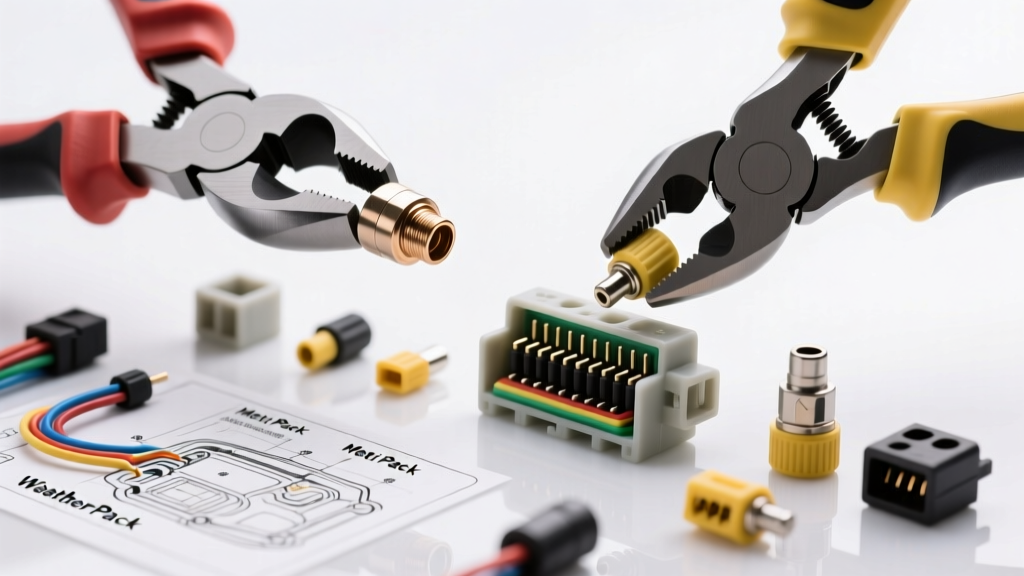
The Critical Role of Precision in Automotive Wiring
Modern vehicle electrical architecture relies on high-vibration resistance, moisture sealing, and precise impedance control. When repairing or modifying wiring harnesses, standard slip-joint or flat-nose pliers are entirely inadequate. Using improper tools on sealed automotive terminals compromises the mechanical retention and electrical conductivity of the crimp, leading to voltage drops, galvanic corrosion, and catastrophic module failures. Selecting the correct auto electrical connector pliers is not just about convenience; it is a requirement for meeting the SAE J1128 standards for low-tension primary cable performance and ensuring long-term harness reliability.
Connector Families and Required Jaw Profiles
Automotive connectors are broadly divided into two terminal styles: open-barrel (stamped) and closed-barrel (machined). Each requires a specific jaw profile on your crimping pliers to achieve a proper cold-weld without severing wire strands or crushing the insulation seal.
| Connector Family | Terminal Style | AWG Range | Required Plier Jaw Profile | Common Applications |
|---|---|---|---|---|
| Delphi Weather-Pack | Open Barrel | 16-20 AWG | F-Crimp / M-Crimp Die | GM sensors, lighting, older EFI |
| Delphi Metri-Pack 150/280 | Open Barrel | 18-22 AWG / 14-16 AWG | F-Crimp Die with Bellmouth | Injectors, O2 sensors, CAN bus |
| Delphi Metri-Pack 630/800 | Open Barrel | 10-12 AWG | Heavy F-Crimp / B-Crimp | Starter solenoids, high-amp feeds |
| TE Deutsch DT / DTM | Closed Barrel | 12-20 AWG | Hex-Indent or 4-Point Indent | Heavy-duty, marine, off-road |
| TE Superseal 1.5 | Open Barrel | 14-20 AWG | F-Crimp with specific width | Modern European OEM sensors |
Delphi (Aptiv) Weather-Pack and Metri-Pack (Open Barrel)
Open-barrel terminals feature two sets of wings: the conductor crimp zone and the insulation crimp zone. Proper auto electrical connector pliers for these terminals must form an 'F' or 'M' shape. The conductor wings must fold inward and overlap to create a gas-tight cold weld, while the insulation wings wrap around the wire jacket to provide strain relief. If the pliers lack a bellmouth-forming feature, the sharp edges of the terminal can slice through copper strands during high-vibration operation, a common failure point in engine bay harnesses.
TE Connectivity Deutsch DT and DTM (Closed Barrel)
As detailed in the TE Connectivity Deutsch assembly specifications, closed-barrel terminals require a completely different approach. These solid cylindrical barrels are typically crimped using a 4-indent or hex-indent die. The pliers must apply uniform radial pressure to compress the barrel around the wire strands without piercing the terminal wall. Using open-barrel pliers on a Deutsch terminal will simply flatten the cylinder, destroying the terminal and preventing it from seating into the connector housing.
Ratcheting vs. Non-Ratcheting Crimpers: A Technical Breakdown
When evaluating auto electrical connector pliers, the ratcheting mechanism is the most critical differentiator between professional and hobbyist tools.
- Full-Cycle Ratcheting Pliers: These tools lock upon initial compression and will not release until the exact predetermined crimp force and depth are achieved. This eliminates human error, ensuring that a 16 AWG wire in a Metri-Pack 280 terminal receives the exact same compression force every time, preventing under-crimping (high resistance) and over-crimping (strand severing).
- Non-Ratcheting (Return) Pliers: These rely entirely on the user's hand strength and judgment. While acceptable for quick field repairs on non-critical circuits (like a trailer light), they are strictly prohibited for engine management, airbag (SRS), or CAN bus circuits where terminal retention force must meet strict OEM Newton-pull specifications.
Top Tier Auto Electrical Connector Pliers Comparison Chart
Below is a technical comparison of the industry-standard crimping tools used by master technicians and harness builders.
| Brand / Model | Mechanism | Die Interchangeability | Best Application | Price Tier |
|---|---|---|---|---|
| IWISS IWS-1500 | Full-Cycle Ratchet | Yes (Standard 4-die set) | Weather-Pack, Metri-Pack 150/280, JST | Mid (Best Value) |
| Knipex 97 53 14 | Full-Cycle Ratchet | No (Fixed Open Barrel) | High-volume Metri-Pack & generic open barrel | Premium |
| TE CERTI-CRIMP 58479-1 | Full-Cycle Ratchet | Yes (TE Specific Dies) | OEM TE / AMP Superseal and Timer connectors | Ultra-Premium |
| Hozan P-707 | Non-Ratcheting | No (Fixed Profile) | Quick field repairs, tight-space harness work | Mid |
| Knoweasy DT Crimper | Full-Cycle Ratchet | Yes (Hex / 4-Indent) | Deutsch DT, DTM, and ATP closed barrels | Budget / Mid |
Extraction and Depinning Tools: The Unsung Heroes
A complete auto electrical connector pliers kit must include terminal extraction tools. Modern sealed connectors utilize a Primary Lock (the flexible lance stamped into the terminal) and a Secondary Lock (the Terminal Position Assurance, or TPA, wedge). Attempting to pull a terminal out with standard needle-nose pliers will snap the primary lance, rendering the terminal useless and requiring a complete harness pigtail replacement.
Specialized depinning pliers feature hollow, tubular tips or double-barbed flat blades designed to slip over the terminal, depress the primary lance, and bypass the TPA simultaneously. For Metri-Pack 280 terminals, a 2.0mm tubular extractor is required. For Weather-Pack, a specialized pick that depresses the outward-facing tangs without damaging the silicone ribbed seal is mandatory.
Real-World Failure Mode: The CAN Bus Voltage Drop
Consider a diagnostic scenario involving a U0100 code (Lost Communication with ECM/PCM). The CAN bus operates on a differential voltage signal utilizing a twisted pair of 20 AWG wires (typically CAN-High and CAN-Low). These terminate into a Metri-Pack 150 or TE Superseal connector. If a technician uses improper, non-ratcheting pliers, the insulation wings may fail to grip the jacket, transferring all mechanical stress to the conductor crimp. Furthermore, if the wire is stripped too far and the insulation jacket is pushed into the conductor crimp zone, the copper strands will not achieve a gas-tight weld. Over time, engine bay heat cycles cause the crimp to expand and contract, introducing micro-oxidation. This alters the characteristic 120-ohm impedance of the CAN circuit, reflecting signals and causing intermittent module drop-offs that are incredibly difficult to diagnose with a standard multimeter.
Real-World Failure Mode: O2 Sensor Heater Circuit Burnout
A common issue on GM LS-platform vehicles is a recurring P0135 (O2 Sensor Heater Circuit Malfunction). The heater circuit draws up to 8 Amps upon cold startup, fed by a 14 AWG Pink or Pink/White wire terminating in a Metri-Pack 630 connector. If a technician attempts to crimp this heavy-gauge wire using light-duty Weather-Pack pliers, the tool will lack the mechanical leverage to fully fold the heavy-gauge copper wings. This results in a 'cold weld'—a mechanical connection with high electrical resistance. Under the 8A load, the high-resistance crimp generates localized heat, melting the plastic connector housing and eventually burning through the terminal. Adhering to the IPC/WHMA-A-620 standard for crimp pull-force and visual inspection criteria prevents these high-amp failures.
Final Selection Criteria for Professional Technicians
When outfitting a shop or a mobile diagnostic rig, your selection of auto electrical connector pliers should be dictated by the connector families you encounter most frequently. For general domestic and import light-duty work, a high-quality ratcheting F-crimp tool (like the IWISS IWS-1500 or Knipex 97 53 14) paired with a comprehensive depinning set will cover 90% of Weather-Pack, Metri-Pack, and JPT repairs. For heavy-duty diesel, agricultural, or marine applications, a dedicated closed-barrel hex-crimper for Deutsch DT/ATM terminals is non-negotiable. Never compromise on tooling; the integrity of the entire vehicle electrical system rests entirely on the millimeter-precision of the terminal crimp.