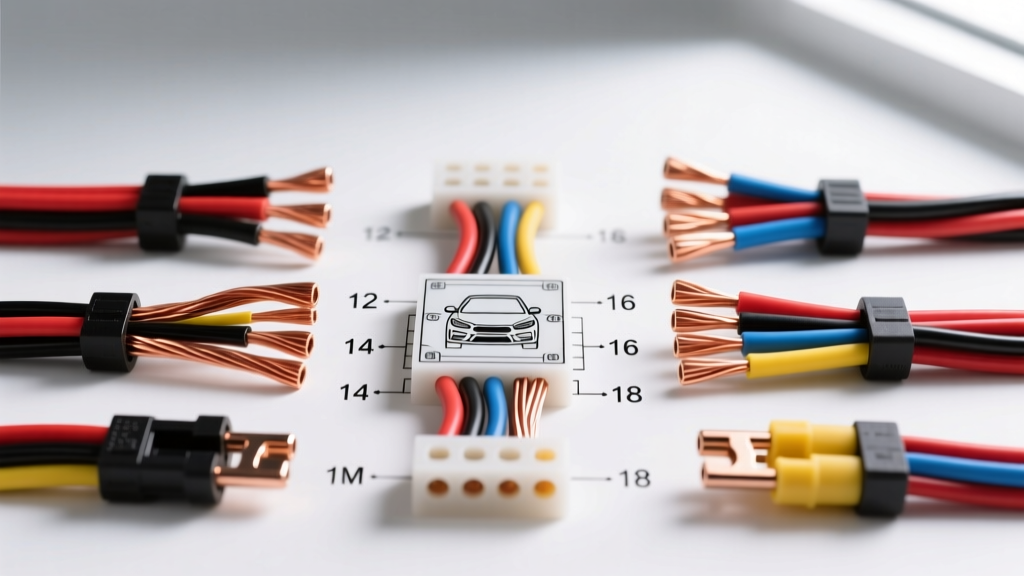
The Core Question: What Gauge Speaker Wire Should I Use?
When building or upgrading a mobile audio system, the most common bottleneck in achieving pristine sound is improper wire sizing. Asking what gauge speaker wire should I use requires understanding the relationship between amplifier output impedance, speaker nominal impedance (usually 4-ohm or 2-ohm), and the parasitic resistance introduced by the wire itself. In automotive environments, wire runs from the trunk-mounted amplifier to the front doors can easily exceed 12 to 15 feet. If the wire is too thin, it acts as a resistor, robbing your speakers of power, altering the crossover frequencies, and destroying the amplifier's damping factor.
Unlike household audio, automotive wiring must endure extreme temperature fluctuations, moisture in door cavities, and constant vibration. Selecting the right American Wire Gauge (AWG) and insulation type is critical for long-term reliability and acoustic accuracy.
AWG Speaker Wire Comparison Chart
The following specification chart compares standard Oxygen-Free Copper (OFC) stranded wire. Resistance values are based on standard 10-foot runs (20 feet total conductor length for positive and negative).
| AWG Size | Conductor Diameter | Resistance (per 10ft) | Max Recommended RMS | Ideal Automotive Application |
|---|---|---|---|---|
| 18 AWG | 0.0403 in | 0.042 Ω | Up to 50W | OEM factory replacements, tweeters, short rear-deck runs |
| 16 AWG | 0.0508 in | 0.026 Ω | 50W - 100W | Standard aftermarket coaxial and component mid-bass drivers |
| 14 AWG | 0.0641 in | 0.016 Ω | 100W - 250W | High-power component systems, long runs to front doors |
| 12 AWG | 0.0808 in | 0.010 Ω | 250W+ | High-current mid-bass, subwoofer enclosures, 2-ohm loads |
Detailed Breakdown: Selecting the Right Gauge for Your Build
18 AWG: Standard Factory Replacements
Most OEM automotive manufacturers utilize 18 AWG or even 20 AWG wire for factory speaker harnesses to save weight and copper costs. If you are simply replacing blown factory 6.5-inch coaxial speakers with efficient aftermarket models (sensitivity above 92dB) running off a low-powered head unit (15W-22W RMS x 4), 18 AWG is sufficient. However, for any amplified system, 18 AWG will introduce noticeable high-frequency roll-off and thermal compression at higher volumes.
16 AWG: The Versatile Aftermarket Standard
For 90% of car audio enthusiasts, 16 AWG is the definitive answer to what gauge speaker wire should be used. It offers an optimal balance between flexibility (crucial for routing through tight factory door boots and A-pillars) and conductivity. A 15-foot run of 16 AWG OFC wire introduces only about 0.078 ohms of total loop resistance. On a 4-ohm speaker, this represents less than a 2% power loss, which is acoustically imperceptible. When running 16 AWG through door hinges, always use wire with SAE J1128 compliant cross-linked polyethylene (XLPE) insulation to prevent cracking from repetitive bending and extreme door-cavity heat.
14 AWG: High-Power Component Systems
If you are driving high-end component speakers with 100W to 200W RMS per channel, or if your vehicle requires exceptionally long wire runs (such as routing from a trunk amplifier to the front doors of a crew-cab truck), 14 AWG is mandatory. Thinner wire in high-power scenarios degrades the amplifier's damping factor. The damping factor is the amplifier's ability to control the speaker cone's movement after a signal stops. High wire resistance reduces this control, resulting in 'muddy' or 'boomy' mid-bass reproduction.
12 AWG: Subwoofers and High-Current Midbass
While rarely used for tweeters or standard door speakers due to its stiffness, 12 AWG is essential for subwoofer wiring and dedicated mid-bass drivers in active 3-way front stages drawing massive current. Furthermore, if you are wiring dual voice coil (DVC) subwoofers down to a 1-ohm or 2-ohm final load, current draw spikes dramatically. According to Belden Wire Specifications, stepping up to 12 AWG ensures voltage drop remains below the critical 3% threshold even under peak transient bass hits.
Material Matters: OFC vs. CCA
When shopping for speaker wire, you will encounter two primary materials: Oxygen-Free Copper (OFC) and Copper Clad Aluminum (CCA).
- Oxygen-Free Copper (OFC): The professional standard. It offers maximum conductivity, resists corrosion, and remains flexible in freezing temperatures.
- Copper Clad Aluminum (CCA): An aluminum core coated with a thin layer of copper. Aluminum has roughly 61% of the conductivity of copper. Therefore, a 14 AWG CCA wire performs electrically like a 16 AWG OFC wire. CCA is also highly prone to galvanic corrosion when exposed to the moisture inside car doors, leading to green oxidation and eventual open-circuit failures.
Expert Rule: Never use CCA for permanent automotive installations. If you are forced to use CCA due to budget constraints, you must upsize by one full AWG (e.g., use 12 AWG CCA to achieve 14 AWG OFC performance).
Automotive Routing, Color Codes, and Connector Best Practices
Adhering to the CTA Mobile Electronics Standards for wire coloring saves hours of troubleshooting during future upgrades or diagnostics. The standard EIA/CEA-CTA-2015 mobile audio wire color codes are:
- Left Front: White (Positive) / White with Black Stripe (Negative)
- Right Front: Gray (Positive) / Gray with Black Stripe (Negative)
- Left Rear: Green (Positive) / Green with Black Stripe (Negative)
- Right Rear: Purple (Positive) / Purple with Black Stripe (Negative)
Termination and Moisture Protection
Never leave bare speaker wire twisted under OEM spring-clip terminals inside the door cavity. Door interiors are wet environments; bare copper will oxidize within months, increasing resistance and causing channel imbalances. Always terminate speaker wires using solder-seal heat shrink butt connectors (such as Ancor marine-grade) or high-quality spade terminals crimped with a ratcheting crimper. Apply dielectric grease to the spade connections before plugging them into the speaker to prevent water intrusion.
EMI and Alternator Whine Avoidance
Speaker wires carry high-current, low-impedance signals and are generally immune to picking up electromagnetic interference (EMI). However, you should never route speaker wires in the exact same loom or zip-tied bundle as low-voltage RCA signal cables. While the speaker wire won't pick up noise, poorly shielded RCAs can sometimes induce crosstalk if run parallel to high-current speaker wires over long distances. Always cross RCA and speaker wires at 90-degree angles if they must intersect.
Real-World Troubleshooting: When Wire Gauge Causes Audio Issues
If you have correctly set your amplifier gains but are still experiencing audio anomalies, your wire gauge selection may be the culprit. Use this diagnostic tree:
- Symptom: Bass sounds 'tight' at low volumes but 'farting' or distorted at high volumes.
Cause: Thermal compression. The wire gauge is too thin (e.g., 18 AWG on a 100W RMS amp). As current increases, the thin wire heats up, its resistance spikes, and the amplifier loses damping control over the woofer.
Fix: Upgrade to 14 AWG OFC. - Symptom: One side of the vehicle sounds noticeably quieter or lacks high-frequency detail.
Cause: Galvanic corrosion on a CCA wire run through a wet door boot, or a loose bare-wire connection oxidizing at the speaker terminal.
Fix: Snip the wire back to clean, bright copper, and re-terminate using solder-seal heat shrink. - Symptom: Amplifier goes into thermal protect mode during heavy bass transients, despite adequate 1/0 AWG power wire.
Cause: Running 4-ohm speakers with thin 16 AWG wire over 20-foot runs forces the amplifier to work harder to overcome the parasitic wire resistance, generating excess heat in the amp's output stage.
Fix: Upsize to 12 AWG speaker wire to lower the total impedance burden on the amplifier.
Ultimately, determining what gauge speaker wire you should use comes down to respecting the physics of electrical resistance. By investing in high-strand-count OFC wire and sizing it correctly for your specific RMS targets and run lengths, you guarantee that every watt your amplifier produces reaches your speakers unaltered.