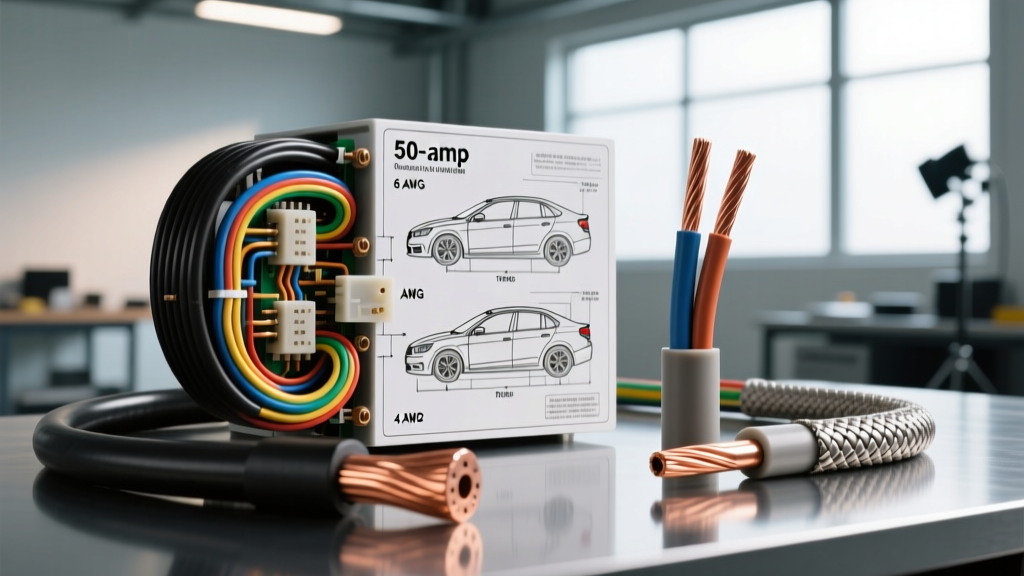
The Core Question: What Wire Gauge for 50 Amps?
When building or upgrading high-current automotive, marine, or off-grid electrical systems, one of the most common questions we receive is: what wire gauge for 50 amps? The short answer is that 6 AWG is the absolute minimum for short chassis wiring, but 4 AWG is the recommended standard for continuous 50-amp loads, longer cable runs, and high-temperature environments.
Selecting the correct wire gauge is not just about preventing melted insulation; it is about managing voltage drop, ensuring efficient power delivery, and preventing catastrophic electrical fires. In automotive applications, a 50-amp draw is substantial—equivalent to running a 500W power inverter, a heavy-duty winch, or a high-output audio amplifier. This guide compares wire sizes, conductor materials, and insulation types to help you select the exact wiring configuration for your 50-amp application.
6 AWG vs. 4 AWG: Automotive Specification Chart
To understand why 4 AWG is often preferred over 6 AWG for 50-amp circuits, we must look at the physical and electrical properties of Oxygen-Free Copper (OFC) wire. The following table compares standard automotive primary wire specifications based on industry benchmarks.
| Specification | 6 AWG OFC Wire | 4 AWG OFC Wire |
|---|---|---|
| Outer Diameter (Approx.) | 0.232 inches (5.89 mm) | 0.292 inches (7.41 mm) |
| Strand Count (30 AWG strands) | 266 Strands | 420 Strands |
| Resistance per 1,000 ft (at 20°C) | 0.410 Ohms | 0.258 Ohms |
| Max Ampacity (Chassis / Short Run) | 60 Amps | 85 Amps |
| Max Ampacity (Continuous / Long Run) | 40 - 45 Amps | 60 - 70 Amps |
| Standard Fuse Protection | 50A MAXI / ANL | 60A - 80A ANL |
Note: Ampacity ratings vary based on ambient temperature and bundling. Always consult the SAE J1128 standard for automotive low-tension cable specifications regarding temperature derating.
Material Showdown: OFC vs. CCA at 50 Amps
When sourcing wire for a 50-amp circuit, you will inevitably encounter two materials: Oxygen-Free Copper (OFC) and Copper-Clad Aluminum (CCA). For any draw exceeding 30 amps, CCA should be strictly avoided.
Why CCA Fails in High-Current Automotive Applications
- Higher Resistance: Aluminum has roughly 61% higher electrical resistance than pure copper. To carry 50 amps safely, a CCA wire must be sized up by at least two AWG steps (e.g., using 2 AWG CCA to match 4 AWG OFC).
- Thermal Expansion & Galvanic Corrosion: Aluminum expands and contracts at a different rate than copper. When crimped into standard copper ring terminals and subjected to the heat of a 50-amp load, CCA connections loosen over time. Furthermore, where the exposed aluminum core meets copper terminals and moisture, rapid galvanic corrosion occurs, increasing resistance and creating a fire hazard.
- Tensile Strength: CCA is brittle. In off-road vehicles or marine environments where vibration is constant, CCA strands are prone to micro-fractures inside the insulation, leading to internal arcing.
The Verdict: Always select 99.9% pure OFC or tinned OFC for 50-amp circuits. Tinned OFC (where individual strands are coated in tin) is highly recommended for marine or high-humidity environments to prevent black oxide corrosion, which increases resistance over time.
Insulation Types: SGT vs. XLPE vs. Standard PVC
The conductor size is only half the equation; the insulation jacket dictates where the wire can be safely routed in a vehicle.
- Standard PVC (GPT): Rated for 105°C. Suitable for interior cabin wiring, trunk amplifiers, and enclosed battery boxes. Do not route GPT wire near exhaust manifolds or turbochargers.
- SGT / SGX (Cross-Linked Polyethylene): Rated for 125°C to 150°C. The insulation is significantly thinner and harder than PVC, offering superior resistance to heat, oils, and solvents. SGX is the mandatory choice for routing 50-amp battery cables through the engine bay or near high-heat exhaust components.
- Marine Grade (Tinned with Flexible Jacket): Often uses a specialized PVC blend rated for 105°C but designed to remain highly flexible in freezing temperatures and resist salt spray.
Application-Specific Selection Guide for 50A Loads
The exact wire gauge you need depends heavily on the duty cycle of the device pulling 50 amps.
1. 500W Power Inverters (Continuous Draw)
A 500W inverter operating at 12V will pull roughly 45 to 50 amps continuously under maximum load. Because inverters are highly sensitive to voltage drop (which triggers low-voltage shutdown alarms), 4 AWG OFC is required for runs up to 15 feet. If the inverter is mounted in the trunk and the battery is under the hood (runs exceeding 15 feet), you must step up to 2 AWG to maintain a voltage drop below 3%. Always protect this circuit with a 60A ANL fuse mounted within 18 inches of the positive battery terminal.
2. Electric Winches (Peak Inrush, Short Duty)
A 9,000 lb electric winch can pull 50 amps at light loads, but its inrush current under heavy stall conditions can exceed 300 amps. While the 50-amp continuous rating might suggest 6 AWG is adequate, the massive voltage drop during inrush will starve the winch motor of torque, causing it to overheat. Winch manufacturers universally recommend 2 AWG or 4 AWG welding-style flex wire to handle the extreme transient current spikes without melting the insulation.
3. High-Output Audio Amplifiers (50A RMS)
For a Class D amplifier drawing 50 amps RMS (roughly a 1000W mono block), transient bass hits demand rapid current delivery. 4 AWG OFC is the standard. Using CCA or undersized 6 AWG wire will result in 'headlight dimming' and dynamic compression, as the wire cannot replenish the amplifier's onboard capacitors fast enough. Ensure the ground wire is the exact same gauge and length as the power wire, terminating to bare, unpainted chassis metal using a 5/16" ring terminal.
Voltage Drop: The Hidden 50-Amp Killer
Voltage drop is the reduction in electrical pressure caused by the resistance of the wire over distance. In a 12V automotive system, a 3% voltage drop equals 0.36V. Critical electronics (ECUs, inverters, fuel pumps) require a drop of less than 3%, while resistive loads (heaters, winch motors) can tolerate up to 10%.
The Calculation:
Voltage Drop = (2 × Length × Current × Resistance per foot)
For a 6 AWG wire running 20 feet (40 ft total round-trip) at 50 Amps:
VD = 2 × 20 × 50 × 0.00041 = 0.82 Volts (6.8% Drop). This is too high for an inverter or sensitive ECU.
For a 4 AWG wire under the same conditions:
VD = 2 × 20 × 50 × 0.000258 = 0.51 Volts (4.2% Drop). Much safer, and easily mitigated by upgrading to 2 AWG for runs longer than 20 feet.
Termination and Connector Best Practices
Running 4 AWG wire for a 50-amp load is useless if the termination points are poorly executed. High-current connections generate the most heat at the crimp joint.
- Connector Material: Use only heavy-wall, tinned copper ring terminals. Avoid stamped aluminum or thin brass connectors, which will crush under high-torque battery terminal bolts.
- Crimping Method: Do not use cheap hammer-crimpers or pliers on 4 AWG wire. Use a dedicated hex-crimp tool or a hydraulic crimper. A hex crimp compresses the copper strands into a solid, unified mass, eliminating air pockets where corrosion can start.
- Sealing: Always seal the crimp joint with adhesive-lined dual-wall heat shrink. When heated, the inner lining melts and flows into the wire strands, creating a waterproof, oxygen-free barrier that prevents green copper oxide from forming inside the lug.
- Hardware: Use stainless steel or zinc-plated steel bolts with split washers and nyloc nuts. Torque battery terminal connections to manufacturer specifications (typically 10-15 Nm for standard side-post or top-post adapters).
Summary Recommendation
If you are asking what wire gauge for 50 amps, the definitive answer for automotive and marine applications is 4 AWG Oxygen-Free Copper (OFC) with SGX or cross-linked insulation for engine bay routing. While 6 AWG may pass a basic ampacity test on a short bench run, the realities of voltage drop, ambient engine heat, and continuous duty cycles make 4 AWG the only reliable choice for safety and performance. Always pair your 50-amp circuit with a properly rated Littelfuse ANL or MEGA fuse to protect the wire in the event of a dead short.