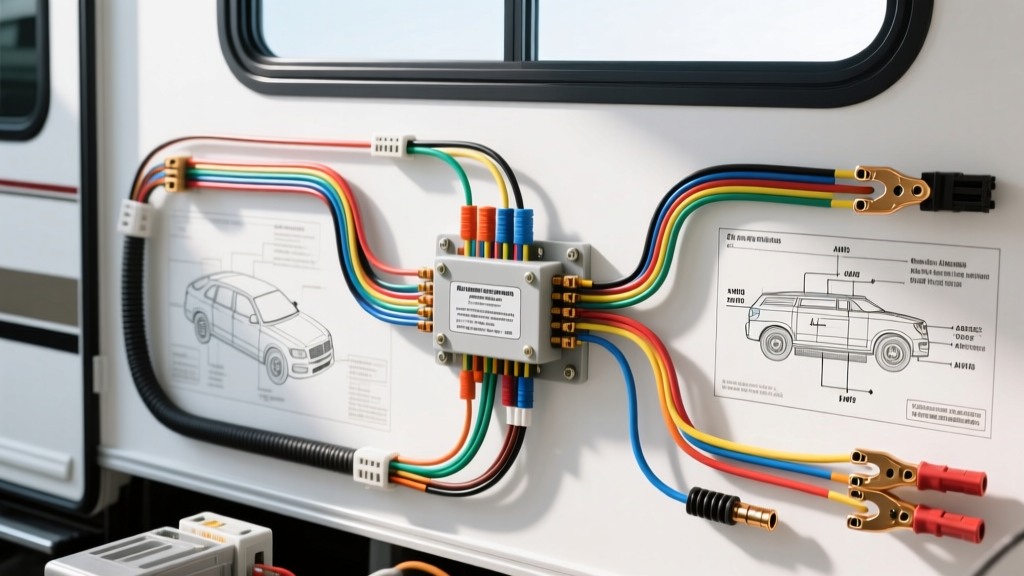
The Intersection of Residential Appliances and Automotive Platforms
Integrating a residential electric range into a luxury motorcoach, Prevost conversion, or high-end custom expedition vehicle presents a unique electrical engineering challenge. While the wire gauge for electric range installations in stationary homes is governed by standard residential codes, automotive and RV platforms must account for severe voltage drop over long chassis cable runs, constant vibration, and the complexities of off-grid DC-to-AC inversion. A standard residential range requires a 240V split-phase supply, typically drawing between 40 and 50 amps at peak load (e.g., during self-cleaning cycles or when all burners and the bake element are engaged simultaneously).
In the automotive and RV sectors, failing to calculate the correct wire gauge for these heavy loads results in catastrophic voltage drop, inverter shutdowns, or thermal events at the termination points. This guide provides an advanced technical deep dive into sizing conductors for electric ranges in 50-amp RV shore power systems and off-grid 48V/12V inverter architectures.
AC Shore Power Wiring: NEMA 14-50R and RVIA Standards
When connected to a 50-amp RV pedestal, the motorcoach receives 120/240V split-phase AC power via a NEMA 14-50R configuration. According to NFPA 70 (NEC Article 551), which governs Recreational Vehicles, the main distribution panel must handle the continuous and non-continuous loads of the chassis.
For a standard 50-amp double-pole breaker feeding an electric range, the baseline requirement is 6 AWG copper THHN/THWN-2 wire. However, automotive environments rarely allow for direct, short-point routing. The cable must navigate through the chassis sub-floor, avoid high-heat exhaust components, and route up into the cabinetry. If the total one-way wire length from the main RV distribution panel to the range receptacle exceeds 45 feet, you must upsize to 4 AWG copper to maintain a voltage drop below 3% (7.2 volts on a 240V circuit).
RVIA Color Code Compliance
The Recreation Vehicle Industry Association (RVIA) mandates specific color codes for 120/240V AC systems to prevent cross-phasing and neutral faults:
- Black (L1): 120V Hot Leg 1
- Red (L2): 120V Hot Leg 2
- White (Neutral): Grounded Conductor (Must be sized identically to the hot legs, 6 AWG or 4 AWG)
- Green or Bare (Ground): Equipment Grounding Conductor (Minimum 10 AWG, though 6 AWG is recommended for fault-current clearing speed in long RV runs).
Off-Grid Inverter Sizing and DC-Side AWG Requirements
The true complexity of the wire gauge for electric range arises when boondocking. Running a 240V residential range off an automotive DC battery bank requires a split-phase inverter setup (such as dual synchronized Victron Quattro units) or a dedicated 240V transformer. The DC-side wire gauge is dictated by the system voltage and the inverter's peak DC current draw.
Consider a 4,500W electric range element. Factoring in a 93% inverter efficiency, the DC input requirement is roughly 4,838W.
12V DC Automotive Systems
On a traditional 12V nominal system (11.5V under load), drawing 4,838W requires 420 Amps of continuous DC current. Standard automotive wire is entirely insufficient here. You must use 4/0 AWG (0000 AWG) SAE J1128 SGX fine-strand welding cable for the battery-to-busbar runs, and parallel dual 4/0 runs for the busbar-to-inverter connections to mitigate heat buildup. Even with 4/0 AWG, the run length from the battery bank to the inverter must not exceed 5 feet to keep voltage drop under 0.5V.
48V DC Expedition Systems
Modern luxury motorcoaches utilize 48V nominal battery banks (e.g., lithium iron phosphate). At 48V (51.2V fully charged, ~46V under heavy load), the 4,838W draw equates to roughly 105 Amps. For a 10-foot round-trip cable run, 2 AWG SAE J1128 SGX or DLO (Diesel Locomotive) cable is required. DLO cable is highly recommended in automotive applications due to its tinned copper stranding and EPDM insulation, which resists chassis vibration, oil, and extreme under-hood temperatures far better than standard THHN.
Wire Gauge for Electric Range: Specification Chart
| System Architecture | Load / Current | Max Run Length (One-Way) | Required Wire Gauge (AWG) | Wire Type Specification |
|---|---|---|---|---|
| 50A AC Shore (NEMA 14-50) | 240V / 50A | 45 feet | 6 AWG | THHN/THWN-2 (Stranded) |
| 50A AC Shore (NEMA 14-50) | 240V / 50A | 75 feet | 4 AWG | THHN/THWN-2 (Stranded) |
| 12V DC to Inverter Bus | 12V / 420A | 5 feet | 4/0 AWG (Parallel Runs) | SAE J1128 SGX / DLO |
| 48V DC to Inverter Bus | 48V / 105A | 15 feet | 2 AWG | SAE J1128 SGX / DLO |
| AC Inverter Output to Range | 240V / 50A | 30 feet | 6 AWG | SOOW Portable Cord (Flexible) |
Termination Torque and Vibration Mitigation
In automotive and RV environments, thermal cycling and chassis torsion cause wire terminations to loosen over time. A loose 6 AWG neutral wire on a 50-amp double-pole breaker will increase resistance, leading to localized heating, melted breaker housings, and potentially a chassis fire.
When terminating 6 AWG or 4 AWG stranded copper into a main RV distribution panel (e.g., Square D QO or Homeline series), you must use a calibrated torque screwdriver. The manufacturer specification for 6 AWG copper under the QO250 breaker lug is 35 in-lbs. Furthermore, all DC-side high-current lugs (such as those on a Victron inverter or Blue Sea busbar) must be crimped using a closed-die hydraulic crimper and sealed with adhesive-lined heat shrink to prevent moisture ingress and subsequent galvanic corrosion.
Advanced Troubleshooting: Phase Sync and Neutral Faults
When wiring an electric range in an off-grid automotive build using dual 120V inverters to create a 240V split-phase supply, phase synchronization is critical. According to Victron Energy split-phase wiring guidelines, the master and slave inverters must be configured via the VE.Bus network to output L1 and L2 exactly 180 degrees out of phase.
Symptom: The electric range control board powers on, but the 240V heating elements fail to engage, while the 120V oven light and convection fan operate erratically.
Cause: Inverter phase drift or a floating neutral fault. If the neutral wire gauge is undersized or the neutral-to-ground bond is improperly placed at the inverter output rather than the main distribution panel, the 240V potential can collapse under load.
Fix: Verify the neutral bus bar torque specs. Ensure the neutral wire gauge matches the hot legs (6 AWG or 4 AWG). Use an oscilloscope to verify the 180-degree phase offset between L1 and L2 at the NEMA 14-50R receptacle under a dummy load before connecting the range.
Summary
Determining the correct wire gauge for electric range applications in motorcoaches and custom automotive builds requires looking beyond basic ampacity charts. You must calculate voltage drop across the entire length of the RV chassis, select SAE-compliant fine-strand wire for DC inversion, and adhere strictly to RVIA color codes and torque specifications. By treating the residential appliance as a high-draw automotive accessory, you ensure safe, reliable operation whether hooked up to shore power or boondocking off-grid.