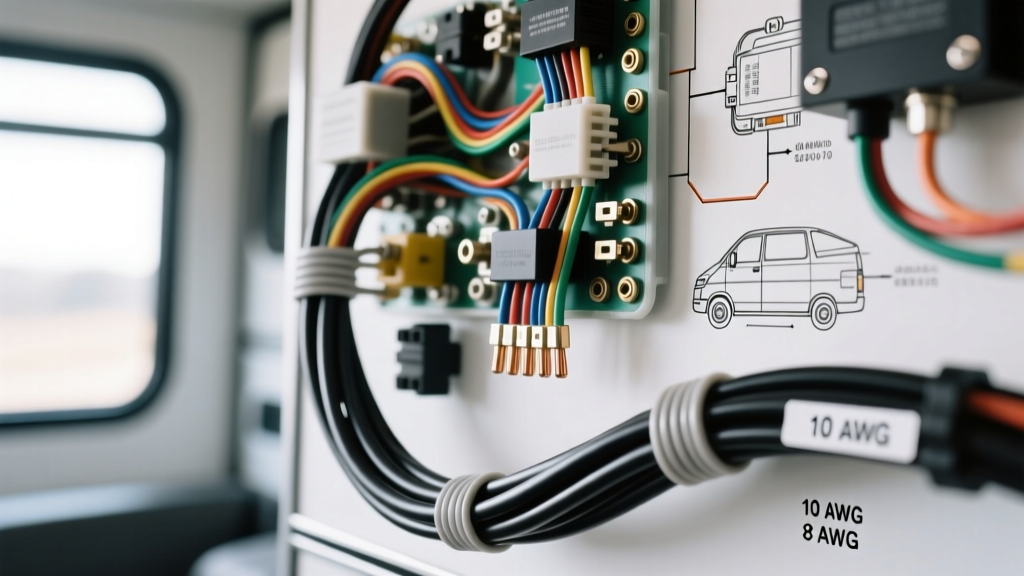
The Challenge of High-Wattage DC Loads in Vehicles
Transitioning from propane to an all-electric galley is one of the most popular upgrades in modern camper vans, overland rigs, and motorhomes. However, searching for the correct wire gauge for electric stove applications often leads DIY builders to residential electrical codes, which are entirely useless—and potentially dangerous—when applied to 12V or 24V automotive DC systems. In a home, an electric stove runs on a 240V AC split-phase circuit, typically requiring 6 AWG or 8 AWG THHN copper wire. In a Ford Transit, Mercedes Sprinter, or custom RV, your electric stove (usually a 1500W to 2000W induction cooktop) relies on a massive DC-to-AC inverter pulling directly from your lithium battery bank.
At Autoflowwire, we specialize in automotive and mobile electrical systems. Running a high-wattage resistive or inductive load off a vehicle's DC architecture requires meticulous wire sizing, specialized insulation types, and rigorous vibration-resistant terminations. This guide breaks down the beginner-friendly fundamentals of sizing your DC and AC wiring to ensure your induction cooktop operates safely without triggering low-voltage disconnects or causing thermal events.
Calculating the True DC Current Draw
Before selecting a wire gauge, you must understand the sheer volume of current an electric stove demands from a low-voltage battery bank. Inverters are not 100% efficient; high-frequency pure sine wave inverters typically operate at about 90% to 93% efficiency under heavy loads.
The Math: 12V vs. 24V Systems
To find the maximum DC current draw, use the following formula:
DC Amps = (Wattage) / (System Voltage x Inverter Efficiency)
- 12V System (2000W Cooktop): 2000W / (12V x 0.92) = 181 Amps
- 24V System (2000W Cooktop): 2000W / (24V x 0.92) = 90 Amps
While 90 Amps on a 24V system is manageable with standard automotive wiring, pulling over 180 Amps continuously on a 12V system requires heavy-duty, large-gauge battery cables. This is why most serious overland and RV builders are migrating to 24V or 48V architectures when installing electric stoves.
DC Side: Battery Bank to Inverter Sizing
The cables connecting your lithium battery bank (or busbar) to the inverter's DC terminals carry the brunt of the electrical load. You must never use solid-core residential wire or cheap, untinned CCA (Copper Clad Aluminum) wire in a mobile environment. You need SAE J1128 SGX or UL 1283/1426 fine-stranded, tinned marine copper wire to resist corrosion, vibration, and heat.
When consulting Blue Sea Systems ABYC wire sizing standards, you must factor in the total length of the circuit (positive AND negative combined) and limit your voltage drop to less than 1% for high-load inverter circuits to prevent the inverter's low-voltage cutoff from tripping when the stove is set to 'High'.
DC Wire Gauge Sizing Chart (Inverter to Battery)
| System Voltage | Max Load (W) | Max DC Amps | Total Wire Length (Pos + Neg) | Recommended AWG (1% Drop) | Minimum Fuse Size |
|---|---|---|---|---|---|
| 12V | 2000W | ~185A | 5 ft (1.5m) | 2/0 AWG | 250A Class T |
| 12V | 2000W | ~185A | 10 ft (3m) | 4/0 AWG | 250A Class T |
| 24V | 2000W | ~92A | 10 ft (3m) | 2 AWG | 125A Class T |
| 24V | 3000W | ~138A | 10 ft (3m) | 1/0 AWG | 175A Class T |
Automotive Integration: Alternators and Chassis Grounding
In a dedicated RV or camper van, your electric stove might be running while the vehicle is in transit, meaning the chassis alternator is actively charging the house bank via a DC-DC charger (like a Victron Orion-Tr Smart or Redarc BCDC). If your alternator is pushing 200 Amps to the house bank, and your stove is pulling 185 Amps via the inverter, the wiring between your starting battery, DC-DC charger, and house busbar must be sized to handle the cumulative thermal load.
Furthermore, never use the vehicle's sheet metal chassis as a return path (ground) for an inverter powering an electric stove. The high-frequency switching of the inverter, combined with the massive DC current, will induce noise into the vehicle's CAN-bus system and potentially fry sensitive automotive ECUs. Always run a dedicated, equal-length negative cable directly back to the house battery busbar or shunt.
AC Side: Inverter to the Electric Stove Receptacle
Once the DC power is inverted to 120V AC, the wiring rules shift slightly, but mobile vibration remains a critical factor. A standard 1500W-2000W induction cooktop requires a 120V, 20-Amp dedicated circuit.
- Wire Type: 12 AWG stranded copper (THHN/THWN-2 or marine-grade tinned).
- Routing: Route the AC wires through split corrugated loom to protect against chafing against the vehicle's metal ribbing.
- Securing: Secure the wiring with cushion-clamp (P-clamp) ties every 12 to 18 inches to prevent fatigue failure at the termination points.
- Receptacle: Use a commercial-grade, vibration-resistant 20A GFCI receptacle mounted in a deep steel or reinforced nylon box.
Terminations, Lugs, and Fusing Best Practices
The most common point of failure in high-draw RV electrical systems is not the wire itself, but the termination. A loose crimp on a 185-Amp circuit will generate immense heat, potentially melting the insulation and causing a fire.
Step-by-Step Termination Protocol
- Strip the Wire: Use a precision wire stripper to avoid nicking the fine copper strands. Nicked strands create localized resistance and heat.
- Select the Lug: Use heavy-duty, tinned copper ring terminals with a viewing window to ensure the wire is fully seated.
- Crimp: Do not use a standard hammer crimper. Use a hydraulic hex-crimp tool (such as the Temco TH0001 or Knipex equivalent) to apply uniform, 360-degree pressure. A proper hex crimp cold-welds the copper, making it gas-tight.
- Seal: Apply adhesive-lined, dual-wall heat shrink. When heated, the inner adhesive melts and seals the wire entry point, preventing moisture and corrosive automotive gases from creeping up the copper strands.
- Torque: According to Victron Energy Wiring Guidelines, terminal nuts must be torqued to the manufacturer's exact specification. For a standard 5/16-inch inverter stud, this is typically 5 Nm to 7 Nm. Use a calibrated torque screwdriver or inch-pound wrench.
Real-World Troubleshooting: Voltage Drop and Thermal Runaway
Even with the correct wire gauge for electric stove applications, mobile environments introduce unique failure modes. Here is a diagnostic decision tree for common induction cooktop issues in RVs:
Symptom: Inverter Shuts Off (Low Voltage Alarm) When Stove is on 'Boost'
- Cause A: Severe voltage drop across the DC cables due to undersized wire or excessive length.
- Fix A: Measure the voltage directly at the battery terminals, then at the inverter terminals while the stove is running. If the delta is greater than 0.5V on a 12V system, upgrade your wire to 4/0 AWG and shorten the run.
- Cause B: Battery Management System (BMS) bottleneck. Many budget lithium batteries restrict continuous discharge to 100A per battery.
- Fix B: Wire two or more batteries in parallel using matched-length, symmetrical busbars to distribute the 185A draw evenly.
Symptom: Melting or Discoloration at the Inverter DC Terminals
- Cause: Improper crimp, missing adhesive heat shrink (allowing oxidation), or undertorqued nuts that vibrate loose while driving on washboard roads.
- Fix: Cut off the damaged lug. Inspect the wire strands for black oxidation (if present, cut back to clean copper). Re-crimp with a hydraulic tool, apply adhesive heat shrink, and torque to spec. Apply a dab of di-electric grease over the nut to prevent future corrosion.
Summary Checklist for Safe Mobile Cooking
Running an electric stove off a vehicle's electrical system is entirely safe and highly efficient, provided you respect the physics of low-voltage, high-amperage DC power. Always prioritize 24V systems for high-wattage appliances to halve your current draw, use SAE J1128 fine-stranded tinned copper, hydraulically crimp your lugs, and protect your investment with fast-acting Class T fuses. By following these automotive-grade standards, your mobile galley will perform flawlessly on any expedition.