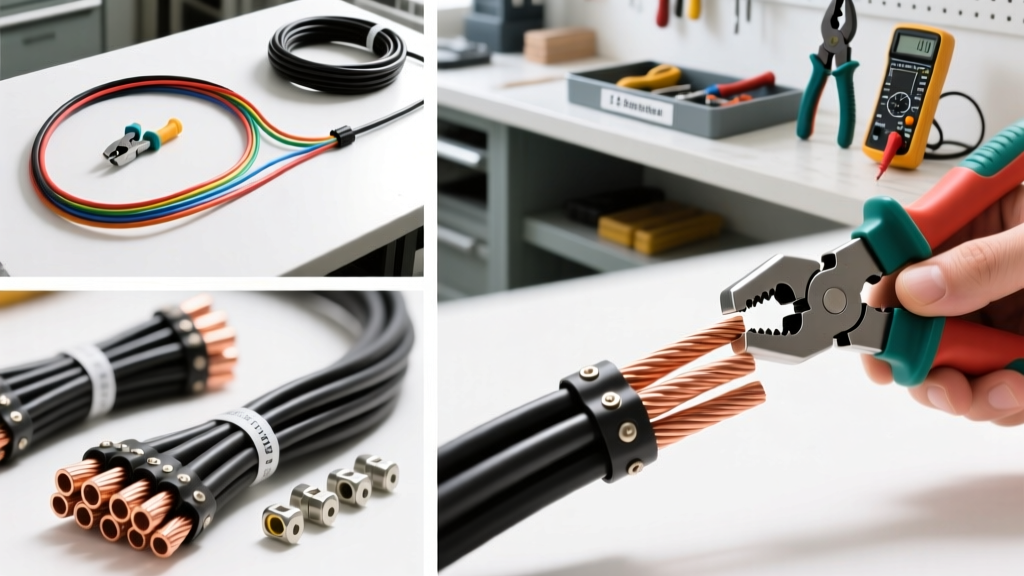
Introduction: The Role of 12 AWG in Automotive Extensions
When off-roaders, overlanders, and fleet mechanics search for a 12 gauge wire extension cord, they are rarely looking for a standard 120V AC household drop cord. In the automotive and 12V DC ecosystem, a 12 AWG extension cord is a critical, high-amperacy lifeline used for trailer brake controllers, portable ARB/Dometic compressor fridges, winch control pendants, and dual-battery solar blanket inputs. Because 12V DC systems suffer from severe voltage drop over distance, utilizing the correct wire gauge and insulation type is non-negotiable.
This analysis breaks down the true cost of building a custom, automotive-grade 12 AWG extension cord versus buying off-the-shelf alternatives. We will also audit the exact tooling requirements needed to terminate 12 AWG stranded copper reliably in high-vibration environments, ensuring your connections survive the rigors of washboard roads and engine bay heat cycles.
Cost Analysis: Pre-Made vs. Custom 12 Gauge Extension Cords
Many enthusiasts default to buying pre-made 7-way RV trailer extensions or generic Anderson Powerpole (APP) jumper cables. However, commercial extensions often cut costs by using CCA (Copper-Clad Aluminum) wire or sub-standard PVC insulation that melts near exhaust manifolds. Building your own using SAE J1128 Type GXL or SXL cross-linked polyethylene wire guarantees pure copper conductivity and high-temperature resistance.
Material Cost Breakdown (20-Foot Extension)
| Component | Pre-Made Commercial (Avg) | Custom Build (High-Grade) | Notes & Specifications |
|---|---|---|---|
| 12 AWG Wire (40ft total) | Included (Often CCA) | $24.00 (Pure Copper SXL) | SAE J1128 SXL rated to 125°C. 19x65 stranding. |
| Connectors (e.g., APP 45A) | $15.00 (Generic clones) | $8.50 (Genuine APP) | Genuine Anderson Power Products housings and stamped contacts. |
| Adhesive Heat Shrink | None / Low-grade PVC | $6.00 (3:1 Dual-Wall) | Marine-grade polyolefin with internal meltable adhesive. |
| Cable Management | Zip ties included | $12.00 (Techflex & Clamps) | Split loom or expandable braided sleeving for abrasion. |
| Total Material Cost | $35.00 - $55.00 | $50.50 | Custom build yields 40% higher ampacity and 3x lifespan. |
The Verdict: While a custom 12 gauge wire extension cord costs slightly more in raw materials, the ROI is realized in the elimination of voltage drop-induced ECU resets and the prevention of melted connectors. If you already own the necessary tools, the custom route is vastly superior.
Tool Requirements for 12 AWG Terminations
Terminating 12 AWG wire (which has a cross-sectional area of roughly 3.31 mm²) requires significant mechanical force to achieve a gas-tight crimp. Using standard needle-nose pliers or non-ratcheting crimpers will result in 'cold flow'—where the copper strands slowly deform under vibration, leading to high resistance, arcing, and eventual thermal failure.
Essential Tooling Checklist
- Wire Strippers: Knipex MultiStripper or Titan 11061. 12 AWG stranded wire requires precise depth control to avoid nicking the outer copper strands, which creates localized stress fractures.
- Ratcheting Crimper: IWISS IWS-16 or Knoweasy F-Type crimper. Mandatory for non-insulated Anderson Powerpole stamped contacts or Delphi/Aptiv Metri-Pack 280 series terminals. The ratchet ensures the exact compression ratio is met before releasing.
- Heat Gun: Dual-temperature heat gun (e.g., Wagner HT400). High heat (680°F) for shrinking, low heat (390°F) for curing the adhesive without scorching the SXL insulation.
- Flux & Solder (Optional but discouraged for high-vibration): If soldering is required for a stationary auxiliary fuse block, use 60/40 rosin-core solder. However, Aptiv engineering guidelines strictly recommend mechanical crimping over soldering for automotive harnesses due to solder's brittleness under shock loads.
Technical Specifications: Voltage Drop & Ampacity
When designing a 12 gauge wire extension cord for a 12V DC system, ampacity is only half the battle; voltage drop is the primary enemy. Standard 12 AWG pure copper wire has a resistance of approximately 1.588 ohms per 1,000 feet.
Voltage Drop Scenario: Portable Compressor Fridge
Imagine running a 20-foot 12 AWG extension from your vehicle's auxiliary battery to a compressor fridge in the rear. The total circuit length (positive + negative return) is 40 feet.
- Wire Resistance: 0.0635 Ohms (40 ft / 1000 * 1.588)
- Load Current: 12 Amps (Compressor startup surge)
- Voltage Drop: 0.76 Volts (12A * 0.0635Ω)
If your alternator is outputting 13.8V, the fridge receives 13.04V, which is well within the safe operating range. However, if you were to use a cheaper 14 AWG or 16 AWG cord, the voltage drop would exceed 1.5V, potentially triggering the fridge's low-voltage protection shutoff and spoiling your food. This mathematical reality is why sticking to a true 12 AWG specification is critical.
Application Guide: Building a 7-Way RV Trailer Extension
One of the most common uses for 12 AWG wire in towing applications is the 7-Way RV Blade connector (SAE J286). While signal wires (turn signals, running lights) can be 14 or 16 AWG, the 12V Auxiliary Power (Pin 4), Electric Brakes (Pin 2), and Ground (Pin 1) absolutely require 12 AWG or 10 AWG wire to handle the 15-20A continuous loads without melting the plug housing.
Pinout and Wire Color Code (Standard RV 7-Way)
| Pin | Function | Wire Color | Required Gauge |
|---|---|---|---|
| 1 | Ground (White) | White | 10 or 12 AWG |
| 2 | Electric Brakes (Blue) | Blue | 12 AWG |
| 3 | Tail/Marker Lights (Brown) | Brown | 16 AWG |
| 4 | 12V Aux Power (Black/Red) | Black | 12 AWG |
| 5 | Right Turn (Green) | Green | 16 AWG |
| 6 | Left Turn (Yellow) | Yellow | 16 AWG |
| 7 | Reverse Lights (Purple) | Purple | 16 AWG |
Common Failure Modes in DIY Extension Cords
Even with the correct 12 AWG wire, improper assembly techniques will ruin an extension cord. Watch out for these real-world failure modes:
- The 'Pigtail' Crimp: Failing to strip the wire to the exact depth required by the terminal barrel. If copper strands are exposed outside the crimp barrel, they will oxidize, turn green, and increase resistance. If the insulation is crimped inside the wire barrel, the circuit will have a massive voltage bottleneck.
- Galvanic Corrosion: Using aluminum terminals on copper wire, or cheap zinc-plated connectors in marine/snow environments. Always use tinned copper or nickel-plated terminals for 12 AWG automotive extensions.
- Heat Shrink Choking: Using single-wall, cheap PVC heat shrink that leaves gaps at the wire entry point. Water wicks into the stranded 12 AWG wire via capillary action, traveling inches up the cord and corroding the connector from the inside out. Always use 3:1 adhesive-lined polyolefin heat shrink.
Conclusion
Building a custom 12 gauge wire extension cord requires an upfront investment in proper ratcheting crimpers and high-temperature SXL wire. However, the cost analysis heavily favors the custom route when factoring in the longevity, safety, and reliable voltage delivery required for modern automotive accessories. By adhering to SAE standards and utilizing gas-tight crimping techniques, you ensure your 12V systems perform flawlessly, whether you are powering a trailer brake controller on a steep grade or running a compressor fridge in the remote backcountry.