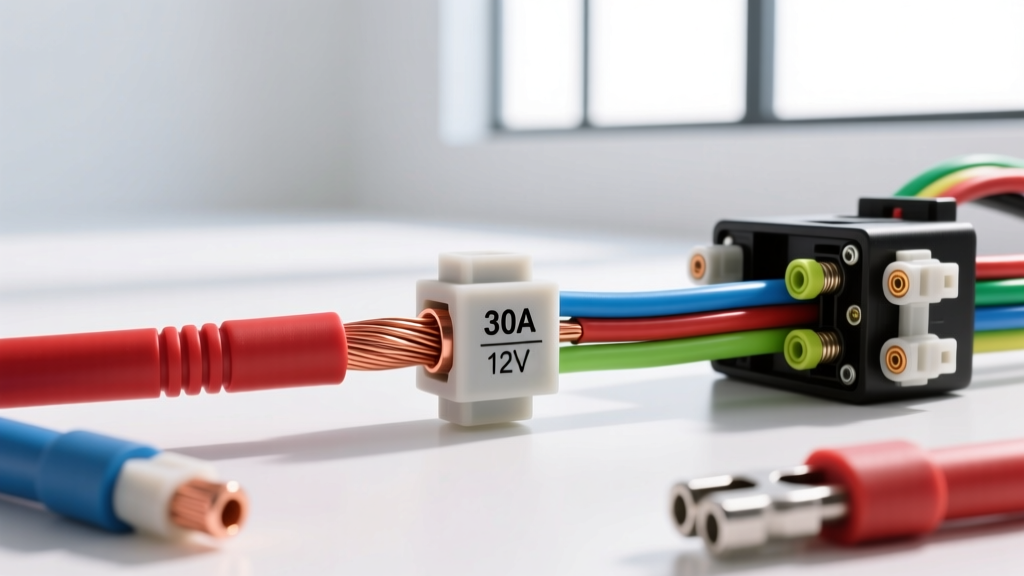
The Hidden Dangers of Incorrect 30A Wire Sizing
When wiring high-draw 12V DC automotive accessories—such as high-flow fuel pumps, heavy-duty air compressors, or 300W off-road light bars—selecting the correct 30A wire gauge is a matter of safety and system reliability. A continuous 30-amp draw on a 12-volt system equates to 360 watts of power. If the wire gauge is undersized, the electrical resistance generates excessive heat, which can melt insulation, cause voltage starvation to the component, or ignite an under-hood fire. Despite the availability of wire charts, automotive enthusiasts and even some professional installers frequently make critical errors when sizing and routing 30-amp circuits. This guide breaks down the most common mistakes, the physics of 12V voltage drop, and the exact specifications required for safe, high-amperage automotive wiring.
Mistake #1: Confusing NEC Household Standards with SAE Automotive Standards
The most pervasive error in automotive wiring is applying the National Electrical Code (NEC) ampacity charts to 12V DC vehicle systems. The NEC dictates that 10 AWG copper wire is sufficient for 30 amps in a 120V/240V AC household environment. However, automotive environments are governed by SAE J1128 standards, which account for extreme under-hood temperatures, chemical exposure, and tight bundle routing.
In a vehicle, ambient temperatures near the exhaust manifold or firewall can easily exceed 105°C (221°F). Standard PVC insulation found on cheap hardware-store wire will soften, crack, and short out against the chassis. For a 30A automotive circuit, you must use SAE J1128 compliant wire, typically featuring Cross-Linked Polyethylene (XLPE) insulation, which is rated for continuous operation at 125°C and resists oil, grease, and battery acid.
Mistake #2: The Copper-Clad Aluminum (CCA) Trap
With the rising cost of copper, the market has been flooded with Copper-Clad Aluminum (CCA) wire. CCA wire features an aluminum core with a thin copper plating. While it looks identical to pure copper when cut with standard strippers, aluminum has only about 61% of the electrical conductivity of pure copper.
If you purchase a spool of '10 AWG' CCA wire and run 30 amps through it, it will perform electrically like a 12 AWG or even 14 AWG pure copper wire. The result is severe voltage drop, overheating, and eventual failure of the wire or the connected component. Always verify that your wire is stamped with 'OFC' (Oxygen-Free Copper) or 'Pure Copper' and inspect the cross-section of a stripped wire; if the center is silvery-white, it is aluminum and must be rejected for high-amperage automotive use.
30A Wire Gauge Sizing & Voltage Drop Chart
In a 12V DC system, voltage drop is often a bigger issue than raw ampacity. A 10 AWG pure copper wire can safely carry 30 amps without melting, but over long distances, the resistance will rob your accessory of necessary voltage. Motors (like fuel pumps and cooling fans) compensate for low voltage by drawing more amps, creating a thermal runaway scenario. The chart below outlines the correct 30A wire gauge based on the total round-trip circuit length (positive wire + ground wire).
| Total Wire Length (Round Trip) | Recommended AWG (Pure Copper) | Voltage Drop at 30A | Application Notes |
|---|---|---|---|
| Under 10 Feet | 10 AWG | ~0.30V | Engine bay accessories, short relay runs. |
| 10 to 20 Feet | 10 AWG | ~0.60V | Standard for most 12V lighting and solenoids. |
| 20 to 35 Feet | 8 AWG | ~0.75V | Required for rear-mounted fuel pumps or winch controls. |
| 35 to 50 Feet | 6 AWG | ~0.80V | Heavy-duty runs to the trunk; essential for sensitive electronics. |
Mistake #3: Ignoring Inrush Current in Automotive Loads
Many installers size the wire and fuse strictly based on the 'continuous' amperage rating printed on the component. However, DC electric motors experience a massive inrush current (locked-rotor amperage) upon startup, which can be 3 to 5 times higher than the running current. A high-flow fuel pump that draws 30A continuously might pull 90A for the first 200 milliseconds of operation. If your 30A wire gauge is too small, or if your fuse is not a 'slow-blow' or 'time-delay' variant, the inrush spike will instantly blow the fuse or cause a severe voltage sag that prevents the motor from starting properly. Always use an 8 AWG wire for the main power feed to accommodate inrush surges, and utilize Littelfuse automotive time-delay fuses to prevent nuisance tripping.
Real-World Application: Wiring a 30A High-Flow Fuel Pump
Let us apply these principles to a common 30A automotive upgrade: installing a high-pressure aftermarket fuel pump (e.g., Aeromotive or Walbro 450). Because the pump is located in the rear of the vehicle, the round-trip wire length often exceeds 25 feet. Therefore, stepping up from 10 AWG to 8 AWG pure copper wire is mandatory to maintain adequate voltage at the pump terminals.
Standard ISO Relay Pinout & Wire Colors
To safely switch a 30A load, you must use a heavy-duty Bosch-style ISO mini relay. Do not run 30 amps through the vehicle's factory ignition switch or a standard toggle switch. Use the following pinout and color coding for professional-grade results:
- Pin 30 (12V+ Battery Feed): 8 AWG Red wire. Connects directly to the battery positive via a MAXI fuse holder.
- Pin 87 (Output to Load): 8 AWG Red wire. Routes to the fuel pump positive terminal.
- Pin 86 (Trigger +): 16 AWG Yellow wire. Connects to a switched 12V source (e.g., fuel pump prime circuit or ignition run).
- Pin 85 (Ground): 16 AWG Black wire. Connects to a clean, bare-metal chassis ground point.
Critical Fusing and Termination Safety Rules
Wire gauge is only half the battle; how you protect and terminate that wire determines the safety of the entire vehicle.
The 18-Inch Rule and Fuse Selection
The primary fuse for a 30A circuit must be installed on the positive wire within 18 inches of the battery terminal. This protects the entire length of the wire in the event of a dead short against the chassis. For a 30A continuous draw with inrush spikes, a 40A Time-Delay MAXI fuse or a 40A ANL fuse is typically recommended, provided the wire is sized to handle the 40A peak (which 8 AWG easily does). Never place the fuse near the component; doing so leaves the long run of wire from the battery completely unprotected.
Proper Termination and Crimping
Soldering is generally discouraged in high-vibration, high-current automotive environments because solder wicks under the wire insulation, creating a stiff point that is prone to work-hardening and snapping. Instead, use high-quality, non-insulated copper ring terminals and a precision ratcheting crimper. Seal the connection using 3:1 adhesive-lined dual-wall heat shrink tubing. The inner layer of hot-melt adhesive melts and flows into the wire strands, creating a waterproof, oxygen-free seal that prevents green corrosion from creeping under the insulation and increasing circuit resistance over time.
By respecting the physics of 12V DC voltage drop, avoiding cheap CCA wire, and adhering to SAE J1128 and Del City Wire specifications, you ensure your 30A automotive circuits remain safe, efficient, and reliable for the life of the vehicle.