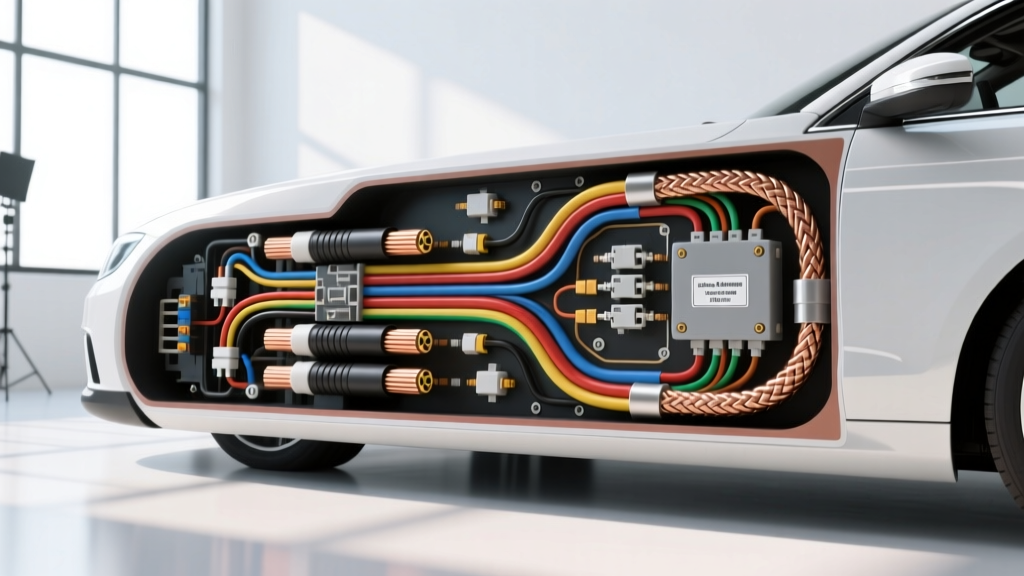
The Short Answer: Is 8 Gauge Wire Good for 50 Amps?
When building custom 12V systems—such as wiring an onboard air compressor, a high-output alternator sense line, or a heavy-duty lighting relay—beginners frequently ask: is 8 gauge wire good for 50 amps? The short answer is yes, but only under specific automotive chassis wiring conditions. If you are running a short cable from a battery to a fuse block, or powering a high-draw accessory under the hood, 8 AWG (American Wire Gauge) copper wire is perfectly capable of handling a 50-amp load. However, if you are running a continuous 50-amp transmission line across the entire length of a vehicle to a rear-mounted winch or a massive audio amplifier, 8 AWG will suffer from severe voltage drop and dangerous heat accumulation. To understand why, we must look at the difference between chassis wiring and power transmission, as well as the critical role of insulation temperature ratings.
Chassis Wiring vs. Power Transmission Limits
The confusion surrounding wire ampacity usually stems from conflicting charts found online. The NFPA 70 National Electrical Code (NEC) rates 8 AWG copper wire at a maximum of 40 amps. However, the NEC is designed for residential and commercial building wiring, which involves bundling multiple wires inside insulated walls over long distances. Automotive electrical systems operate under the SAE J1128 standard for chassis wiring. In a vehicle, wires are typically routed individually in free air, exposed to moving air currents that aid in cooling, and usually span much shorter distances. Under SAE chassis wiring guidelines, a single 8 AWG wire in free air can safely carry upwards of 50 to 60 amps for short runs without degrading the insulation or creating a fire hazard.
Ampacity & Insulation Specifications
The physical thickness of the copper is only half the equation; the jacket insulation dictates how much heat the wire can withstand before melting or shorting out against the vehicle chassis. When sourcing 8 AWG wire for a 50-amp automotive circuit, you must verify the insulation type. Standard PVC wire found in big-box hardware stores is not rated for the high ambient temperatures found near an engine block or exhaust manifold.
| Wire Type / Insulation | Max Temp Rating | 50A Auto Use Case | Thickness |
|---|---|---|---|
| SAE GXL (Cross-Linked) | 125°C (257°F) | Excellent (Engine bay routing) | Thin wall, high heat resistance |
| SAE TXL (Cross-Linked) | 125°C (257°F) | Excellent (Tight harness spaces) | Extra thin wall, flexible |
| Standard PVC (Primary) | 105°C (221°F) | Poor (Cabin or trunk only) | Thick wall, melts near exhaust |
| THHN / THWN-2 | 90°C (194°F) | Not Recommended (Stranding issues) | Solid or coarse strand, stiff |
For any 50-amp circuit routed under the hood, always specify SAE GXL or TXL cross-linked polyethylene (XLPE) insulated wire. These jackets resist melting when resting against warm components and withstand exposure to automotive fluids like oil and brake cleaner.
The Hidden Killer: Voltage Drop at 50 Amps
Even if 8 AWG wire does not melt under a 50-amp load, it is subject to the laws of electrical resistance. According to Engineering Toolbox AWG Data, 8 AWG copper wire has a resistance of approximately 0.6282 ohms per 1,000 feet. When you push 50 amps through that resistance, voltage drops. In a 12V automotive system, a voltage drop exceeding 3% (0.36V) can cause sensitive electronics, ECU modules, or relay coils to malfunction, chatter, or fail to engage.
Voltage Drop Chart: 8 AWG at 50 Amps (12V System)
| Total Wire Length (Out & Back) | Voltage Drop | Percentage Drop (12V) | Verdict for 50A Circuit |
|---|---|---|---|
| 5 Feet | 0.15V | 1.25% | Excellent (Safe for 8 AWG) |
| 10 Feet | 0.31V | 2.58% | Acceptable (Under 3% limit) |
| 15 Feet | 0.47V | 3.91% | Borderline (Consider 6 AWG) |
| 20 Feet | 0.62V | 5.16% | Fail (Upgrade to 4 AWG required) |
Beginner Rule of Thumb: If your 50-amp accessory (like a Viair 400-series compressor or a winch solenoid control line) requires more than 10 feet of total wire length (positive and ground combined), 8 gauge wire is no longer good for 50 amps. You must step up to 6 AWG or 4 AWG to maintain system voltage.
Real-World 50A Automotive Applications & Best Practices
Where do we actually see 50-amp draws in the automotive world? Common applications include high-output air compressors, electric cooling fan relays, EV battery heater circuits, and secondary fuse block feeds. Here is how to properly execute these connections.
1. Wire Color Coding Standards
Never use random wire colors for high-current circuits. Following standard automotive color codes prevents catastrophic mistakes during future troubleshooting. Use Red for constant 12V battery positive feeds. Use Black for heavy gauge chassis grounds. Warning: Never use Green or Yellow/Green tracer wires for high-current 12V feeds, as these colors are strictly reserved for SRS (Airbag) and safety restraint systems in modern vehicles. Accidentally splicing into an airbag harness with a 50A compressor feed can deploy the SRS system or trigger permanent module locks.
2. Overcurrent Protection (Fusing)
If you are using 8 AWG wire for a 50-amp circuit, standard ATO/ATC blade fuses will not work, as they max out at 30A or 40A. You must use a 50-Amp MIDI (or AMI) fuse. MIDI fuses feature a bolt-down design capable of handling high continuous current without suffering from the thermal fatigue that plagues cheap inline AGU glass fuses. The fuse must be installed on the positive 8 AWG wire within 7 inches of the battery terminal. If a dead short occurs against the firewall, the 50A MIDI fuse will blow before the 8 AWG wire can catch fire.
3. Terminal Crimping & Torque Specifications
A 50-amp load will instantly expose a poor crimp. The resistance of a loose connection generates extreme heat, melting the insulation and causing a voltage drop. For 8 AWG wire, you must use closed-barrel, non-insulated ring terminals (typically sized for a #10 or 5/16" stud).
The Crimping Process:
- Strip exactly 3/8" to 1/2" of insulation using a precision wire stripper to avoid nicking the outer copper strands.
- Insert the wire fully into the closed barrel until it bottoms out.
- Use a dedicated hexagonal crimp die or a closed-barrel indent crimper. Avoid cheap plier-style crimpers that simply smash the barrel flat; a proper hex crimp cold-welds the copper to the terminal.
- Seal the termination with 3:1 ratio adhesive-lined marine heat shrink. The internal glue melts and seals out moisture, preventing green corrosion (copper oxide) which increases resistance over time.
- When securing the ring terminal to a battery post or distribution busbar, torque the hardware to the manufacturer specification. For a standard 5/16" battery terminal bolt, the target torque is typically 10 to 12 Nm (89 to 106 in-lbs). Overtightening can stretch the bolt and snap it; undertightening will cause arcing under the 50A load.
The CCA Warning: Avoid Cheap Wiring Kits
When shopping for 8 AWG wire online, beginners often fall for incredibly cheap "Oxygen-Free" wiring kits. Many of these are actually CCA (Copper-Clad Aluminum). CCA wire has an aluminum core with a microscopic copper coating. Aluminum has roughly 61% of the conductivity of pure copper. An 8 AWG CCA wire will perform electrically like a 10 AWG or 11 AWG pure copper wire. If you push 50 amps through an 8 AWG CCA wire, it will overheat, the voltage drop will be severe, and the terminals will likely melt. Always verify that your wire is stamped with OFC (Oxygen-Free Copper) or pure copper stranding. You can test this by scratching the cut end of a strand with a razor blade; if it reveals a silver/white core, it is CCA and must be thrown away.
Summary Checklist for 8 AWG / 50A Circuits
- Is 8 gauge wire good for 50 amps? Yes, for runs under 10 feet (total circuit length) in free air.
- Wire Type: SAE GXL or TXL (125°C rated) for under-hood use.
- Material: 100% OFC (Oxygen-Free Copper) only. Never CCA.
- Fusing: 50A MIDI/AM fuse within 7 inches of the power source.
- Termination: Hex-crimped closed-barrel terminals with adhesive heat shrink.
- Color Code: Red for 12V+, Black for Ground. Avoid SRS colors.