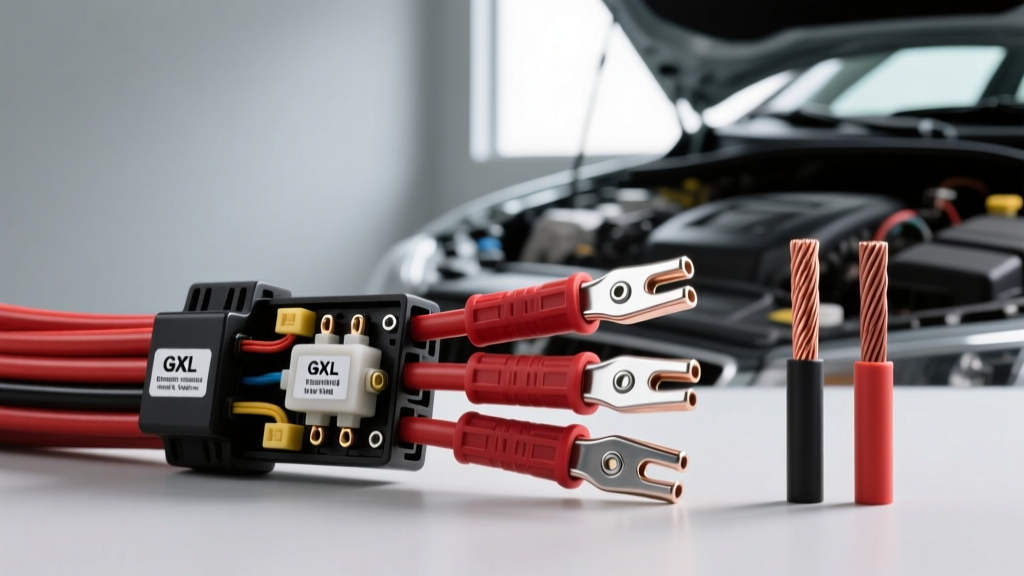
What Is 6 Gauge Wire Rated For? The Technical Baseline
When planning high-current automotive modifications, one of the most common questions electrical technicians and DIY builders ask is: what is 6 gauge wire rated for? In automotive and chassis wiring applications, 6 AWG (American Wire Gauge) copper wire is generally rated for 55 to 75 amps, depending on the insulation temperature rating, ambient engine bay temperatures, and whether the wire is routed in a bundled harness or in free air. According to the SAE J1128 standard for low-tension primary automotive wire, a 6 AWG conductor with a 125°C cross-linked insulation (such as GXL or TXL) can safely handle continuous loads up to 75 amps in a single-wire, free-air configuration.
However, the true cost and success of a 6 AWG wiring project extend far beyond simply purchasing the wire. Working with this heavy-gauge conductor requires specialized tooling, specific termination hardware, and an understanding of material costs. This guide provides a comprehensive cost and tool requirements analysis for integrating 6 gauge wire into high-output alternator upgrades, EV battery interconnects, and heavy-duty winch circuits.
6 AWG Technical Specifications & Ampacity Chart
Before evaluating costs, it is critical to understand the physical and electrical properties of 6 AWG wire. The resistance per foot dictates your voltage drop, which is the primary limiting factor in long wire runs, such as routing power from the front battery to a rear-mounted amplifier or winch solenoid.
| Specification | 6 AWG (Stranded Copper) | 6 AWG (Solid Copper) |
|---|---|---|
| Diameter (Inches) | 0.1620" (Nominal) | 0.1620" |
| Cross-Sectional Area | 13.30 mm² (26,240 CM) | 13.30 mm² |
| Resistance @ 20°C | 0.3951 Ω / 1,000 ft | 0.3951 Ω / 1,000 ft |
| Max Ampacity (Chassis/Free Air) | 75 Amps (SAE J1128) | 55 Amps (NEC 310.16) |
| Max Ampacity (Bundled Harness) | 50 - 60 Amps | 40 - 50 Amps |
Note: Automotive applications exclusively use finely stranded copper (typically 19 to 37 strands) to withstand the constant vibration and flexing of a vehicle chassis. Solid core wire will fracture under vehicular vibration and must never be used in automotive harnesses.
Cost Analysis: Budgeting for 6 Gauge Automotive Wiring
The financial outlay for a 6 AWG wiring project is dictated by the conductor material and the insulation jacket. Cutting corners here is a common failure point that leads to melted harnesses and electrical fires.
Copper vs. CCA (Copper Clad Aluminum)
When sourcing 6 gauge wire, you will encounter CCA (Copper Clad Aluminum) wire sold at a 30% to 40% discount compared to pure oxygen-free copper (OFC). Do not use CCA for high-current automotive applications. Aluminum has roughly 61% of the conductivity of copper. A 6 AWG CCA wire will have the ampacity equivalent to roughly 8 AWG pure copper, leading to severe voltage drop and overheating at the termination points due to galvanic corrosion where the aluminum core meets copper ring terminals. Pure OFC 6 AWG wire costs between $1.80 and $3.00 per foot, whereas CCA costs around $0.90 to $1.20 per foot. The $40 saved on a 40-foot run is not worth the risk of a melted alternator feed.
Insulation Types: GXL/TXL vs. THHN
Another cost variable is the insulation jacket. Hardware stores sell THHN (Thermoplastic High Heat-resistant Nylon-coated) building wire for roughly $0.80 per foot. While THHN is rated for 90°C and 75 amps in residential conduit, its stiff thermoplastic jacket becomes brittle in freezing weather and melts easily when routed near exhaust manifolds.
Automotive-grade GXL (General Cross-Linked) or TXL insulation costs roughly $2.20 per foot. GXL features a thin-wall, cross-linked polyethylene jacket rated for 125°C continuous and 150°C peak. It is highly resistant to under-hood chemicals, oil, and heat. For any 6 AWG run inside the engine bay, the 175% price premium of GXL over THHN is mandatory for safety and longevity.
Tool Requirements: Crimping, Stripping, and Terminating
Working with 6 AWG wire requires significant mechanical force. Standard diagonal cutters and needle-nose pliers will not suffice. To achieve a gas-tight, millivolt-drop-free connection, you must invest in the correct tooling.
Heavy-Duty Strippers and Cutters
Stripping the thick insulation of a 6 AWG GXL wire without nicking the 26,240 circular mils of copper stranding requires a heavy-duty ratcheting wire stripper or a specialized precision blade.
- Tool: Knipex 12 62 180 or Titan 11904 Heavy Duty Stripper.
- Cost: $45 - $75.
- Technique: Score the insulation and pull; do not twist aggressively, as this can unravel the fine copper stranding and weaken the wire's structural integrity.
Crimping Tools & Die Sizes
Crimping a 6 AWG ring terminal or battery lug requires a tool capable of exerting 5 to 12 tons of force to cold-weld the copper terminal to the wire strands. Soldering alone is strictly prohibited for 6 AWG high-current automotive connections, as the solder can melt under high-resistance heat and wick into the wire strands, creating a brittle point that will snap under engine vibration.
| Terminal Type | Required Tool Type | Estimated Cost | Crimp Profile |
|---|---|---|---|
| Non-Insulated Copper Lugs | Hydraulic Crimper (e.g., IWISS HX-50B) | $80 - $120 | Hexagonal (Hex) |
| Heat-Shrink Insulated Terminals | Heavy-Duty Ratcheting Crimper | $35 - $50 | Indent / Oval |
| Open Barrel (Packard/Delphi) | Precision Ratcheting Crimper (e.g., TE SCT) | $150 - $300 | M-Shape / Double U |
For high-amperage alternator upgrades (e.g., upgrading a 2005 Silverado 2500HD to a 250-amp Nations Starter & Alternator unit), you will be terminating 6 AWG wire into heavy copper battery lugs. A hydraulic hex crimper is mandatory here. The hex crimp compresses the lug uniformly from all six sides, ensuring maximum surface area contact and minimizing electrical resistance.
Heat Shrink & Environmental Sealing
Once crimped, 6 AWG terminations must be sealed against moisture and road salt. Standard PVC heat shrink is insufficient. You must use 3:1 shrink ratio, adhesive-lined (marine-grade) polyolefin heat shrink. The inner layer of thermoplastic adhesive melts and flows into the wire strands, creating a waterproof barrier that prevents capillary action from drawing moisture under the insulation jacket. A 1/2-inch or 3/4-inch diameter adhesive heat shrink tube is required for 6 AWG lugs. Cost: ~$15 for a box of 50 pieces.
Real-World Automotive Applications & Voltage Drop Analysis
Understanding what 6 gauge wire is rated for is only half the battle; calculating voltage drop over distance is where most builds fail. Let us analyze a common application: wiring a 12,000 lb electric winch to a front-mounted solenoid.
Winch Power Feed Calculation
A 12,000 lb winch can draw up to 450 amps under peak stall load, but the continuous operational draw during a heavy pull is typically around 80 to 100 amps. Because the winch motor is grounded to the chassis, the positive 6 AWG feed wire from the battery to the solenoid might be 8 feet long, and the ground path through the chassis adds equivalent resistance.
Let us calculate the voltage drop for a 10-foot total circuit loop (5 feet positive wire, 5 feet ground path equivalent) at a continuous 80 Amps:
- Resistance of 6 AWG: 0.3951 Ω per 1,000 ft.
- Resistance for 10 ft: 0.003951 Ω.
- Voltage Drop (V = I x R): 80A x 0.003951 Ω = 0.316 Volts.
A 0.316V drop is well within the acceptable 3% limit (0.36V on a 12V system). However, if the winch is mounted on a trailer requiring a 25-foot run from the truck battery (50-foot total loop), the voltage jump to 1.58 Volts. At this point, 6 AWG is insufficient, and you must step up to 2 AWG or 1/0 AWG wire to prevent the winch motor from overheating and the solenoid contacts from welding shut due to low-voltage/high-amperage arcing.
Common Failure Modes & Troubleshooting
When 6 AWG circuits fail, it is rarely the wire itself that breaks down. The failures occur at the termination points and routing paths. Consult this decision tree when troubleshooting high-current 6 AWG circuits:
- Symptom: Alternator whining in audio system / Dimming headlights at idle.
Cause: High resistance at the 6 AWG ring terminal crimp. The crimp tool was undersized, leaving voids inside the lug.
Fix: Cut off the lug. Perform a millivolt drop test across the new crimp under load. A good 6 AWG crimp should show less than 5mV drop at 50 Amps. - Symptom: Melted insulation near the exhaust manifold.
Cause: Used THHN wire instead of GXL/TXL, or routed wire within 6 inches of unshielded exhaust headers.
Fix: Replace with SAE J1128 rated GXL wire and install high-temp fiberglass sleeving (e.g., Raychem DR-25) over the harness. - Symptom: Green/white crusty corrosion creeping out from under the heat shrink.
Cause: Used non-adhesive heat shrink, allowing road salt and water to wick into the copper strands via capillary action.
Fix: Cut back the wire until clean copper is found. Re-terminate and seal with 3:1 adhesive-lined marine heat shrink.
Summary of Project Costs
To properly execute a 20-foot 6 AWG automotive wiring run (such as an EV battery interconnect or high-amp alternator feed), expect the following baseline costs for professional-grade materials and tools:
- 20 ft GXL 6 AWG Copper Wire: $50.00
- 4x Copper Lugs (3/8" Stud): $8.00
- Adhesive Heat Shrink: $5.00
- Hydraulic Crimper (One-time tool cost): $95.00
- Heavy Duty Wire Stripper: $50.00
While the initial tooling investment pushes the project cost over $200, the resulting gas-tight, SAE-compliant terminations ensure the 6 AWG wire performs flawlessly at its 75-amp rating for the life of the vehicle. For more detailed resistance charts and automotive wire sizing data, refer to the Del City Wire Size Chart and the Pacer Group Technical Resources library.