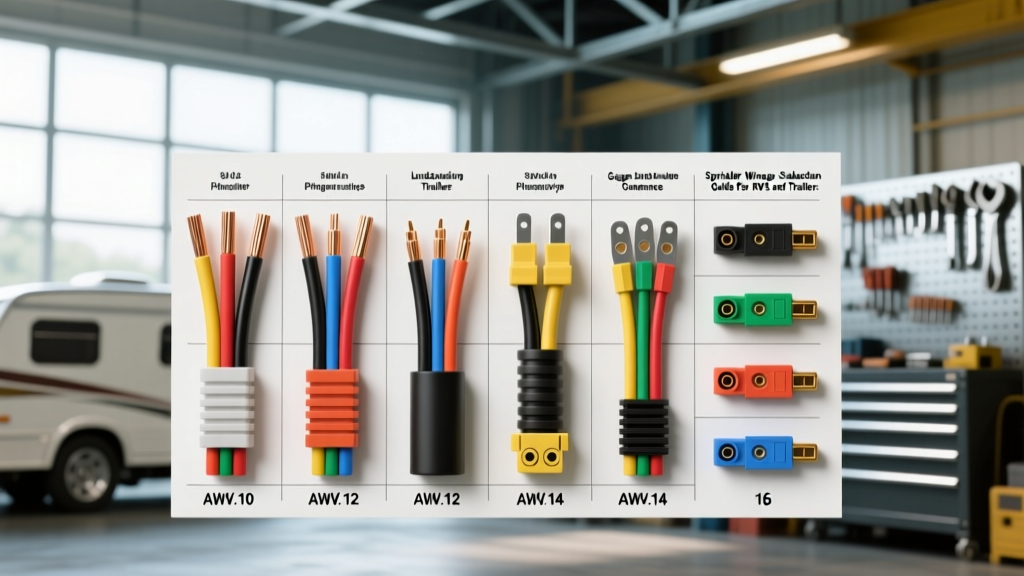
The Mobile Irrigation Paradigm: Why Standard Sprinkler Wire Fails on the Road
When outfitting a landscaping trailer with a water tank and 12V DC diaphragm pump, or rigging an overland RV with an exterior wash-down and sprinkler system, selecting the correct sprinkler wire gauge is critical. Most hardware stores sell standard underground irrigation wire—typically 18 AWG solid copper with a PVC jacket. While this wire is perfectly suited for 24V AC residential solenoid valves buried in the dirt, it is a catastrophic choice for mobile, 12V DC automotive applications.
Mobile sprinkler systems and trailer-mounted water pumps operate in high-vibration, high-temperature environments. A standard 18 AWG solid core wire will quickly suffer from metal fatigue and snap due to chassis vibration. Furthermore, 12V DC diaphragm pumps (such as the popular Shurflo 8000 series) draw between 10 and 15 amps under load. Pushing 15 amps through 18 AWG wire results in severe voltage drop, causing the pump motor to overheat, cycle erratically, or fail to start entirely. To build a reliable mobile irrigation or RV wash-down system, you must transition from landscaping wire to automotive-grade cross-linked wire.
Standard Irrigation Wire vs. SAE J1128 Automotive Wire
The Society of Automotive Engineers (SAE) sets the benchmark for mobile electrical systems under the SAE J1128 standard. For trailer and RV sprinkler pump wiring, you should exclusively use GXL, TXL, or SXL stranded copper wire. These wires feature cross-linked polyethylene (XLPE) insulation, which is highly resistant to abrasion, chemicals, and extreme heat.
| Specification | Standard 18 AWG Irrigation Wire | 14 AWG GXL Automotive Wire | 12 AWG SXL Automotive Wire |
|---|---|---|---|
| Conductor Type | Solid Copper (7 strands max) | Stranded Copper (19 strands) | Stranded Copper (19 strands) |
| Jacket Material | UF-B PVC / Polyethylene | Cross-Linked Polyethylene (XLPE) | Cross-Linked Polyethylene (XLPE) |
| Max Temperature | 140°F (60°C) | 257°F (125°C) | 257°F (125°C) |
| Jacket Thickness | 0.030 in. (Bulk insulation) | 0.010 in. (Thin wall) | 0.015 in. (Standard wall) |
| Vibration Resistance | Poor (Snaps under flex) | Excellent | Excellent |
| Max Ampacity (12V DC) | ~3 Amps (Short runs) | 15 Amps (Continuous) | 20 Amps (Continuous) |
For most trailer-mounted sprinkler pumps drawing 10-12 amps, 14 AWG GXL is the optimal choice. It offers the necessary ampacity while maintaining a thin outer diameter, making it easy to route through trailer A-frames and RV underbellies. If your pump is rated for 15 amps or higher, or if the wire run exceeds 15 feet, step up to 12 AWG SXL to mitigate voltage drop.
Calculating Voltage Drop for 12V DC Sprinkler Pumps
In a 12V DC system, voltage drop is the enemy of electric motors. According to RV Travel's 12V DC electrical standards, a voltage drop exceeding 3% (0.36V) can severely impact the performance of inductive loads like water pumps. The formula for calculating voltage drop is:
Voltage Drop = (2 x Length x Current x Resistance per 1000ft) / 1000
Below is a reference chart for selecting your sprinkler wire gauge based on the one-way distance from the power source (battery or 7-way connector) to the pump, assuming a 12-amp continuous draw.
| One-Way Wire Length | 16 AWG GXL (Voltage Drop) | 14 AWG GXL (Voltage Drop) | 12 AWG SXL (Voltage Drop) | 10 AWG SXL (Voltage Drop) |
|---|---|---|---|---|
| 5 Feet | 0.48V (4.0%) - Fail | 0.30V (2.5%) - Pass | 0.19V (1.6%) - Pass | 0.12V (1.0%) - Pass |
| 10 Feet | 0.96V (8.0%) - Fail | 0.60V (5.0%) - Marginal | 0.38V (3.1%) - Pass | 0.24V (2.0%) - Pass |
| 15 Feet | 1.44V (12%) - Fail | 0.90V (7.5%) - Fail | 0.57V (4.7%) - Marginal | 0.36V (3.0%) - Pass |
| 20 Feet | 1.92V (16%) - Fail | 1.20V (10%) - Fail | 0.76V (6.3%) - Fail | 0.48V (4.0%) - Marginal |
Expert Recommendation: For a standard landscaping trailer where the battery box is 10 feet from the rear-mounted water tank, use 14 AWG GXL. For a large RV where the pump is located in a rear storage bay and the auxiliary power feed originates near the front 7-way connector (20+ feet), you must use 10 AWG SXL for the main feed, stepping down to 14 AWG only for the final connection at the relay.
Integrating with the 7-Way RV Connector and Relay Pinouts
Many landscaping trailers and RVs rely on the tow vehicle's electrical system to power auxiliary water pumps. The standard 7-way RV blade connector provides a dedicated 12V auxiliary pin. As detailed in etrailer's 7-way wiring guide, Pin 4 (the center pin) supplies 12V+ from the tow vehicle's auxiliary circuit, while Pin 1 (the 7 o'clock position) serves as the chassis ground.
Because the 7-way auxiliary circuit is typically protected by a 30A or 40A breaker in the tow vehicle, you must install a localized relay and fuse near the trailer's water pump to protect your sprinkler wire gauge from a dead short.
Standard Bosch-Style 30A Relay Wiring Diagram
Use a weather-sealed 30A automotive relay (e.g., Bosch-style 5-pin, utilizing 4 pins). Wire the circuit as follows:
- Pin 30 (Common / Power In): Connect to the trailer battery positive OR the 7-Way Pin 4 feed. Must include an inline 15A ATC fuse within 18 inches of the power source. Use 12 AWG SXL wire.
- Pin 87 (Normally Open / Power Out): Connect to the positive terminal of the 12V sprinkler pump. Use 14 AWG GXL wire.
- Pin 86 (Coil Power): Connect to a low-amp toggle switch in the cab or trailer control box, which is fed by a 3A fused ignition source. Use 18 AWG GXL wire.
- Pin 85 (Coil Ground): Connect to the trailer chassis ground using a ring terminal and self-tapping star washer. Use 18 AWG GXL wire.
By using a relay, the heavy current (12A) only travels through the thick 12 AWG and 14 AWG wires, while the switch inside the vehicle or on the trailer tongue only handles the minimal current (<1A) required to energize the relay coil.
Termination, Environmental Sealing, and Troubleshooting
Mobile sprinkler systems are exposed to water, mud, and road salt. Standard twist-on wire nuts or vinyl electrical tape will fail within weeks. All terminations must be made using adhesive-lined heat shrink butt connectors (such as 3M Highland) or Deutsch DT series connectors for removable pump connections.
Symptom-Cause-Fix Troubleshooting Matrix
| Symptom | Probable Cause | Diagnostic Fix |
|---|---|---|
| Pump clicks rapidly but won't spin | Severe voltage drop; relay chattering due to low coil voltage. | Check wire gauge. Replace 16/18 AWG runs with 14 AWG GXL. Clean chassis ground at Pin 85. |
| Pump runs slowly, draws high amps | Motor starving for voltage; wire insulation melting. | Measure voltage at pump terminals under load. If below 11.5V, upgrade main feed to 10 AWG SXL. |
| Pump works when cold, fails when hot | Thermal overload tripping due to undersized wire or poor ventilation. | Verify wire ampacity. Ensure GXL wire is routed away from exhaust or hot water lines. |
| Corrosion at pump spade terminals | Moisture ingress; lack of environmental sealing. | Replace spade terminals with Deutsch DT plugs or apply dielectric grease and marine-grade heat shrink. |
Final Selection Summary
When specifying the sprinkler wire gauge for any automotive, RV, or trailer-mounted irrigation system, abandon the mindset of residential landscaping. Treat the water pump as a critical automotive accessory. By selecting SAE J1128 compliant GXL or SXL stranded wire, calculating voltage drop based on the exact one-way run length, and isolating the high-amperage circuit with a properly fused relay, you ensure your mobile water system will operate reliably across thousands of miles of rough terrain.