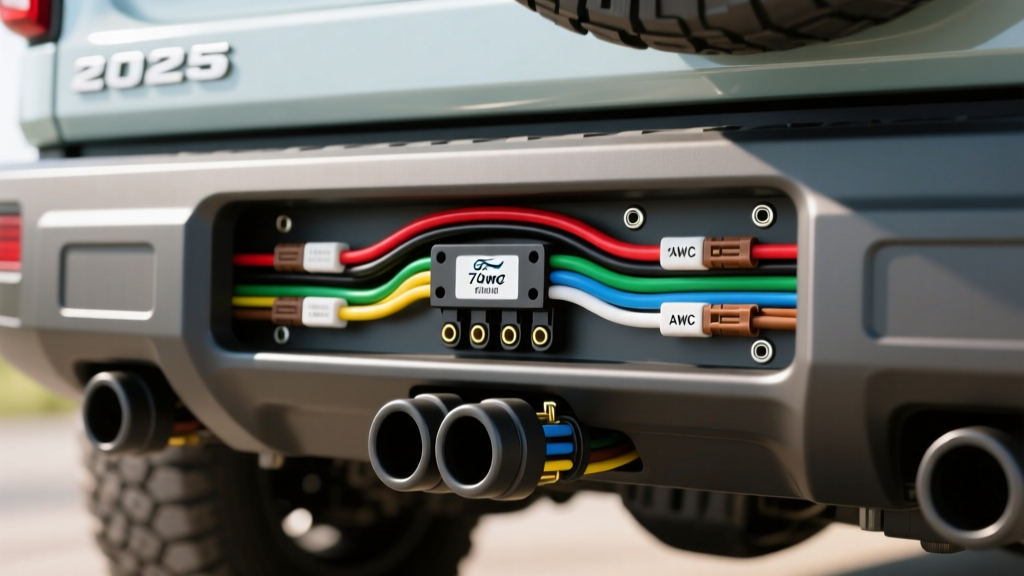
Project Overview: Upgrading the 2025 Bronco Tow Architecture
The 2025 Ford Bronco is an exceptional platform for overlanding and towing, but many base and mid-tier trims leave the factory with only a 4-pin flat connector. If you plan to tow a travel trailer, enclosed car hauler, or any rig equipped with electric brakes, upgrading your 2025 Ford Bronco trailer wiring harness to a fully integrated 7-pin RV blade is a mandatory modification. This upgrade project bridges the gap between the Bronco’s Body Control Module (BCM) and heavy-duty trailer requirements, ensuring safe braking, auxiliary charging, and reliable lighting.
Unlike older vehicles where you could simply splice into taillight wires, the 2025 Bronco utilizes a multiplexed CAN-bus system and low-current LED drivers. Direct splicing without a powered isolation module will trigger Diagnostic Trouble Codes (DTCs), cause hyper-flashing, or permanently damage the BCM. This guide details the proper methodology for installing a 7-way USCAR connector, integrating a proportional brake controller, and routing heavy-gauge wiring safely along the high-strength steel frame.
Required Tools and Materials
- USCAR 7-Way RV Blade Socket and Pigtail (Pre-wired with 10 AWG and 12 AWG leads)
- Powered Taillight Converter Module (e.g., Tekonsha 119190KIT or Curt 56384) if lacking factory tow package
- Proportional Brake Controller (e.g., Tekonsha Prodigy P3 or Redarc Tow-Pro Elite)
- 10 AWG Primary Wire (Red/Black for 12V Aux, Blue for Brakes, White for Ground)
- 30A Inline Circuit Breaker and 40A Maxi-Fuse
- Heat-Shrink Butt Connectors, Ring Terminals, and Star Washers
- Wire Loom, Zip Ties, and Dielectric Grease
- Digital Multimeter and Wire Stripper/Crimper
Understanding the 7-Way RV Blade Pinout (SAE J286)
Before routing any wires, it is critical to understand the SAE J286 Standard for 7-way trailer connectors. Miswiring this plug can send 12V power directly into your trailer’s brake magnets or ground out the Bronco’s BCM. Below is the definitive pinout and wire gauge specification for the 2025 Bronco 7-pin upgrade.
| Pin Position | Function | Wire Color | Min. AWG | Circuit Protection |
|---|---|---|---|---|
| 1 (Bottom Center) | Chassis Ground | White | 10 AWG | Direct to Chassis/Battery Neg |
| 2 (Top Left) | Tail / Running Lights | Green | 12 AWG | 15A Fuse (via BCM/Converter) |
| 3 (Top Right) | Left Turn / Stop | Red | 12 AWG | 15A Fuse (via BCM/Converter) |
| 4 (Center) | 12V Auxiliary Power | Black | 10 AWG | 30A Auto-Reset Breaker |
| 5 (Bottom Right) | Right Turn / Stop | Brown | 12 AWG | 15A Fuse (via BCM/Converter) |
| 6 (Bottom Left) | Electric Trailer Brakes | Blue | 10 AWG | 30A Fuse (at Brake Controller) |
| 7 (Top Center) | Reverse Lights / Aux | Yellow | 12 AWG | 15A Fuse (via Upfitter/Relay) |
Phase 1: Rear Harness Routing and BCM Protection
Locating the Factory USCAR Plug
If your 2025 Bronco is equipped with the factory Class II or Class III Tow Package, Ford has already routed a USCAR 7-way pigtail behind the rear bumper fascia on the driver’s side. You will need to remove the lower rear valance clips using a plastic trim removal tool to access this plug. Simply mate the aftermarket 7-way socket to the factory USCAR plug, secure it to the hitch crossmember using the provided bracket, and apply dielectric grease to the terminals to prevent galvanic corrosion.
Splicing with a Powered Converter (Non-Tow Package Models)
If your Bronco lacks the factory tow package, you must install a powered taillight converter. Do not tap directly into the Bronco’s taillight harness to power the trailer. The BCM monitors current draw on the lighting circuits; adding trailer incandescent bulbs will exceed the threshold, causing the BCM to shut down the circuit entirely.
- Signal Tapping: Use Posi-Taps or solder-and-shrink methods to connect the converter’s signal wires (Red, Green, Brown, Yellow) to the Bronco’s rear taillight circuits. These wires only tell the converter module when to activate.
- Power Routing: Run a dedicated 12 AWG red power wire from the converter module, routed along the driver-side frame rail, up to the engine bay. Connect it directly to the positive battery terminal via an inline 15A fuse.
- Grounding: The white ground wire from the converter must be terminated to bare metal on the chassis. Sand away the factory e-coating, use a star washer to bite into the steel, and torque securely. Measure resistance with a multimeter; it must read less than 0.5 ohms to the battery negative.
Phase 2: Electric Brake Controller Integration
Towing over 1,500 lbs requires electric trailer brakes, which necessitates running a 10 AWG blue wire from the rear 7-pin socket to the brake controller under the dash. According to the Ford Motor Company Towing Guide, the 2025 Bronco features pre-wired upfitter circuits and blunt-cut trailer brake pigtail wires under the driver’s side kick panel, provided the vehicle has the auxiliary tow prep package.
Dash Wiring and Pinout
Remove the lower driver-side kick panel and locate the taped-up blunt-cut wires. For most 2025 Bronco configurations, the color coding for the brake controller pigtail is as follows:
- Red/Black: 12V Battery Feed (Connect to Brake Controller Black wire via 30A fuse)
- White: Chassis Ground (Connect to Brake Controller White wire)
- Blue: Output to Trailer Brakes (Connect to Brake Controller Blue wire)
- Light Green w/ Red Stripe: Stoplamp Switch Signal (Connect to Brake Controller Red wire)
Use heat-shrink butt connectors to join the brake controller pigtail to your chosen proportional controller (such as the Tekonsha Prodigy P3). Mount the controller strictly in line with the direction of travel, as proportional controllers rely on internal inertia sensors to gauge braking force. Mounting it sideways or upside down will result in erratic trailer braking.
Phase 3: Auxiliary Power and Reverse Circuits
To activate Pin 4 (12V Aux) for charging a trailer breakaway battery or powering interior camper lights, run a 10 AWG black wire from the rear 7-pin socket to the engine bay. Install a 30A auto-reset circuit breaker within 18 inches of the battery positive terminal. Route the wire through the firewall using an existing rubber grommet behind the glovebox, ensuring you do not pinch the wire against the dash sub-frame.
For Pin 7 (Reverse/Aux), you can tap into the Bronco’s reverse light circuit at the rear harness, but it is highly recommended to use a relay triggered by the reverse light circuit to pull power directly from a rear auxiliary fuse block. This prevents voltage drop when engaging trailer reverse lockout solenoids on hydraulic surge brake systems.
Validation, Load Testing, and Troubleshooting
Before connecting a trailer, validate the 2025 Ford Bronco trailer wiring harness with a digital multimeter and a 7-pin circuit tester. Check for a solid 12.6V at the Black (Aux) and Green (Tail) pins with the vehicle running. Activate the manual override on your brake controller and verify 12V at the Blue pin.
Common Failure Modes and Fixes
- Symptom: Trailer brakes lock up when headlights are turned on.
Cause: Poor ground at the 7-pin socket or trailer tongue. The brake circuit is seeking a ground path through the taillight circuit.
Fix: Clean the chassis ground point and upgrade the ground wire to 8 AWG. - Symptom: Bronco dashboard displays 'Trailer Wiring Fault' message.
Cause: The BCM detects an abnormal current draw or short on the lighting circuits, often caused by moisture ingress in the 7-pin plug or a failing trailer side-marker light.
Fix: Inspect the 7-pin socket for corrosion, apply dielectric grease, and check trailer wiring for pinched insulation. - Symptom: Brake controller displays 'S.H.' (Short Circuit) or fails to power on.
Cause: The blue brake wire is pinched against the frame rail, or the 30A fuse at the battery is blown.
Fix: Trace the blue wire along the frame, replace damaged sections with adhesive-lined heat shrink, and verify fuse continuity.
By following this comprehensive upgrade protocol, your 2025 Bronco will be safely integrated with heavy-duty towing infrastructure, preserving the integrity of the factory CAN-bus while delivering reliable power and braking to your trailer.