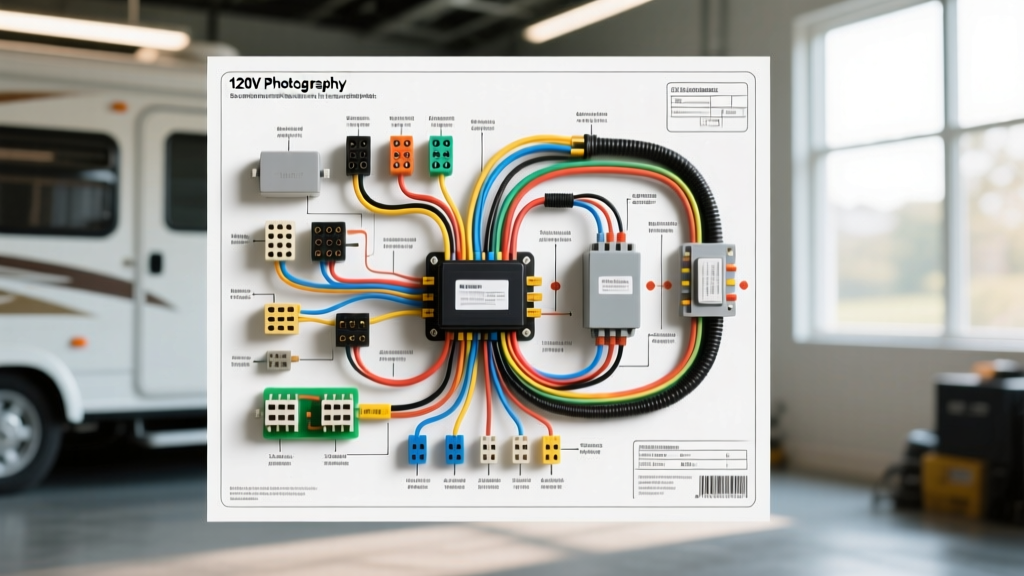
Integrating High-Draw Appliances in Motorhomes and Overland Rigs
Adding a compact dishwasher to a Class A motorhome, luxury fifth-wheel, or custom overland expedition vehicle elevates the off-grid experience, but it introduces severe transient loads to your house electrical system. When referencing a wiring diagram dishwasher layout for 120V AC RV integration, the primary challenge is managing the resistive heating element load. Standard compact dishwashers (such as the Fisher & Paykel Drawer or Vesta 18-inch models) utilize a 120V AC heating element that pulls 10 to 12 amps continuously during the dry cycle. If your inverter and branch circuits are not sized correctly, you will experience voltage sag, inverter fault codes, or melted terminal connections.
This guide provides a comprehensive, expert-level installation strategy for wiring a 120V dishwasher into an RV or expedition vehicle, focusing on pure sine wave inverter integration, GFCI protection, and a critical 12V DC water pump interlock to prevent catastrophic dry-firing.
System Architecture & Load Calculation
Before pulling wire, we must calculate the DC-side current draw to size the inverter feed cables properly. A 12A load at 120V AC equals 1,440W. Factoring in inverter efficiency losses (typically 85-90%), the DC draw from your battery bank will be approximately 135A to 145A during the heating cycle.
Inverter Sizing and DC Feed Specifications
To handle the 1,440W continuous load alongside concurrent appliances (like a microwave or coffee maker), a minimum 3000W Pure Sine Wave Inverter/Charger is mandatory. Modified sine wave inverters will cause the dishwasher's internal control board to overheat and fail prematurely due to harmonic distortion.
- Inverter DC Feed: 2/0 AWG stranded copper battery cable (SAE J1127 compliant).
- Overcurrent Protection: 250A ANL fuse on the positive battery feed, mounted within 18 inches of the battery bank positive terminal.
- Grounding: 2/0 AWG chassis ground bonded to a cleaned, bare-metal frame rail using a 3/8-inch ring terminal and star washer.
The 120V AC Branch Circuit Wiring Diagram
The branch circuit running from your RV's AC distribution panel to the dishwasher must be treated as a high-load continuous circuit. According to NFPA 1192 (Standard on Recreational Vehicles), branch circuits supplying heating elements must be rated for 125% of the continuous load.
Branch Circuit Specifications & Color Codes
| Parameter | Specification | Notes / Standards |
|---|---|---|
| Wire Gauge | 12 AWG THHN Stranded | Stranded is mandatory for vehicle vibration resistance. |
| Hot Wire (Line) | Black | Connects to 20A GFCI Breaker Line terminal. |
| Neutral Wire | White | Connects to GFCI Load Neutral terminal. |
| Ground Wire | Green or Bare | Bonded to dishwasher chassis and RV ground bus bar. |
| Breaker Rating | 20A GFCI | Must be rated for 120V AC / 60Hz. |
| Terminal Torque | 1.2 Nm (10.6 in-lbs) | Verify with breaker manufacturer spec to prevent arcing. |
Conduit and Routing
Never run 120V AC branch circuits parallel to 12V DC data lines (like CAN bus or RS485 inverter communication cables) to prevent electromagnetic interference (EMI). Route the 12 AWG THHN through flexible liquid-tight non-metallic conduit (LFNC-B), securing it every 18 inches with UV-resistant cable ties to prevent chassis chafing during highway transit.
GFCI Protection & Neutral Bonding Rules
Because RVs and overland rigs operate in wet environments, GFCI (Ground Fault Circuit Interrupter) protection is non-negotiable for kitchen appliances. However, integrating a GFCI breaker on an inverter-fed circuit is a common failure point for DIY installers due to improper neutral-ground bonding.
Most modern RV inverter/chargers (such as the Victron MultiPlus-II) feature an internal transfer switch and a configurable neutral-to-ground relay. If your inverter is configured with a "bonded neutral" (where neutral and ground are tied together inside the inverter), and you also have a neutral-ground bond at your AC distribution panel, the GFCI breaker will detect a parallel neutral path and trip immediately upon startup.
The Fix: Ensure your AC distribution panel operates with a "floating neutral" when fed by the inverter. The neutral-to-ground bond should only occur at the inverter's internal relay or the shore-power inlet, never at the sub-panel. The dishwasher's green ground wire must connect to the RV's main ground bus bar, while the white neutral wire must remain isolated all the way back to the GFCI breaker's load terminal.
Water Pump Interlock: Preventing Dry-Fires
In a residential home, water pressure is guaranteed by the municipal grid. In a vehicle, water is supplied by a 12V DC demand pump. If the fresh water tank runs dry, or the pump's inline strainer clogs, the dishwasher will attempt to fill, cavitate the internal circulation pump, and eventually burn out its heating element. To prevent this, we wire a 12V DC interlock relay that disables the dishwasher's AC contactor unless the RV water pump is actively pressurized.
12V DC Interlock Relay Pinout
Use a high-quality, sealed Bosch-style 5-pin 12V automotive relay (minimum 40A rating) housed in a weatherproof fuse box near the dishwasher.
| Relay Pin | Function | Connection Target |
|---|---|---|
| 86 (Coil +) | Trigger Signal | 12V DC water pump positive feed (activates when pump runs). |
| 85 (Coil -) | Coil Ground | 12V DC chassis ground bus. |
| 30 (Common) | AC Line In | 120V AC Hot (Black) from GFCI Breaker Load terminal. |
| 87 (NO) | AC Line Out | 120V AC Hot (Black) to Dishwasher Terminal Block. |
| 87a (NC) | Not Used | Cap and insulate (Normally Closed contact). |
Expert Note: Relay contacts designed for 12V DC can suffer from severe arcing when switching 120V AC inductive/reactive loads. Ensure the relay you select is explicitly rated for 120V AC / 20A on pins 30 and 87, or use the 12V relay to trigger a secondary 120V AC solid-state contactor.
Step-by-Step Installation Procedure
- Mount the GFCI Breaker: Install the 20A GFCI breaker into the RV's AC distribution panel. Ensure the panel is de-energized and shore power is disconnected.
- Pull the Branch Circuit: Route the 12 AWG stranded THHN (Black, White, Green) through liquid-tight conduit from the distribution panel to the dishwasher cavity.
- Wire the Interlock Relay: Splice into the 12V DC water pump positive wire using a marine-grade heat-shrink butt connector (not a T-tap, which causes corrosion). Connect this to Pin 86 of the interlock relay.
- Terminate AC Connections: Strip 1/2 inch of insulation from the 12 AWG wires. Crimp on insulated ferrule or ring terminals using a ratcheting crimp tool (e.g., IWISS or Admiral). Torque the GFCI and dishwasher terminal block screws to 1.2 Nm.
- Grounding: Bond the dishwasher chassis ground lug to the RV's main copper ground bus bar using 10 AWG green wire and a star washer to bite through any powder coating or paint.
- System Test: Re-energize the inverter. Turn on a faucet to trigger the 12V water pump. Verify the interlock relay clicks, allowing 120V AC to reach the dishwasher. Initiate a rapid test cycle and measure voltage at the dishwasher terminal block with a True-RMS multimeter; it should read between 115V and 120V under load.
Troubleshooting Common Inverter Faults
Symptom: Inverter Overload Alarm During Dry Cycle
Cause: The dishwasher's heating element (1440W) is running simultaneously with another high-draw appliance (e.g., 1000W coffee maker), exceeding the inverter's continuous wattage limit.
Fix: Install a smart load-shedding relay or program your inverter's auxiliary relay to disable secondary AC circuits when the total AC load exceeds 2500W.
Symptom: GFCI Breaker Trips Immediately Upon Dishwasher Fill
Cause: The dishwasher's internal EMI suppression capacitor is leaking a harmless but measurable amount of current to the chassis ground, which the highly sensitive RV GFCI interprets as a ground fault. Alternatively, a duplicated neutral-ground bond exists in the AC panel.
Fix: Verify the inverter's neutral-ground relay settings via the manufacturer's software (e.g., VictronConnect). Ensure the AC sub-panel neutral bus bar is completely isolated from the ground bus bar. If the issue persists, replace the standard GFCI with an RV-specific GFCI breaker designed to tolerate minor appliance EMI leakage.
Symptom: Dishwasher Fails to Start, No Power at Terminal Block
Cause: The 12V DC water pump interlock relay is not triggering because the RV's fresh water tank is empty, or the 12V inline fuse on Pin 86 has blown due to a voltage spike from the pump motor's inductive kickback.
Fix: Install a flyback diode (e.g., 1N4007) across the water pump motor terminals, or a snubber diode across the relay coil (Pins 85 and 86, cathode to 86) to absorb the inductive voltage spike and protect the relay coil.
Conclusion
Integrating a residential-style appliance into a mobile platform requires strict adherence to SAE wiring standards and an understanding of how AC and DC systems interact in a vibrating, temperature-fluctuating environment. By correctly sizing your 12 AWG branch circuits, managing your inverter's neutral bond, and implementing a 12V water pump interlock, your RV dishwasher will operate safely and reliably, whether you are hooked up to shore power or boondocking deep in the backcountry.