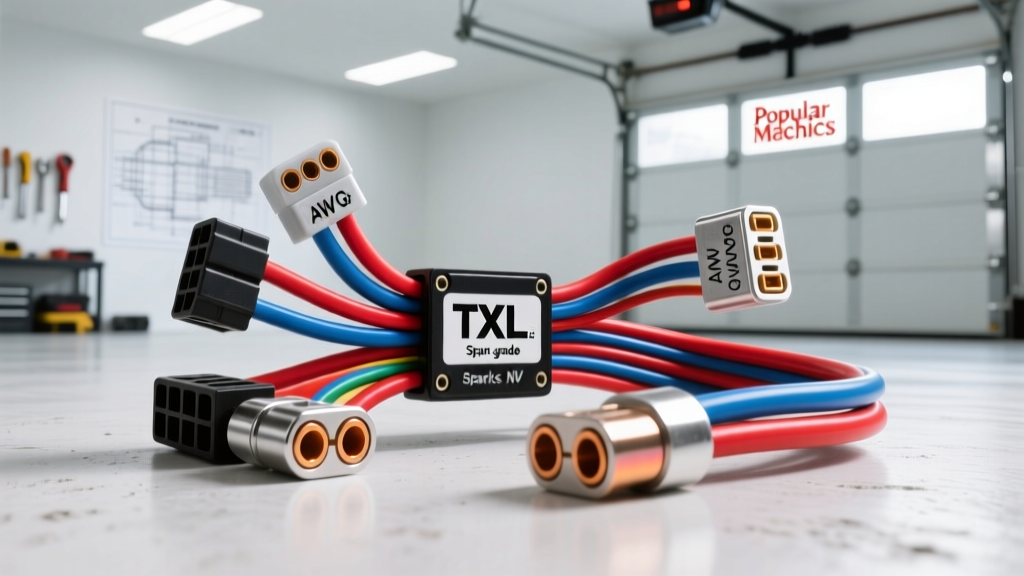
The Unique Demands of Northern Nevada Automotive Wiring
Building or restoring a vehicle in the Reno-Sparks basin presents a unique set of environmental challenges that standard automotive electrical systems are rarely designed to withstand. When selecting an automotive wiring harness Sparks NV enthusiasts and fabricators must account for extreme summer ambient temperatures exceeding 105°F, under-hood heat spikes from tightly packed engine bays, and the highly abrasive, alkaline silica dust native to the high desert. Whether you are executing a classic C10 LS swap, wiring a desert racing prerunner, or restoring a vintage Bronco, the selection of your wiring harness kit dictates the long-term reliability of your build.
Standard off-the-shelf harnesses often utilize cheap Polyvinyl Chloride (PVC) insulation and unsealed spade terminals. In the dry, high-vibration environment of Northern Nevada, PVC becomes brittle, cracks under thermal cycling, and allows fine dust to infiltrate connections, leading to micro-fretting and high-resistance voltage drops. This product comparison and selection guide breaks down the exact wire chemistries, connector ecosystems, and protective sheathing required for vehicles operating in the Sparks, NV climate.
Wire Insulation Comparison: TXL vs. GXL vs. SXL
The foundation of any premium aftermarket wiring harness is the primary cable insulation. According to the SAE J1128 Standard for Low Tension Primary Cable, cross-linked polyethylene (XLPE) is the mandatory standard for high-temperature automotive applications. Unlike PVC, which melts and degrades at approximately 105°C (221°F), XLPE undergoes a chemical cross-linking process that creates a three-dimensional molecular bond, allowing it to withstand continuous temperatures up to 150°C (302°F) without melting or flowing.
When sourcing an automotive wiring harness in Sparks NV, you will encounter three primary SAE J1128 wire types. Selecting the correct profile depends on your routing constraints and heat exposure.
| Wire Type | Insulation Material | Wall Thickness (Nominal) | Max Continuous Temp | Best Application in NV Builds |
|---|---|---|---|---|
| TXL | Cross-Linked (XLPE) | 0.58 mm (0.023 in) | 125°C (257°F) | Tight harness wraps, ECU pigtails, and modern dash integrations where space is limited. |
| GXL | Cross-Linked (XLPE) | 0.79 mm (0.031 in) | 125°C (257°F) | General chassis wiring, headlight circuits, and standard OEM replacement harnesses. |
| SXL | Cross-Linked (XLPE) | 1.02 mm (0.040 in) | 125°C - 150°C | High-vibration off-road rigs, heavy-duty alternator feeds, and high-heat exhaust proximity routing. |
| PVC (Standard) | Polyvinyl Chloride | 0.80 mm - 1.20 mm | 105°C (221°F) | Avoid for under-hood use. Acceptable only for interior, climate-controlled cabin wiring. |
For most engine swaps performed in the Sparks area, a GXL or TXL wiring harness kit is the optimal choice. TXL allows fabricators to bundle large 24-pin ECU connectors and 8-pin injector harnesses into tight looms without creating excessive bulk, while still providing superior abrasion resistance against aluminum intake manifolds and cylinder heads.
Connector Selection for High-Dust Desert Environments
The alkaline dust found in the Sparks and Fernley basins is notoriously fine. When this dust infiltrates an electrical connection and mixes with morning condensation or winter road brine, it creates a highly conductive, corrosive sludge that rapidly destroys brass and copper terminals. Selecting the right sealed connector ecosystem is non-negotiable for under-hood and undercarriage harnesses.
Aptiv (Delphi) Metri-Pack 2.8 Series
The Metri-Pack 2.8 is the gold standard for high-current engine management circuits, including fuel injectors, ignition coils, and electronic throttle bodies. Featuring a 2.8mm blade width, these terminals handle up to 30 amps continuously. The critical advantage of the Metri-Pack in dusty environments is its double-locking mechanism and deep silicone radial lip seals. When crimped properly using an open-barrel F-crimp tool, the terminal achieves a minimum pull-out force of 35 lbs, ensuring that high-vibration desert washboard roads will not back the pin out of the housing.
Weather-Pack vs. Deutsch DT
For auxiliary lighting, winch solenoids, and exterior sensors, fabricators often debate between Weather-Pack and Deutsch DT connectors. Weather-Pack connectors are excellent for lighting circuits (up to 20A) and feature a robust silicone tower seal. However, for extreme off-road applications common in the nearby Virginia Range or Black Rock Desert, Deutsch DT connectors are superior. The DT series utilizes a solid thermoplastic housing with a rear grommet that seals the entire wire bundle, preventing capillary wicking of dust and moisture into the harness core.
AWG Sizing and Voltage Drop for Extended Harnesses
A common mistake in custom truck builds—particularly extended cab and long-bed pickups popular in Nevada—is undersizing the wire gauge for long runs. A 14 AWG wire might be perfectly adequate for a 4-foot run to a headlight, but a 15-foot run from the firewall to a rear-mounted auxiliary fuel pump or trailer brake controller will suffer from severe voltage drop, leading to component failure and melted insulation.
When designing or modifying your automotive wiring harness in Sparks NV, use the following voltage drop chart based on a 12.6V source and a 10-foot total circuit length (5 feet positive, 5 feet negative).
| AWG Size | Max Ampacity (Chassis) | Resistance per 1,000 ft | Voltage Drop @ 10A (10ft run) | Recommended Circuit Application |
|---|---|---|---|---|
| 10 AWG | 30 Amps | 0.9989 Ω | 0.20V | Main ECU power feeds, high-amperage fuel pumps, radiator fan relays. |
| 12 AWG | 20 Amps | 1.588 Ω | 0.32V | Headlight high/low beams, power windows, HVAC blower motors. |
| 14 AWG | 15 Amps | 2.525 Ω | 0.50V | Tail lights, horn relays, 12V accessory sockets. |
| 16 AWG | 10 Amps | 4.016 Ω | 0.80V | Instrument cluster illumination, ECU sensor grounds, radio memory. |
| 18 AWG | 7 Amps | 6.385 Ω | 1.27V | Low-current ECU signal wires (O2 sensors, MAP, TPS), LED indicators. |
Expert Tip: For any circuit where a voltage drop exceeding 0.5V will cause operational issues (such as EFI injector pulse width or sensitive 5V reference sensors), always step up one AWG size for runs exceeding 8 feet.
Crimp vs. Solder in High-Vibration Off-Road Builds
A persistent myth in automotive wiring is that soldering connections is superior to crimping. In the context of off-road vehicles and heavy-duty trucks subjected to the harmonic vibrations of large-displacement V8 engines, soldering is a liability. Solder creates a rigid, brittle joint. Where the stiff soldered wire meets the flexible stranded wire, a stress concentration point is formed. Under constant vibration, the wire will fatigue and snap precisely at the edge of the solder joint.
Professional harness fabricators, including industry leaders like Painless Performance Products, exclusively use precision ratcheting crimpers for open-barrel terminals. A properly executed F-crimp deforms the terminal wings around the wire strands, creating a cold-weld that maintains the wire's flexibility and tensile strength. Always use a ratcheting crimper calibrated for the specific AWG and terminal type; a cheap pair of pliers will result in under-crimped pins that arc and melt under load.
Protective Sheathing: Defeating Under-Hood Heat and Silica Dust
The final layer of defense for your harness is the outer sheathing. Standard corrugated split-loom tubing is cheap and easy to install, but it traps heat, degrades under UV exposure, and its longitudinal slit allows fine Nevada dust to enter and abrade the wire insulation over time.
- Expandable Braided Sleeving (PET): Excellent for interior harnesses and tight engine bays. It is flexible, abrasion-resistant, and allows heat to dissipate. However, it is not dust-proof and should be wrapped with high-temp vinyl tape at termination points.
- Adhesive-Lined Heat Shrink (Dual Wall): Mandatory for all under-hood splices and connector backshells. The inner layer of hot-melt adhesive seals out moisture and alkaline dust, preventing galvanic corrosion.
- Silicone-Coated Fiberglass Sleeving: Required for any wire routed within 4 inches of LS-swap exhaust manifolds or turbocharger downpipes. Rated for continuous 480°F (250°C) and intermittent 600°F, this sleeving prevents the insulation from melting onto hot exhaust components.
- T304 Stainless Steel Braided Loom: The ultimate protection for desert racing harnesses routed along the chassis floor. It provides total protection against rock strikes, abrasive sand, and extreme heat, though it requires careful edge-trimming to prevent the stainless strands from fraying and shorting against the chassis.
Sourcing and Fabrication: Local vs. Pre-Built Kits
When planning an engine swap or full rewire in the Sparks area, you must decide between a universal pre-built kit and a custom-fabricated harness. Universal kits (like those from Painless or American Autowire) are cost-effective and come with pre-terminated bulkhead connectors and labeled circuits. However, they often use generic wire lengths that require excessive coiling and zip-tying, which can look messy and trap debris.
For high-end restomods, custom LS/LT swaps, or dedicated off-road racers, commissioning a custom-fabricated harness utilizing TXL wire, Raychem DR-25 heat shrink, and sealed Deutsch/Metri-Pack connectors is the superior route. A custom harness is measured exactly to your specific engine bay layout, eliminating slack, reducing weight, and ensuring that no wires are stretched taut across sharp brackets or resting against high-heat exhaust components.
Final Troubleshooting Matrix for Desert Climate Wiring
If you are diagnosing an existing harness in a vehicle that has spent its life in the Northern Nevada desert, use this symptom-cause-fix matrix to identify common failure points:
| Symptom | Probable Cause in High Desert | Diagnostic Fix |
|---|---|---|
| Intermittent misfire under load | Dust intrusion in coil pack connector causing micro-arcing. | Inspect Metri-Pack 2.8 seals; apply dielectric grease and verify terminal drag. |
| Dim headlights at idle | Undersized ground wire or corroded chassis ground point. | Upgrade headlight grounds to 10 AWG; sand chassis to bare metal and seal. |
| ECU throws O2 sensor codes | Wire insulation melted on exhaust, causing short to chassis. | Check sensor harness routing; install silicone fiberglass sleeving and re-pin. |
| Starter clicks but won't crank | Voltage drop across undersized 12AWG starter solenoid wire. | Test voltage at solenoid during crank; upgrade to 8 AWG if drop exceeds 2V. |
By prioritizing cross-linked wire chemistries, sealed connector ecosystems, and proper AWG sizing, you can build an automotive wiring harness that will reliably withstand the extreme heat, abrasive dust, and high-vibration demands of the Sparks, NV environment for decades to come.