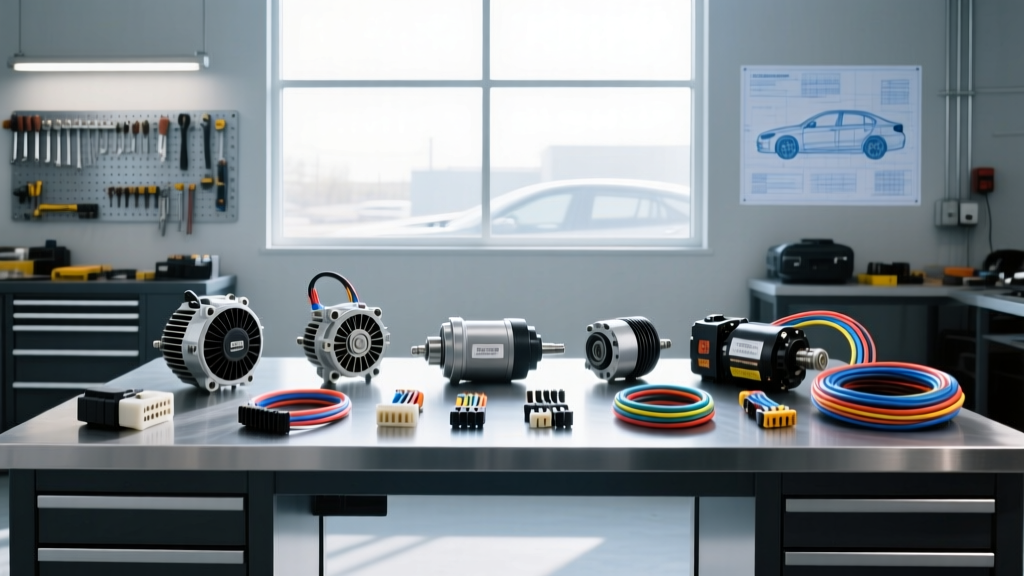
Introduction: Sourcing Auto Electric Components in the Midwest
When fleet managers, off-road enthusiasts, and daily drivers search for an auto electric Fort Wayne specialist or parts supplier, they are usually battling a specific set of environmental challenges. The Midwestern climate is notoriously brutal on vehicle electrical architectures. Sub-zero winter temperatures drastically reduce battery chemical efficiency, demanding higher Cold Cranking Amps (CCA), while the heavy application of magnesium chloride and road salt accelerates galvanic corrosion on PCM grounds and alternator B+ terminals. Furthermore, Fort Wayne’s deep ties to heavy-duty truck manufacturing and GM assembly mean local buyers often require high-amperage upgrades for plows, winches, and auxiliary lighting.
This product comparison and selection guide evaluates Original Equipment Manufacturer (OEM) versus heavy-duty aftermarket auto electric components. We will break down alternator stator outputs, battery cable AWG requirements, and wiring insulation standards to ensure your electrical system survives the harshest conditions.
Alternator Selection: OEM CS144 vs. High-Output AD244
The General Motors CS144 (Charging System, 144mm stator diameter) has been a staple in Midwest trucks and SUVs for decades. While reliable, its standard 130A to 140A output often falls short when running modern auxiliary loads like LED light bars, heated seats, and aftermarket air compressors. Upgrading to an AD244 (Alternator Delco, 244mm case diameter) or a high-amp aftermarket equivalent is a common solution sourced from top-tier auto electric suppliers.
Output Comparison & Thermal Management
| Specification | OEM Delco CS144 | Aftermarket AD244HD (High-Amp) |
|---|---|---|
| Rated Output | 130A - 140A @ 6,000 RPM | 200A - 250A @ 4,500 RPM |
| Idle Output (1,800 RPM) | ~75A | ~150A+ |
| Stator Wire Gauge | Standard Copper | Heavy-Gauge High-Temp Copper |
| Diode Bridge Rating | 25A per diode | 50A+ per diode (Hairpin design) |
| Regulator Type | Internal, Linear | Internal, PWM / Smart-Sense |
According to testing data outlined by Mad Electrical Alternator Tech, the AD244 platform utilizes a hairpin stator design that significantly improves heat dissipation and low-RPM amperage output. For a Fort Wayne plow truck that idles for hours at 2,000 RPM in freezing weather, the AD244's ability to push 150A+ at idle prevents the battery from slowly draining while powering hydraulic solenoids and cab heaters.
Understanding the GM 4-Pin Regulator Connector
When retrofitting or diagnosing these alternators, understanding the 4-pin connector pigtail is critical. Incorrect pinning will result in a no-charge condition or a fried PCM.
- Pin A (L - Lamp/Exciter): Typically Brown/White wire. Provides the initial 12V excitation to the rotor via a dashboard indicator bulb or a 10-ohm resistor. Switched ignition power.
- Pin B (F - Field): Typically Gray wire. Used on 1996+ OBD-II vehicles. The PCM uses this PWM (Pulse Width Modulated) signal to monitor alternator field duty cycle and adjust engine idle speed to compensate for electrical load.
- Pin C (P - Phase): Typically Purple wire. Taps into the stator phase to provide an AC voltage signal for the tachometer or to signal the PCM that the alternator is spinning.
- Pin D (S - Sense): Typically Red wire. Must be routed directly to the positive battery terminal or main distribution block. If this wire senses voltage drop, the regulator ramps up output. Never jumper this to the B+ terminal on the back of the alternator, or voltage drop in the chassis wiring will cause system overvoltage.
Wiring & Cable Standards: Surviving the Salt and Freeze
A major point of failure in Midwest vehicles is the degradation of primary wire insulation. Standard PVC (Polyvinyl Chloride) wire becomes brittle in sub-zero temperatures and melts when routed too close to exhaust manifolds. When sourcing wiring from an auto electric Fort Wayne distributor, always specify SAE J1128 compliant cross-linked polyethylene (XLPE) wire.
SAE J1128 Wire Insulation Comparison
| Wire Type | Insulation Material | Max Temp Rating | Wall Thickness | Best Application |
|---|---|---|---|---|
| GPT | PVC | 105°C (221°F) | Thick | Interior cabin, protected harnesses |
| GXL | Cross-Linked (XLPE) | 125°C (257°F) | Thin | Under-hood general purpose, tight bends |
| TXL | Cross-Linked (XLPE) | 125°C (257°F) | Extra Thin | High-density multi-pin connectors |
| HDT | PVC | 105°C (221°F) | Heavy/Thick | Heavy-duty battery cables, abrasion resistance |
For under-hood harness repairs, GXL is the gold standard. Its thin wall allows for easier routing through tight firewall grommets, and its cross-linked molecular structure prevents melting if it briefly contacts a 160°C exhaust heat shield. Furthermore, when terminating these wires, avoid cheap stamped brass ring terminals. Always use MIL-SPEC tinned copper lugs crimped with a hex-die crimper to ensure a gas-tight seal that prevents moisture and salt intrusion.
Starter Circuits & Voltage Drop Tolerances
Cold weather increases engine oil viscosity, exponentially raising the mechanical resistance the starter motor must overcome. A starter that draws 180 Amps in 70°F weather can easily pull 350+ Amps at -10°F. If your battery cables are undersized, the voltage at the starter solenoid will drop below the 9.6V threshold required to engage the Bendix drive, resulting in a rapid clicking sound and a no-crank condition.
Performing a Cranking Voltage Drop Test
Before replacing a starter, a competent auto electric technician will perform a voltage drop test under load. Using a digital multimeter (DMM), follow these strict thresholds:
- Positive Side Test: Place the red DMM lead on the battery positive post and the black lead on the starter B+ terminal. Crank the engine. The maximum allowable voltage drop is 0.20V. If you read 0.45V, you have high resistance in the positive cable, battery clamp, or intermediate fuse block.
- Negative Side Test: Place the red DMM lead on the starter casing (bare metal) and the black lead on the battery negative post. Crank the engine. The maximum allowable drop is 0.10V. Higher readings indicate a corroded engine block ground strap or a compromised battery negative terminal.
For heavy-duty diesel trucks and plow rigs, upgrading from the OEM 4 AWG battery cables to 1/0 AWG (One-Aught) fine-strand tinned copper cable is highly recommended. This reduces resistance by over 60% compared to 4 AWG, ensuring maximum current delivery to the starter solenoid during extreme cold cranking.
Overcurrent Protection: Selecting the Right Fusing
When installing high-output alternators or auxiliary winch wiring, selecting the correct overcurrent protection is non-negotiable. According to Eaton Bussmann circuit protection guidelines, fuses must be rated based on the wire's ampacity, not just the load.
- ANL Fuses: Ideal for alternator B+ output lines and inverter feeds. They feature a silver-plated copper element that handles high inrush currents without nuisance blowing. A 200A AD244 alternator should be protected by a 250A ANL fuse, mounted within 18 inches of the battery positive terminal, using 2/0 AWG wire.
- MEGA / AMF Fuses: Commonly used on OEM starter motor feeds. They are more compact than ANLs but have a lower interrupting capacity. Ensure the mounting hardware is torqued to exactly 12 Nm (106 in-lbs) to prevent micro-arcing at the bolt interface.
- Circuit Breakers: Avoid standard thermal resettable circuit breakers for high-amperage starter circuits. In sub-zero Fort Wayne winters, the bi-metallic strip inside a thermal breaker can become overly sensitive or fail to reset properly when frozen. Always use high-amp fuses for critical engine-cranking circuits.
Conclusion: Prioritizing Quality Over Cost
Whether you are rebuilding a classic GM square-body or maintaining a fleet of modern heavy-duty pickups, the electrical system is the nervous system of the vehicle. By selecting SAE J1128 GXL wiring, upgrading to AD244 hairpin alternators, and utilizing 1/0 AWG tinned copper cabling, you ensure your vehicle will start and operate reliably regardless of the Midwest weather. Always demand these specifications when consulting with your local auto electric supplier to guarantee long-term durability and performance.