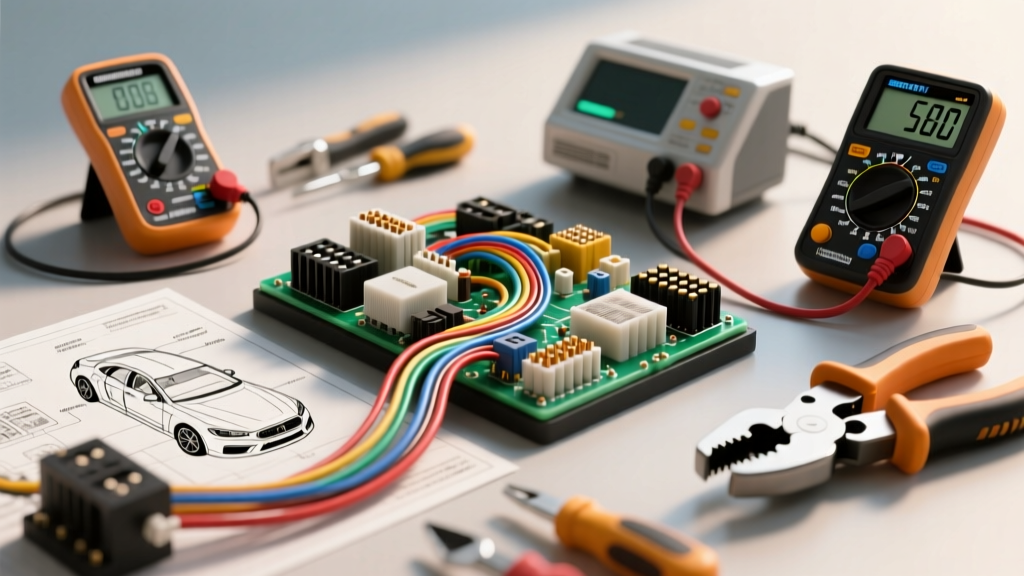
The True Cost of Automotive Electrical Diagnostics
When building a professional or advanced DIY garage, investing in high-quality car electrical tools is often the dividing line between a swift, accurate repair and a catastrophic misdiagnosis. The modern vehicle is essentially a rolling network of multiplexed data buses, pulse-width modulated (PWM) sensors, and high-current actuator circuits. Replacing a $1,200 Body Control Module (BCM) because a $20 multimeter loaded down a 5-volt reference circuit is a costly mistake. This analysis breaks down the financial and technical requirements of essential automotive electrical diagnostic and repair tools, evaluating their return on investment (ROI) through the lens of real-world wiring architecture.
Tier 1: High-Impedance Digital Multimeters (DMM)
The foundation of any automotive electrical toolkit is the Digital Multimeter. However, not all multimeters are created equal. For automotive CAN bus and ECU diagnostic work, a meter must possess a minimum input impedance of 10 Megohms (10MΩ).
The Fluke 87V MAX: Industry Standard
The Fluke 87V MAX (retailing around $450) is the benchmark for automotive technicians. Its 10MΩ impedance ensures that when you back-probe a delicate 5V sensor reference wire (often a 22 AWG or 20 AWG Grey/Black wire on GM platforms), the meter does not draw enough current to pull the voltage down to 2.5V, which would falsely indicate a short-to-ground to the ECU.
- Safety Rating: CAT III 1000V / CAT IV 600V. Essential for modern Hybrid and EV battery pack diagnostics where lethal DC voltages are present.
- Min/Max Recording: Crucial for capturing intermittent voltage drops across a starter solenoid B+ terminal during engine cranking.
- Cost vs. ROI: While a $40 hardware store meter works for checking a 12V battery, it will destroy sensitive Hall-effect sensor circuits. The $450 investment pays for itself the first time it prevents an unnecessary ECU replacement.
Tier 2: Circuit Load Testers and the Power Probe Dilemma
Circuit load testers, most notably the Power Probe series, allow technicians to apply direct battery voltage or ground to a component. While incredibly useful for actuating fuel pump relays or testing window motors, they carry severe risks if misused.
Power Probe IV vs. Logic Probes
The Power Probe IV (approx. $250) can supply up to 20 amps of continuous current. This is excellent for testing a rear window defogger grid or a high-amperage cooling fan motor. However, never use a standard Power Probe on SRS (Airbag) squib circuits, CAN bus lines, or ECU driver transistors. Applying 12V to a CAN High line (which normally operates between 2.5V and 3.5V) will instantly fry the transceiver chip inside the ECU.
For PCM-controlled circuits, such as a fuel injector ground wire (typically a 14 AWG Pink/Black wire on Ford EcoBoost engines), a high-impedance logic probe or a standard test light with a high-resistance LED bulb is required. The ROI of a $250 Power Probe is high for power distribution testing, but it must be paired with a $40 LED test light for computer-controlled circuits to avoid $2,000 in collateral damage.
Tier 3: Automotive Oscilloscopes for Network Analysis
Multimeters only display average voltage over time. They cannot display the rapid square-wave transitions of a digital network. To diagnose modern communication faults, an automotive oscilloscope is mandatory.
PicoScope 4425A and CAN Bus Diagnostics
The PicoScope 4425A (approx. $1,600) is a 4-channel scope that allows technicians to view CAN High and CAN Low signals simultaneously. According to ISO 11898-2 standards, a high-speed CAN bus operates with a 60-ohm termination resistance.
- OBD2 Pin 6 (CAN High): Recessive state 2.5V, Dominant state 3.5V.
- OBD2 Pin 14 (CAN Low): Recessive state 2.5V, Dominant state 1.5V.
- Diagnostic Value: If a multimeter reads 2.5V on Pin 6 and 2.5V on Pin 14, the network appears dead. A PicoScope, however, might reveal that the CAN High wire is shorted to the CAN Low wire, showing overlapping waveforms rather than the mirrored, symmetrical square waves required for proper differential signaling.
At $1,600, the scope is a major investment. However, diagnosing a "U-code" (Network Communication code) without a scope often results in the unnecessary replacement of multiple modules. The scope pays for itself in one complex network diagnosis.
Tier 4: Terminal Crimping and Wire Prep Tools
Electrical repairs are only as reliable as their physical connections. Soldering is generally discouraged in high-vibration automotive environments due to the risk of solder wicking and creating a rigid stress point that snaps under engine harmonic vibration, as noted in SAE J1128 wiring standards. Instead, proper mechanical crimping is required.
Deutsch DT and Weather-Pack Crimpers
For heavy-duty and engine bay repairs, the Deutsch DT series connectors are the standard. Using a generic pair of pliers to crush a DT solid barrel terminal will result in high resistance and eventual thermal failure.
- Tool Requirement: A dedicated 4-indent crimping tool (like the Astro Pneumatic 4812 or IWISS equivalent, costing $80-$120) designed specifically for 16-20 AWG wire.
- Technical Spec: The 4-indent crimp creates a gas-tight seal, achieving a pull-out force exceeding 60 lbs on an 18 AWG wire, ensuring the terminal will not back out of the connector housing when the locking wedge is inserted.
- Heat Shrink Stations: For inline splices, a dual-core hot air rework station (e.g., Quick 861DW, $350) is necessary to evenly shrink dual-wall adhesive heat shrink tubing without melting the adjacent PVC or XLPE wire insulation.
Cost vs. Capability Matrix
| Tool Category | Recommended Model | Approx. Cost | Primary Application | Risk of Cheap Alternative |
|---|---|---|---|---|
| Digital Multimeter | Fluke 87V MAX | $450 | 5V Ref testing, Voltage Drop, Parasitic Draw | Low impedance loads down ECU circuits, causing false shorts. |
| Circuit Load Tester | Power Probe IV | $250 | Actuating relays, testing high-amp motors | Frying ECU driver transistors or deploying SRS squibs. |
| Oscilloscope | PicoScope 4425A | $1,600 | CAN bus waveforms, PWM injector analysis | Inability to see network shorts, leading to blind module swapping. |
| Terminal Crimper | IWISS / Astro 4-Indent | $110 | Deutsch DT, 16-20 AWG gas-tight crimps | High resistance, thermal melting, terminal push-out. |
| Amp Clamp | Fluke i410 | $280 | Parasitic draw, Starter current ramping | Inaccurate low-amp DC readings, missing small BCM draws. |
Real-World ROI: Diagnosing a Parasitic Draw
Consider a vehicle with a dead battery every morning. A novice using a cheap multimeter in series (breaking the circuit) might blow the meter's internal 10A fuse when the vehicle's modules wake up upon connection, drawing an initial 15A surge.
Using the Fluke i410 DC Amp Clamp ($280) or a dedicated 50-amp shunt allows the technician to monitor the current without breaking the physical connection. The technician can watch the current drop from 15A (modules awake) down to the target sleep state of 30mA - 50mA. If the draw settles at 450mA, the technician can pull fuses while monitoring the clamp. If pulling the "Radio/Amp" fuse drops the draw to 40mA, the amplifier's internal capacitor or CAN bus transceiver is failing to sleep. The $280 clamp saves hours of frustrating, blown-fuse diagnostics and accurately isolates the fault.
Conclusion and Industry Standards
Investing in professional-grade car electrical tools is not merely about convenience; it is about protecting the vehicle's sensitive architecture and ensuring repair longevity. Adhering to standards outlined by SAE J1939 for heavy-duty networks and ISO 11898 for light-duty CAN bus systems requires tools that can accurately measure and interact with these protocols without causing collateral damage. While the initial capital outlay for a Fluke DMM, PicoScope, and proper crimping stations may exceed $2,500, the ROI is realized immediately through accurate diagnostics, preserved ECUs, and permanent, gas-tight wiring repairs.