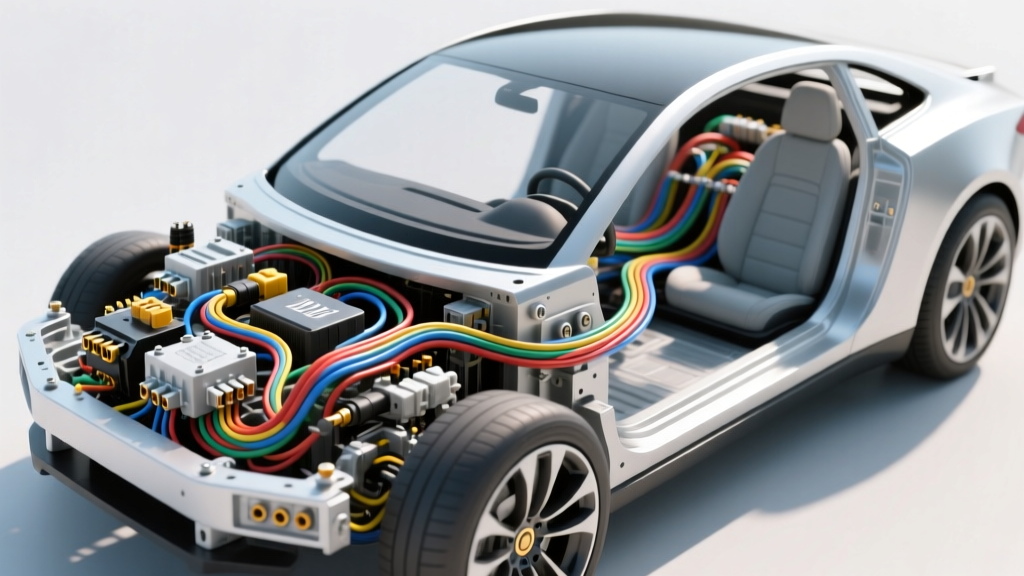
Architectural Overview of the Slate Auto Electric Vehicle Platform
Working on the modular skateboard chassis of a Slate Auto electric vehicle requires a fundamental shift from traditional 12V internal combustion electrical diagnostics to high-voltage (HV) DC architectures and multiplexed low-voltage (LV) networks. The Slate Auto EV platform utilizes a centralized 400V to 800V nominal battery pack, feeding silicon carbide (SiC) inverters, electric AC compressors, and PTC heaters. Concurrently, a 12V lithium-iron-phosphate (LiFePO4) auxiliary battery manages the LV logic, CAN FD bus communications, and High Voltage Interlock Loops (HVIL).
For independent shops, fleet technicians, and upfitters, preparing a bay to safely service, diagnose, and repair the Slate Auto electric vehicle wiring harness demands a significant capital investment. This analysis breaks down the exact tooling, personal protective equipment (PPE), wiring materials, and diagnostic software costs required to operate safely and effectively on this EV platform.
High-Voltage vs. Low-Voltage Tooling Requirements
The electrical architecture of the Slate Auto EV strictly separates HV (orange-jacketed cables per ISO 6722-1) and LV systems. Diagnosing these systems requires specialized, isolated testing equipment to prevent catastrophic short circuits and ensure technician safety.
Insulated Hand Tools & PPE Costs
Before touching any HV service disconnect, technicians must don appropriate PPE and use rated insulated tools. Standard automotive wrenches can arc and weld to HV busbars if dropped, causing severe arc flash incidents.
- Class 0 HV Insulating Gloves (ASTM D120): Rated for up to 1,000V AC / 1,500V DC. Cost: $120 - $180 per pair. Must be paired with leather protectors ($45) and re-tested every 6 months ($35 per test).
- Arc Flash Face Shield & Balaclava: Minimum 8 cal/cm² rating for EV battery pack service. Cost: $250 - $350.
- VDE-Certified Insulated Hand Tools: 1,000V rated torque wrenches, ratchets, and socket sets. A comprehensive 40-piece insulated mechanic's set costs between $800 and $1,400.
- Insulated Rescue Hook: Mandatory for pulling a technician away from an energized HV busbar. Cost: $150.
Diagnostic Scan Tools & Oscilloscopes
Standard OBD2 scanners cannot access the Slate Auto EV's battery management system (BMS) or inverter gate drivers. You need EV-specific diagnostic interfaces and high-speed oscilloscopes to read CAN FD traffic and PWM inverter waveforms.
- True RMS Multimeter (CAT III 1000V / CAT IV 600V): The Fluke 1587 FC Insulation Multimeter is the industry standard, capable of testing HV cable insulation degradation (megger testing) and verifying zero voltage. Cost: $900 - $1,100.
- Automotive Oscilloscope: A 4-channel PicoScope 4425A with differential probes and HT leads is required to view HVIL square waves and resolver sensor signals. Cost: $1,500 (plus $400 for 1000V differential probes).
- Milliohm Meter: Essential for testing HV cable crimp integrity and busbar contact resistance. Standard multimeters cannot resolve resistance below 0.1 ohms accurately. Cost: $400 - $600.
Slate Auto EV Wiring Specifications & Material Costs
Repairing damaged harnesses or upfitting the Slate Auto electric vehicle for auxiliary equipment (e.g., snow plows, off-road lighting, or mobile work stations) requires automotive-grade shielded wiring. Standard copper wire from a hardware store will fail due to vibration, thermal cycling, and electromagnetic interference (EMI).
| System / Circuit | AWG Size | Jacket Color & Type | Connector Type | Est. Cost / Ft |
|---|---|---|---|---|
| Main Battery to Inverter | 4/0 AWG (211 kcmil) | Orange, Shielded Braid (ISO 6722) | Amphenol SurLok Plus / TE HVA280 | $38.00 - $45.00 |
| PTC Heater & AC Compressor | 2/0 AWG | Orange, Shielded Braid | TE Connectivity HVA280 2-Pin | $22.00 - $28.00 |
| HVIL (Interlock Loop) | 18 AWG | Orange/Black Twisted Pair | Sealed Deutsch DT (Pins A & B) | $1.50 - $2.00 |
| 12V Auxiliary Power | 8 AWG to 4 AWG | Red/Black, GXL/TXL (SAE J1128) | Anderson SB / Standard Ring | $3.50 - $6.00 |
| CAN FD Bus Network | 20 AWG (0.5mm²) | Green/White Twisted, Foil Shield | 4-Pin Waterproof Superseal | $2.20 - $3.00 |
HVIL Diagnostics and Pinout Troubleshooting
The High Voltage Interlock Loop (HVIL) is a critical safety circuit on the Slate Auto EV. It uses a low-voltage (typically 5V or 12V) logic signal that passes through every HV connector in series. If a connector is unplugged, the loop breaks, and the BMS immediately opens the main contactors to de-energize the HV bus.
When diagnosing a 'HVIL Open' fault code on the Slate Auto platform, follow this decision tree:
- Verify the Fault: Use your scan tool to identify which specific HV component (e.g., Rear Motor Inverter, OBC, or DC-DC Converter) is reporting the open circuit.
- Visual Inspection: Check the HV connector at the flagged component. Ensure the secondary lock (CPA - Connector Position Assurance) is fully seated. A loose CPA will mechanically break the HVIL pins before the main HV pins disengage.
- Pinout Testing: Disconnect the 12V auxiliary battery. Using a milliohm meter, measure continuity across the HVIL pins (typically Pin A and Pin B on the component side of the harness). Resistance should be less than 0.5 ohms. If OL (Open Loop), the internal interlock jumper inside the component's lid or receptacle has failed.
- Harness Continuity: If the component checks out, back-probe the harness side. You should read the BMS reference voltage (usually 5V or 12V) on the supply wire when the system is keyed ON but contactors are OPEN. If 0V, trace the harness back to the BMS for a chafed wire or corroded bulkhead connector.
Note: Always refer to SAE J2464 guidelines for EV safety and isolation testing before attempting to bypass or jump any HVIL circuits, which is strictly prohibited and highly dangerous.
Busbar Torque Specifications and Thermal Management
Electrical resistance generates heat. In the Slate Auto EV's battery pack and power distribution unit (PDU), loose busbar connections will lead to thermal runaway or localized melting. Standard automotive torque wrenches often lack the precision required for HV busbars.
- M6 Busbar Bolts: Torque to 10 - 12 Nm (88 - 106 lb-in).
- M8 Busbar Bolts: Torque to 22 - 25 Nm (16 - 18 lb-ft).
- M10 Inverter Terminals: Torque to 35 - 40 Nm (25 - 29 lb-ft).
After torquing, technicians must use a thermal imaging camera (e.g., FLIR C5 or Snap-on Modis) during a loaded dyno test to verify that no busbar joint exceeds a 15°C delta-T above ambient. A hot spot indicates a poor crimp, missing Belleville washer, or contaminated mating surface.
Total Investment Breakdown for Independent EV Technicians
Transitioning a standard auto electrical bay to service the Slate Auto electric vehicle requires a calculated investment. Below is a realistic cost matrix for a professional setup.
| Equipment Category | Specific Item / Tooling | Estimated Cost (USD) |
|---|---|---|
| Safety & PPE | Class 0 Gloves, Protectors, Arc Flash Shield, Rescue Hook | $650 - $850 |
| Insulated Hand Tools | 1000V VDE Torque Wrenches, Sockets, Ratchets | $1,200 - $1,800 |
| Diagnostic Hardware | Fluke 1587 FC, PicoScope 4425A, Milliohm Meter | $2,800 - $3,500 |
| Crimping & Termination | Hydraulic Crimper (up to 4/0 AWG), Wire Strippers, Heat Gun | $450 - $700 |
| Software & Subscriptions | Slate Auto OEM Service Portal Access, Wiring Diagram Licenses | $1,500 / year |
| Facility Upgrades | EV Battery Lift Table, Insulated Floor Matting, LOTO Station | $2,500 - $4,000 |
Conclusion and Safety Directives
The Slate Auto electric vehicle represents the next generation of modular, utilitarian EV platforms. However, its electrical complexity demands rigorous adherence to safety protocols and the use of precision diagnostic tooling. Cutting corners on HV-rated tools or utilizing substandard wiring materials will inevitably lead to EMI-induced CAN bus failures, HVIL faults, or catastrophic thermal events.
Technicians must prioritize ongoing education, strictly follow NFPA 70E electrical safety standards, and maintain their insulated PPE. By investing in the proper diagnostic ecosystem and understanding the intricate pinouts and shielding requirements of the Slate Auto EV, independent shops can safely and profitably service this emerging electric fleet.