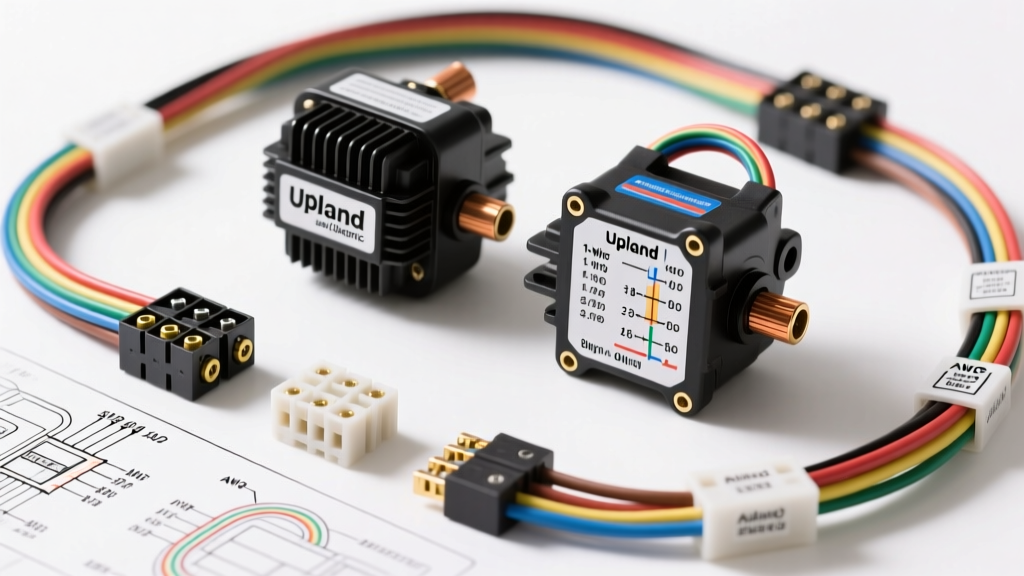
Upland Auto Electric: High-Output Alternator Selection
When upgrading a vehicle's electrical architecture for overlanding, high-draw off-road lighting, or competition car audio, the factory 80-amp alternator quickly becomes a bottleneck. Upland Auto Electric has established a reputation for supplying robust, high-amperage charging systems designed to handle extreme electrical loads. However, selecting the right Upland Auto Electric alternator—and more importantly, wiring it correctly—is critical to preventing voltage drop, melted harnesses, and catastrophic electrical fires.
This guide compares the core Upland Auto Electric alternator configurations, detailing the exact AWG requirements, terminal specifications, and circuit protection strategies required for a safe, high-output installation.
1-Wire vs. 3-Wire Upland Alternators: Architecture Comparison
Upland Auto Electric primarily offers high-output units in two distinct regulator configurations: the 1-wire (self-exciting) and the 3-wire (remote sense) setups. Choosing between them depends entirely on your vehicle's electrical draw profile and dash integration requirements.
The 1-Wire 'Self-Exciting' Configuration
The 1-wire Upland alternator features an internal voltage regulator that relies on a single heavy-gauge output cable connected directly to the battery positive terminal. The exciter circuit is internally tied to the output post.
- Pros: Exceptionally clean engine bay; eliminates the need for a factory alternator harness; ideal for engine swaps and custom tube-chassis builds.
- Cons: Requires a specific RPM threshold (usually 1,200–1,500 RPM) to 'turn on' or excite the regulator. Furthermore, because the voltage sense is internal to the alternator case, the regulator cannot compensate for voltage drop across long cable runs to the battery.
The 3-Wire 'Remote Sense' Configuration
The 3-wire Upland Auto Electric unit utilizes a multi-pin Delphi Packard connector. This setup separates the battery output, the ignition-switched exciter, and the remote battery sense wire.
- Pros: True remote sensing allows the regulator to monitor voltage directly at the battery post or main distribution block, compensating for voltage drop in the charging cable. It also charges immediately at idle without requiring an RPM bump.
- Cons: Requires routing a dedicated 3-wire harness through the firewall and integrating it with the ignition switch and dash warning lamp.
Upland Auto Electric Wiring Specifications & AWG Chart
Upgrading to a 200A or 270A Upland alternator while retaining the factory 8 AWG or 6 AWG charging wire is a guaranteed recipe for a melted harness or an electrical fire. The charging cable must be sized to handle the maximum continuous output of the unit, plus a 20% safety margin. Below is the mandatory specification chart for Upland high-output installations.
| Upland Alternator Output | Minimum Cable AWG | Optimal Cable AWG (Runs > 4 ft) | Required Fuse Type & Rating | Terminal Lug Size |
|---|---|---|---|---|
| 140 Amp | 4 AWG | 2 AWG | 150A ANL Fuse | 3/8' Ring (M10) |
| 200 Amp | 1/0 AWG | 2/0 AWG | 225A ANL Fuse | 3/8' Ring (M10) |
| 270 Amp | 2/0 AWG | 4/0 AWG | 300A Class T Fuse | 1/2' Ring (M12) |
According to the SAE J1171 standard for marine and heavy-duty electrical systems, all high-amperage charging cables routed through engine compartments must be encased in split-loom tubing or braided sleeving to prevent abrasion against the engine block or cylinder heads, which can lead to a dead short.
Connector Pinouts and the 3-Wire Harness
If you select the 3-wire Upland Auto Electric alternator, you will interface with a standard 2-pin or 3-pin regulator plug (often matching the GM CS130D or Denso SC series footprint, depending on the specific Upland casing). Proper pinout identification is critical.
- Pin 'S' (Sense): This is the most critical wire. It must be an 12 AWG or 10 AWG wire routed directly to the positive battery post or the main mega-fuse distribution block. Never splice this into a random 12V accessory wire, or the alternator will overcharge the battery to compensate for accessory voltage drop.
- Pin 'L' (Lamp/Exciter): Typically a 16 AWG or 18 AWG wire. This connects to an ignition-switched 12V source, often routed through a dash warning lamp (which provides the necessary initial resistance to protect the regulator diodes upon startup).
- Pin 'F' (Field - if applicable): Used for PCM monitoring on modern OBD-II vehicles to prevent the ECU from throwing a charging system code when the high-output unit deviates from factory voltage parameters.
Termination Standards: Crimping and Torque Specs
High-amperage circuits fail most frequently at the termination points due to increased electrical resistance and localized heat generation. When terminating 1/0 AWG or 2/0 AWG welding cable for your Upland alternator:
- Strip and Clean: Strip the insulation and clean the copper strands with a wire brush and electrical contact cleaner.
- Adhesive Heat Shrink: Use only adhesive-lined (dual-wall) heat shrink terminals. When heated, the inner epoxy melts and seals the copper from oxygen and moisture, preventing green corrosion and strand fraying.
- Hydraulic Crimping: Do not use mechanical hammer crimpers or pliers on 1/0 AWG or larger. Use a hydraulic crimper with the correct hex die to ensure a cold-weld connection.
- Torque Specifications: The alternator output stud is typically an M8 or M10 metric thread. Torque the nut to 12-15 Nm (9-11 ft-lbs) using a flanged hex nut. Over-torquing will snap the internal diode bridge connection inside the alternator casing, destroying the unit.
Circuit Protection: ANL vs. Class T Fusing
The main charging cable must be protected within 18 inches of the battery positive terminal. For Upland Auto Electric units producing under 200A, an ANL fuse is acceptable. However, for 200A to 300A+ units, you must upgrade to a Class T fuse.
As noted in the Bosch Automotive Electrics Handbook, Class T fuses offer a much higher Ampere Interrupting Capacity (AIC) — typically 20,000 amps at 125VDC. In the event of a catastrophic dead-short where the alternator goes into full thermal runaway, an ANL fuse may literally explode or sustain an electrical arc, whereas a Class T fuse will safely extinguish the arc and sever the circuit.
Real-World Troubleshooting & Failure Modes
Even with premium Upland Auto Electric components, improper installation leads to distinct failure modes. Use this diagnostic tree if issues arise post-installation:
- Symptom: Battery voltage reads 14.8V+ at idle, boiling the battery.
Cause: The remote sense wire (Pin S) is broken, disconnected, or spliced into a switched accessory circuit. The regulator defaults to internal sensing and maxes out output to overcome perceived resistance.
Fix: Run a dedicated 12 AWG sense wire directly to the battery positive post. - Symptom: Alternator whine in the audio system or CB radio.
Cause: Ground loop. The alternator case ground to the engine block is compromised by paint, powder coating, or corrosion.
Fix: Scrape paint from the alternator mounting ears and engine block. Install a dedicated 4 AWG ground strap from the alternator case directly to the chassis ground bus. - Symptom: Melted battery post or lug.
Cause: Undersized lugs, poor mechanical crimp, or missing dielectric grease causing high resistance.
Fix: Cut back the cable, re-crimp with a hydraulic tool using adhesive-lined lugs, and apply a thin layer of NO-OX-ID A-Special conductive grease. - Symptom: Headlights dim at idle, brighten when revving (1-Wire Setup).
Cause: The 1-wire internal exciter threshold is not being met at idle, or the single output cable is undersized, causing massive voltage drop before reaching the battery.
Fix: Verify cable AWG against the chart above. If cabling is correct, consider switching to a 3-wire Upland unit for better low-RPM regulation.
Expert Verdict: Selecting Your Upland System
If you are building a dedicated off-road vehicle with massive winch loads, auxiliary lighting, and dual-battery management systems, the Upland Auto Electric 3-Wire 200A+ system is the only logical choice. The remote sensing capability ensures that when your winch pulls 400 amps and drops system voltage to 11.5V, the alternator immediately senses the drop at the battery and ramps output to maximum, rather than reacting to the voltage at the back of the alternator case.
Conversely, for a classic muscle car restomod or a clean-look street rod where the electrical load is moderate (under 120A) and hidden wiring is paramount, the Upland 1-Wire 140A unit provides massive charging capability with a single, cleanly routed 4 AWG cable. Regardless of your choice, adhering strictly to the AWG, fusing, and termination protocols outlined above will ensure your charging system operates safely for the life of the vehicle.