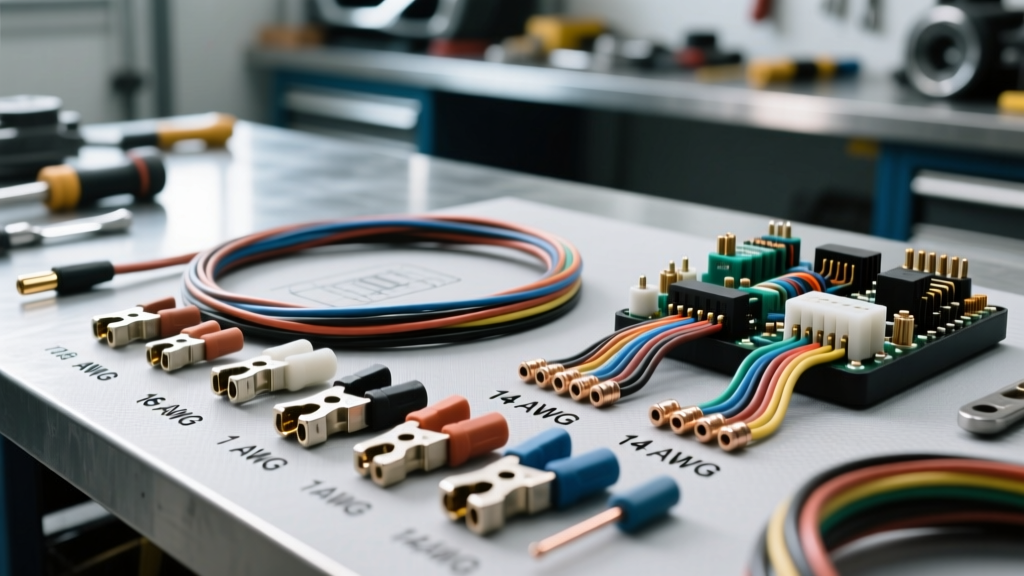
The "Good Gauge for Speaker Wire" Dilemma in Automotive Audio
When upgrading a factory car audio system, one of the most frequently asked questions among enthusiasts and professional installers alike is: what is a good gauge for speaker wire? While the internet is flooded with generic home-audio advice, automotive environments present unique electrical, thermal, and physical challenges. Running wires through a vehicle's chassis, door jambs, and under carpets requires strict adherence to safety standards and electrical principles. Choosing the wrong wire gauge or material does not just degrade your sound quality; it can lead to amplifier thermal runaway, clipped signals, and in extreme cases, electrical fires.
At Autoflow Wire, we see the aftermath of improper car audio wiring every day. From melted door boots to blown output transistors, the consequences of cutting corners on speaker wire are severe. This guide breaks down the most critical mistakes installers make when selecting and routing speaker wire, providing the technical depth needed to ensure your system performs flawlessly and safely.
Critical Mistake #1: Confusing CCA with OFC Copper (The Hidden Fire Hazard)
The most dangerous mistake in car audio wiring is purchasing bargain-bin speaker wire made from Copper-Clad Aluminum (CCA) instead of Oxygen-Free Copper (OFC). CCA wire features an aluminum core with a microscopic copper coating. Because aluminum has roughly 61% of the conductivity of copper, a 16 AWG CCA wire actually performs electrically like a 20 AWG OFC wire.
When you push high current through undersized CCA wire to a 2-ohm subwoofer or high-wattage component set, the aluminum core exhibits high resistance. This resistance generates excessive heat. In the confined, insulated spaces of a vehicle's interior—such as beneath carpeting or inside a sealed subwoofer enclosure—this heat cannot dissipate. The insulation melts, leading to short circuits against the vehicle's steel chassis. According to Crutchfield's Car Audio Speaker Wire Guide, OFC wire is the only acceptable standard for reliable, high-current mobile audio applications due to its superior thermal dissipation and corrosion resistance.
Critical Mistake #2: Ignoring Damping Factor and Run Length in Long-Wheelbase Vehicles
Many installers assume that because speaker-level signals are not powering the amplifier itself, voltage drop is irrelevant. This is a fundamental misunderstanding of electromagnetics. Speaker wire resistance acts as a voltage divider in series with the speaker's voice coil. More importantly, it destroys the amplifier's damping factor—the amplifier's ability to control the speaker cone's movement after the signal stops.
If you are wiring a long-wheelbase vehicle like a Ford F-150 SuperCrew or a Chevrolet Suburban, running 18 AWG wire from the trunk-mounted amplifier to the front doors is a critical error. Over a 15-foot run, 18 AWG OFC wire introduces enough resistance to audibly alter the frequency response of a mid-bass driver, resulting in "muddy" or "boomy" bass. For runs exceeding 12 feet, stepping up to 14 AWG or even 12 AWG OFC wire is mandatory to maintain a damping factor above 50, ensuring tight, accurate bass reproduction.
Automotive Speaker Wire Sizing & Safety Matrix
Use the following matrix to determine the correct OFC wire gauge based on your amplifier's RMS output and the physical run length from the amp to the driver. These specifications assume a standard 12V/14.4V automotive electrical system and account for the total round-trip length of the conductor.
| Wire Gauge (OFC) | Max RMS Watts (4-Ohm) | Max RMS Watts (2-Ohm) | Max Recommended Run Length | Primary Application |
|---|---|---|---|---|
| 18 AWG | 50W | Not Recommended | 8 Feet | Tweeters, Factory Radio Replacements |
| 16 AWG | 100W | 75W | 12 Feet | Standard 6.5" Coaxials & Components |
| 14 AWG | 200W | 150W | 16 Feet | High-Power Midbass, Long SUV Runs |
| 12 AWG | 400W | 300W | 20 Feet | Shallow-Mount Subwoofers, 2-Ohm Loads |
| 10 AWG | 800W+ | 600W+ | 20+ Feet | High-SPL Subwoofers, 1-Ohm Stable Amps |
Critical Mistake #3: Door Jamb Routing and Insulation Failures
Routing speaker wire from the cabin into the doors is notorious for causing electrical shorts. The rubber door boot (or grommet) is a high-flex zone. Every time the door is opened and closed, the wire bundle bends, twists, and compresses. If you use standard home-audio zip cord or thin-walled PVC wire, the insulation will quickly crack and expose the bare copper. When the bare positive conductor touches the steel door hinge or chassis ground, it creates a dead short directly back to the amplifier's output stage.
To prevent catastrophic amplifier failure, automotive professionals use wire that meets the SAE J1128 Low Voltage Primary Cable Standard. Specifically, GXL (General Cross-Linked) or SXL (Special Cross-Linked) insulation offers extreme abrasion resistance and high-temperature tolerance. While bulkier, cross-linked insulation will survive years of door-jamb flexing without degrading. Furthermore, always use split-loom tubing and secure the wire with automotive-grade Tesa tape to prevent rattling and chafing against sharp sheet metal edges inside the door cavity.
Standard Car Audio Wire Color Codes & Termination Protocols
Another common mistake that leads to hours of troubleshooting is ignoring standardized wire color codes and utilizing poor termination methods. Twisting wires together and wrapping them in cheap electrical tape guarantees eventual oxidation and signal loss due to automotive vibration and humidity.
According to the CEA-2015 standard (now maintained by the Consumer Technology Association), mobile audio speaker wire should follow these specific color codes to ensure phase consistency and simplify future diagnostics:
- Front Left: Solid White (+) / White with Black Stripe (-)
- Front Right: Solid Gray (+) / Gray with Black Stripe (-)
- Rear Left: Solid Green (+) / Green with Black Stripe (-)
- Rear Right: Solid Purple (+) / Purple with Black Stripe (-)
For termination at the speaker basket, never rely on bare wire stuffed into spring terminals. Solder the connections using a rosin-core solder (never acid-core, which will corrode the voice coil tinsel leads) and seal the connection using dual-wall marine-grade heat shrink. The inner wall of this heat shrink contains a polyamide adhesive that melts and seals out moisture, preventing the copper from turning green and increasing resistance over time. If soldering inside a cramped door panel is impossible, use nylon-insulated, fully insulated female spade connectors crimped with a calibrated ratchet crimper to ensure a gas-tight mechanical bond.
Warning Signs of Incorrect Gauge and Impedance Mismatch
If you have already installed your system, be vigilant for the following symptoms, which indicate your speaker wire gauge is insufficient for the electrical load:
- Amplifier Thermal Protection Tripping: If your amp shuts down after 15 minutes of moderate listening, the wire resistance may be forcing the amplifier to work outside its safe operating area (SOA), generating excessive internal heat.
- Audible Clipping at Low Volumes: High resistance in undersized wire alters the load impedance seen by the amplifier. A 2-ohm speaker might present a reactive 1.2-ohm load at certain frequencies due to wire inductance and resistance, causing the amp's output transistors to clip prematurely.
- Discolored or Warm Wire Insulation: If the speaker wire feels warm to the touch near the amplifier terminals or shows brown discoloration beneath the jacket, it is operating beyond its thermal limits. Replace it with a thicker AWG immediately to prevent a fire.
Final Thoughts on Automotive Wire Sizing
Determining a good gauge for speaker wire is not just about matching a number on a chart; it is about understanding the physics of your specific vehicle and audio system. By strictly utilizing OFC copper, adhering to SAE insulation standards for high-flex zones, respecting run lengths in large vehicles, and executing flawless terminations, you protect your investment and ensure reference-grade audio quality. Never compromise on the copper that connects your amplifier to your drivers—the integrity of your entire car audio system depends on it.