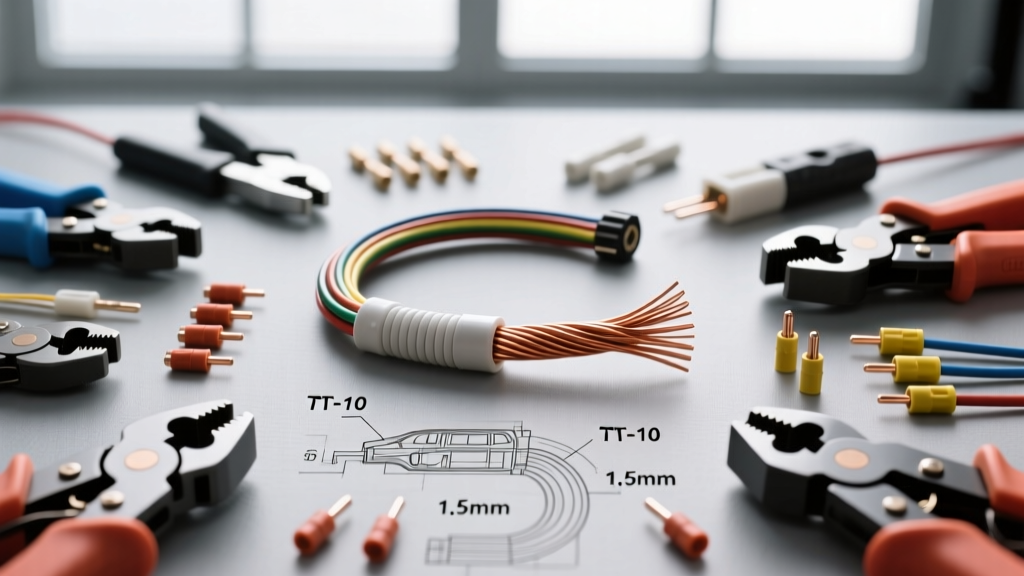
Decoding the .25 Wire Gauge Specification in Automotive Diagnostics
When automotive technicians and harness builders reference the .25 wire gauge, they are almost exclusively referring to the metric 0.25 mm² cross-sectional area wire standard defined by ISO 6722-1, rather than the American Wire Gauge (AWG) 25. True 25 AWG is virtually non-existent in modern 12V and 48V vehicle harnesses due to its extreme fragility. Instead, the 0.25 mm² metric wire—which translates to approximately 23 or 24 AWG—is the undisputed industry standard for low-amperage signal circuits, multiplexed networks (CAN-bus, LIN-bus), and sensitive 5V reference lines.
Working with this micro-gauge wire presents unique challenges. The cost of materials is low, but the cost of improper tooling and botched repairs can result in catastrophic ECU failures, intermittent network dropouts, and hours of lost diagnostic time. This comprehensive guide breaks down the exact technical specifications, cost-benefit analyses of repair components, and the specialized micro-crimping tooling required to master the .25 wire gauge.
Technical Specifications & Ampacity Matrix
Understanding the physical and electrical limits of 0.25 mm² wire is critical before integrating it into any vehicle harness. According to the ISO 6722-1 Road Vehicles Standard, this wire is designed for signal transmission, not power delivery.
| Specification Metric | 0.25 mm² (Metric) | 24 AWG (SAE J1128 Equivalent) |
|---|---|---|
| Conductor Stranding | 14 x 0.15 mm (Bunched Copper) | 19 x 0.127 mm (Stranded) |
| Conductor Diameter | 0.57 mm (Nominal) | 0.61 mm (Nominal) |
| Insulation Type | XLPE (Cross-Linked) or PVC | GXL / TXL (Thin-Wall) |
| Insulation Thickness | 0.25 mm (Class B) | 0.20 mm |
| Overall Diameter (OD) | 1.07 mm - 1.20 mm | 1.01 mm - 1.15 mm |
| Max Resistance @ 20°C | 76.0 mΩ/m | 84.2 mΩ/m |
| Max Ampacity (Chassis) | 3.0 Amps (Signal Only) | 3.5 Amps (Signal Only) |
| Temperature Rating | 125°C (XLPE) / 105°C (PVC) | 125°C (GXL) |
Note: Never use 0.25 mm² wire for injector drivers, ignition coils, or high-current sensor heaters (like O2 sensor heater circuits, which require a minimum of 0.75 mm² / 18 AWG to handle 10A+ inrush currents).
Cost Analysis: Wire, Terminals, and OEM Pigtails
One of the most common mistakes in automotive electrical repair is underestimating the economics of micro-gauge harness repair. While the raw wire is inexpensive, the termination ecosystem dictates the true cost.
1. Raw Wire and Bulk Spooling
High-quality, automotive-grade XLPE 0.25 mm² wire typically costs between $0.18 and $0.35 per foot when purchased in 500-foot spools. Brands like TE Connectivity, Leoni, and Prysmian dominate the OEM supply chain. Using cheap, non-automotive PVC hook-up wire from a hardware store will result in insulation melting near engine bay heat sources and premature brittle fracture due to vibration.
2. Terminals: Reel vs. Loose vs. OEM Pigtails
The terminals used for .25 wire gauge circuits are typically in the 0.64mm blade/receptacle category (e.g., TE Connectivity Micro Quadlock II, Yazaki 0.64 series, or Molex MX150).
- Bulk Reel (Aftermarket): Purchasing tin-plated copper alloy 0.64mm terminals on a reel of 5,000 brings the cost down to roughly $0.04 to $0.08 per terminal. However, this requires a professional unwinding and crimping setup.
- Loose Terminals (Retail): Buying small packs of 10-50 from electronics suppliers inflates the price to $0.40 - $0.75 per terminal.
- OEM Dealer Pigtails: If you order a pre-crimped pigtail harness from a dealership (e.g., VW VAS 1978 repair kit or GM ACDelco PT-series), expect to pay $18.00 to $55.00 per single-circuit pigtail. While expensive, this guarantees the correct wire color, insulation seal, and terminal lance geometry for the specific ECU cavity.
Tool Requirements: The Hidden Cost of Micro-Crimping
You cannot reliably crimp a 0.25 mm² wire using a standard $30 automotive crimping tool designed for 10-22 AWG weather-pack terminals. The wire will either slip out under a 2-pound pull test, or the crimper will sever the delicate 14-strand copper bunched conductor. According to the TE Connectivity Automotive Application Specifications, a proper crimp on a 0.64mm terminal requires precise four-indentor compression to ensure gas-tight metal-to-metal contact without crushing the wire.
Recommended Tooling Matrix & Investment
| Tool Category | Budget / DIY Option | Professional / OEM Option | Why It Matters for 0.25mm² |
|---|---|---|---|
| Wire Strippers | $25 Manual Stripper | $140 Knipex MultiStrip 10 | Manual strippers easily nick the 0.15mm micro-strands, reducing ampacity and creating fracture points. |
| Micro-Crimper | $45 Non-Ratcheting Pliers | $450 Rennsteig PEW 12 (w/ 1.2mm Die) | Ratcheting tools ensure the exact crimp height is reached before release, preventing high-resistance CAN-bus faults. |
| Terminal Insertion | $5 Plastic Spudger | $35 TE Cavity Tool Set | 0.64mm terminal lances are microscopic. Metal tools will bend the lance, causing the terminal to back out of the ECU connector. |
| Seal Plugs | Omit (High Risk) | $15 / 100pcs Silicone Plugs | Omitting silicone seal plugs on 0.25mm² wires in engine-bay connectors guarantees capillary action water ingress into the ECU. |
Real-World Automotive Applications & Color Codes
The .25 wire gauge (0.25 mm²) is heavily utilized in modern multiplexed networks and sensitive sensor loops. Identifying these circuits by color code is essential for diagnostics.
- High-Speed CAN (HS-CAN): Typically 0.25 mm² to 0.35 mm². GM: Orange/Black (CAN-H) & Orange/Brown (CAN-L). Ford: White/Black & White/Violet. BMW: Green & Green/White.
- Local Interconnect Network (LIN-Bus): Single wire, 0.25 mm². Often Purple, Violet, or White/Red depending on the OEM. Used for mirror controls, rain sensors, and steering column modules.
- 5V Reference & Signal Return: Used for MAF sensors, MAP sensors, and Throttle Position Sensors (TPS). Usually routed to specific Bosch Motronic ECU pins (e.g., Pins 12, 14, and 33 on many 60-pin ECUs).
Expert Troubleshooting Decision Tree: 0.25mm² Circuit Failures
When diagnosing faults related to micro-gauge wiring, follow this symptom-cause-fix decision tree to isolate the failure mode.
- Symptom: Intermittent U0100 (Lost Communication with ECM/PCM) or CAN-Bus Dropout.
- Check 1: Measure terminal crimp resistance. If > 0.5 Ω, the terminal was under-crimped with a non-ratcheting tool, allowing oxidation to infiltrate the strand bundle.
- Fix 1: Cut back to clean copper, strip using calibrated automatic strippers, and re-crimp using a ratcheting PEW 12 tool with the correct 0.64mm die cavity.
- Symptom: P0102 (Mass or Volume Air Flow Circuit Low Input) with a verified good sensor.
- Check 2: Inspect the 5V reference wire (0.25 mm²) for insulation displacement. If the wire stripper nicked the copper strands, the wire's cross-section is reduced, causing a voltage drop under the sensor's micro-load.
- Fix 2: Perform a voltage drop test across the signal return wire. Replace the harness segment using OEM-spec XLPE wire and heat-shrink solder splices (if crimping is inaccessible).
- Symptom: Terminal Backing Out of High-Density ECU Connector.
- Check 3: Inspect the terminal locking lance. If bent or sheared, it was forced into the connector cavity without a proper plastic guide tool, or the wire was pulled during routing.
- Fix 3: Replace the 0.64mm terminal. Always use a secondary locking wedge (TSR) or connector position assurance (CPA) clip if the connector housing supports it.
Summary: The Economics of Doing It Right
Mastering the .25 wire gauge requires a paradigm shift from standard power-wire repairs. While investing $500+ in precision Rennsteig or TE Connectivity ratcheting crimpers and automatic strippers seems steep, it pays for itself immediately. A single botched CAN-bus crimp can lead to a misdiagnosed $1,500 ECU replacement or a vehicle that returns to the shop three times with ghost network codes. By adhering to SAE J1128 and ISO 6722-1 standards, utilizing correct 0.64mm terminals, and respecting the strict tooling requirements of micro-gauge wire, you ensure OEM-level reliability in every harness repair.