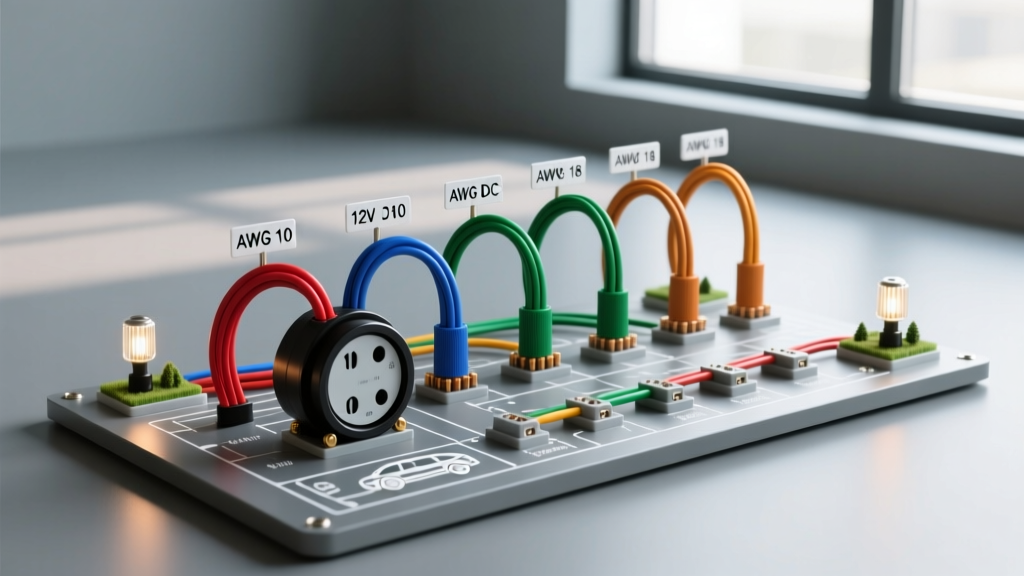
Introduction: The 12V DC Landscape Lighting Paradigm
When DIYers, off-grid builders, and RV owners ask, "what gauge landscape lighting wire should I use," they are usually met with answers tailored to 120V AC residential systems. However, at Autoflowwire, we specialize in automotive, marine, and 12V DC electrical systems. If you are wiring landscape lighting for an RV, an off-grid cabin, a skoolie conversion, or a 12V solar-powered yard setup, standard AC wiring advice will leave you with dim, flickering lights due to severe voltage drop. In the automotive and mobile electrical world, we apply strict SAE (Society of Automotive Engineers) standards to ensure efficiency, durability, and safety. This guide breaks down exactly how to size, select, and terminate 12V DC landscape lighting wire using professional automotive-grade methodologies.
Why 12V DC Requires a Different Approach to Wire Sizing
In a standard 120V AC home landscape system, you can run 14 AWG wire hundreds of feet with minimal voltage loss. In a 12V DC system, the current (amperage) is ten times higher for the exact same wattage. According to Ohm's Law (Current = Power / Voltage), a 60-watt landscape lighting setup draws just 0.5 amps at 120V, but it draws a full 5 amps at 12V. This exponential increase in amperage generates significant heat and resistance over distance. If you undersize your wire, the LEDs at the end of the run will suffer from voltage starvation, resulting in a weak, yellowish glow instead of a crisp, bright beam.
The 3% Voltage Drop Rule
For sensitive automotive and 12V DC LED drivers, we recommend keeping voltage drop below 3%. On a 12.6V fully charged battery system, a 3% drop equates to just 0.38V. If your wire gauge is too thin, the resistance per foot will eat up your available voltage before it ever reaches the fixture, triggering low-voltage cut-offs in smart LED controllers.
Automotive Wire Types vs. Standard Direct Burial Wire
Big-box hardware stores sell cheap, untinned copper "direct burial" wire. While fine for static AC applications, it degrades quickly in mobile or high-vibration environments (like an RV chassis or overland trailer). As automotive electrical experts, we recommend using wire that meets SAE J1128 standards, specifically GXL or SXL (Cross-linked polyethylene) wire, or marine-grade tinned copper.
- GXL (General Cross-Linked): Features thin insulation, high heat resistance (125°C), and excellent flexibility. Ideal for routing through tight chassis conduits and grommets before exiting to the landscape.
- Tinned Copper (Marine/Off-Grid): The copper strands are coated in tin to prevent galvanic corrosion and "black-wire disease," which is critical when burying wire in damp soil or running it under a mobile chassis exposed to road salt and moisture.
- UV-Resistant Jacketing: If the wire will be exposed to sunlight before burial, ensure the outer jacket is rated for UV exposure, or run it through split-loom corrugated tubing to prevent the insulation from becoming brittle and cracking.
12V DC Landscape Lighting Wire Gauge Specification Chart
The following chart is based on SAE J1128 ampacity ratings and copper resistance at 20°C (68°F). Always calculate your total run length (positive AND negative wire combined) to determine the true circuit distance for 12V DC systems.
| AWG Size | Max Ampacity (SAE) | Resistance (Ω/1000ft) | Max Run Distance (10A @ 3% Drop) | Recommended Application |
|---|---|---|---|---|
| 18 AWG | 10A | 6.385 | 7 feet | Single low-draw LED marker lights |
| 16 AWG | 13A | 4.016 | 11 feet | Short-run accent lighting (under 5W total) |
| 14 AWG | 17A | 2.525 | 18 feet | Standard 12V garden path lights (up to 20W) |
| 12 AWG | 24A | 1.588 | 29 feet | Heavy-duty off-road area lights and long runs |
| 10 AWG | 33A | 0.999 | 46 feet | Main trunk lines from solar charge controller |
Step-by-Step Sizing Calculation for Your Yard or RV Skirt
Let's walk through a real-world scenario. You are installing six 12V DC LED path lights, each drawing 1.5 amps (18 watts), spaced out along a 40-foot run from your main 12V distribution block.
- Step 1: Calculate Total Amperage. 6 fixtures x 1.5A = 9A total draw.
- Step 2: Determine Total Wire Length. The distance from the power source to the furthest light is 40 feet. Because DC requires a dedicated ground return (unlike AC which can sometimes use earth or chassis ground), your total circuit length is 40 feet out + 40 feet back = 80 feet.
- Step 3: Apply the Voltage Drop Formula. Voltage Drop = (2 x L x I x R) / 1000.
- Step 4: Select the Gauge. If we test 14 AWG (Resistance = 2.525 Ω/1000ft): Drop = (2 x 40 x 9 x 2.525) / 1000 = 1.81V. A 1.81V drop on a 12.6V system is a massive 14% drop. Your lights will barely turn on.
- Step 5: Upsize to 10 AWG. (Resistance = 0.999 Ω/1000ft): Drop = (2 x 40 x 9 x 0.999) / 1000 = 0.71V. This is a 5.6% drop. To get strictly under 3%, you would step up to 8 AWG for the main trunk line, then branch off with 14 AWG to the individual fixtures.
Automotive Relays and Photocell Integration
To automate your 12V landscape lighting, integrate a standard automotive 4-pin ISO mini relay. This ensures your heavy lighting load bypasses the low-amperage cab switch or light sensor, protecting your control circuits from melting. Wire the relay as follows: Pin 30 (12V+ from Battery via inline ATC fuse), Pin 87 (12V+ output to the landscape lights), Pin 86 (12V+ trigger from the photocell or dashboard switch), and Pin 85 (Ground to chassis or negative busbar). Use 14 AWG wire for the relay trigger circuit and 10 AWG or 12 AWG for the high-current Pins 30 and 87.
Connectors, Terminals, and Environmental Sealing
In automotive wiring, a connection is only as good as its environmental seal. Burying standard twist-on wire nuts or unsealed crimps will result in oxidation and failure within months. When answering what gauge landscape lighting wire is best, the termination method is equally critical.
Adhesive-Lined Heat Shrink (Dual Wall)
For direct burial splices, you must use dual-wall, adhesive-lined heat shrink tubing. When heated, the inner meltable adhesive wall flows into the wire strands and connector crimp, creating a 100% waterproof, IP67-rated seal that blocks moisture, soil acids, and galvanic corrosion.
Deutsch DT and DTM Connectors
If your landscape lighting setup involves modular RV awning lights or removable overland trailer markers, use TE Connectivity Deutsch DT series connectors. These thermoplastic connectors feature silicone rear wire grommets and wedge locks that ensure the pins (stamped and formed copper alloy) cannot back out under vibration. A standard DT04-2P (2-pin receptacle) handles up to 13 amps per pin, making it perfect for 14 AWG or 12 AWG landscape branch lines that may need to be disconnected for vehicle maintenance or storage.
Automotive Color Coding for 12V DC Landscaping
Maintaining automotive color standards prevents catastrophic reverse-polarity shorts when integrating landscape lighting with an RV's main 12V fuse panel or a Blue Sea Systems DC distribution block.
- Red: Primary 12V+ unswitched power from the battery or main busbar.
- Black: Dedicated 12V DC ground return to the negative busbar (never rely on earth ground for DC circuits).
- Blue or Yellow: Switched 12V+ power, routed through a relay or a smart-controller to turn the landscape lights on via a cab switch or photocell.
Troubleshooting Common 12V Landscape Lighting Failures
Even with the correct wire gauge, 12V DC systems can present unique electrical gremlins. Here is an expert diagnostic tree for common issues.
Symptom: Lights at the end of the run are dim or flickering.
Cause: Severe voltage drop or a high-resistance connection acting as a bottleneck.
Fix: Measure voltage at the source, then at the furthest fixture while the circuit is under load. If the drop exceeds 0.5V, you must run a heavier gauge trunk line (e.g., upgrading from 12 AWG to 8 AWG) or implement a "home run" wiring topology where each light has a dedicated wire back to the distribution block.
Symptom: The inline ATC/ATO fuse keeps blowing immediately.
Cause: Dead short to ground, often caused by a landscaping spike piercing the wire insulation, or water ingress in a non-sealed crimp.
Fix: Disconnect the load and use a digital multimeter in continuity mode. Probe the positive wire against the ground wire. If you read near-zero ohms, trace the run looking for physical damage. Replace any damaged sections using a proper marine/automotive wiring repair kit and seal with adhesive heat shrink.
Conclusion: Size for the Future
When determining what gauge landscape lighting wire to deploy for a 12V DC or off-grid application, always err on the side of a thicker wire. The cost difference between 12 AWG and 10 AWG automotive GXL wire is negligible compared to the labor of digging up your yard or RV skirt to replace a voltage-starved circuit. By applying strict automotive electrical principles—calculating true circuit length, utilizing SAE-rated cross-linked wire, and sealing connections with dual-wall heat shrink—you will build a landscape lighting system that is as rugged and reliable as a heavy-duty truck harness.