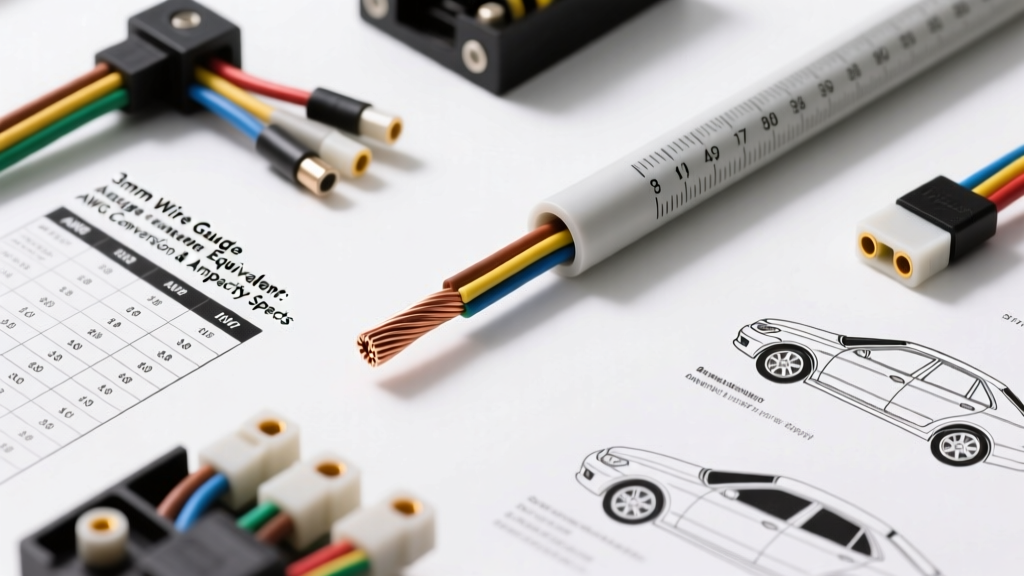
Understanding the 3mm Wire Gauge Standard in Automotive Wiring
When working on modern automotive electrical systems, technicians frequently encounter metric wire sizing alongside the traditional American Wire Gauge (AWG) standard. The 3mm wire gauge designation is a common point of confusion in the repair bay. To properly size fuses, select relays, and calculate voltage drop, it is critical to understand whether a specification refers to a 3mm² cross-sectional area or a 3mm outer diameter (OD). In 99% of automotive OEM wiring diagrams (including European and Asian imports), a "3mm" or "3.0" callout refers to the cross-sectional area of the copper conductor (3mm²), not the outer insulation diameter.
The 3mm² Metric Standard vs. 3mm Outer Diameter
A wire with a 3mm² copper cross-section is the metric equivalent of 11.5 AWG, which is universally rounded to 12 AWG in North American aftermarket applications. This wire is a heavy-duty primary cable used for high-current circuits. Conversely, a wire with a 3mm outer diameter (including insulation) typically houses a much smaller conductor, usually 18 AWG (0.82mm²) or 16 AWG (1.31mm²), depending on the insulation thickness. Using a 3mm OD wire in a circuit designed for a 3mm² cross-section will result in catastrophic voltage drop, melted insulation, and potential electrical fires. Always verify the copper cross-section when sourcing replacement primary wire.
3mm² Wire Gauge to AWG Conversion & Technical Specifications
The following specification chart details the physical and electrical properties of standard 3mm² (12 AWG equivalent) automotive primary wire, manufactured to SAE J1128 standards for low-tension primary cable.
| Specification Metric | 3mm² (Metric) | 12 AWG (SAE Equivalent) |
|---|---|---|
| Nominal Copper Area | 3.00 mm² | 3.31 mm² (AWG 12) |
| Strand Configuration (GXL) | 41 strands x 0.32mm | 41 strands x 0.32mm |
| Max Conductor Diameter | 2.40 mm | 2.45 mm |
| Resistance at 20°C (68°F) | 5.30 mΩ/m (1.61 mΩ/ft) | 5.20 mΩ/m (1.58 mΩ/ft) |
| Chassis Ampacity (Single Wire) | 25A - 30A | 25A - 30A |
| Max Voltage Rating | 60V DC (Primary Auto) | 60V DC (Primary Auto) |
Insulation Types: GXL, TXL, and SXL
When sourcing 3mm² wire for engine bay or chassis routing, the insulation type is just as critical as the copper gauge. According to standard wire engineering metrics, modern vehicles utilize thin-wall insulation to reduce harness weight and bulk.
- GXL (General Cross-Linked): The most common OEM standard. Features a thin wall thickness (approx. 0.58mm for 3mm²) and a continuous temperature rating of 125°C. Ideal for under-hood routing near exhaust manifolds.
- TXL (Thin Cross-Linked): Even thinner insulation (approx. 0.41mm). Used primarily inside the cabin or in tightly packed multi-pin connectors where space is at a premium. Rated for 125°C.
- SXL (Special Cross-Linked): Thicker insulation for high-abrasion environments. Often used in commercial trucking or heavy machinery where the harness is exposed to chassis vibration and road debris.
Common Automotive Applications for 3mm² (12 AWG) Wire
In 12V and 24V automotive systems, 3mm² wire is the backbone for medium-to-high continuous draw circuits. It is rarely used for ECU sensors or CAN-bus networks (which require 0.35mm² to 0.50mm² twisted pairs). Typical applications include:
1. Fuel Pump Feed Circuits
High-flow in-tank fuel pumps (such as the Walbro 450 or AEM 340) can draw 15A to 22A under peak load. Running a 3mm² wire from the fuel pump relay to the tank sending unit ensures the pump receives a full 13.8V, preventing vapor lock and lean fuel conditions caused by voltage starvation.
2. Headlight and Auxiliary Lighting Power
While modern LED headlights draw minimal current, older H4 dual-filament halogen bulbs draw 55W (low) and 60W (high) per bulb. A 3mm² wire is required for the main power feed from the headlight relay to the left/right bank splitters. Standard wire colors for these circuits often include Red with a White tracer (power) and Black with a Yellow tracer (ground), though this varies heavily by manufacturer.
3. Radiator Cooling Fan Relays
Primary and secondary electric cooling fans can pull 20A to 25A each upon startup (inrush current). The feed wire from the battery junction box to the fan relay, and from the relay to the fan motor, must be 3mm² or larger to handle the inrush spike without tripping the circuit breaker or melting the relay socket.
Voltage Drop Calculations for 3mm² Wiring
A wire's ampacity rating is useless if the circuit length causes excessive voltage drop. Automotive electronics, particularly EFI sensors and fuel pumps, require a minimum of 12.0V to operate correctly. We use the standard voltage drop formula: V_drop = Current × (Resistance per ft × Total Circuit Length in ft). Note that total circuit length must include both the positive and ground return paths.
Example Calculation:
You are wiring a 15A auxiliary light bar using 3mm² (12 AWG) wire. The distance from the battery to the relay is 5 feet, and from the relay to the light bar is 10 feet. The ground return to the chassis is 2 feet. Total wire length = 34 feet (rounding up for safety).
- Current (I) = 15 Amps
- Resistance of 3mm² wire = 0.00161 Ω/ft
- Total Length (L) = 34 ft
- Voltage Drop = 15 × (0.00161 × 34) = 0.82 Volts
A 0.82V drop on a 14.4V charging system leaves 13.58V at the load, which is well within the acceptable 3% voltage drop threshold for non-critical lighting. However, if this were a 25A fuel pump circuit, the drop would be 1.36V, which is borderline unacceptable for EFI systems. In high-draw, long-run scenarios, upgrading to 4mm² (10 AWG) is recommended.
Connector Specifications and Terminal Crimping
Terminating 3mm² wire requires specific open-barrel or closed-barrel terminals. Using undersized terminals creates a high-resistance bottleneck that will melt the connector housing.
- Aptiv (Delphi) Metri-Pack 280 Series: The industry standard for 3mm² wire in high-current automotive applications. The 280-size female and male terminals are rated for up to 30A. Ensure you use the correct cavity plugs and secondary locks (TPA).
- Weather-Pack 1500 Series: Excellent for external, weather-exposed connections (e.g., trailer wiring, exterior lighting). The 1500 series terminals accept 12 AWG / 3mm² wire and utilize a silicone ribbed seal for IP67 waterproofing.
- Crimping Tooling: Never use standard pliers or cheap non-ratcheting crimpers on 3mm² wire. Use a ratcheting open-barrel crimper (such as the TE Connectivity CERTI-CRIMP or equivalent IWISS tools) with the 1.5mm² - 2.5mm² / 4.0mm² die jaws. A proper crimp will yield a bellmouth on the insulation and conductor crimps, ensuring the copper strands are compressed to roughly 80% of their original volume for optimal cold-weld conductivity.
Troubleshooting Common 3mm² Wire Failures
When diagnosing electrical faults in circuits utilizing 3mm² wire, look for these specific failure modes:
1. Bulkhead Connector Corrosion (Green Rot)
In vehicles from the 1990s and early 2000s (notably GM and Chrysler trucks), the firewall bulkhead connectors often suffer from capillary action wicking. Moisture enters the 3mm² headlight or blower motor wires and wicks under the insulation, causing copper oxidation (green rot) deep inside the harness. Fix: Do not simply repin the connector. You must cut back the wire at least 6 inches to find clean, shiny copper before splicing and repinning.
2. Chafing at Firewall Grommets
Because 3mm² wire is relatively stiff (especially in cold weather), it can wear through its GXL insulation if the firewall rubber grommet is missing or torn. The wire rubs against the sharp sheet metal edge, causing a dead short to ground. This usually blows a 20A or 25A maxi-fuse instantly. Fix: Replace the grommet, wrap the 3mm² wire in split-loom and Tesa tape, and apply dielectric grease to the grommet lip to prevent future friction.
3. Relay Socket Melt-Downs
If a 3mm² wire is crimped poorly, the resistance at the terminal increases. According to Joule's first law, heat generation increases with resistance. This localized heat transfers into the plastic relay socket, melting the housing and causing the relay pins to lose tension. Fix: Replace the entire pigtail socket, cut back the heat-discolored wire, and use a ratcheting crimper with adhesive-lined marine heat shrink to seal the termination.