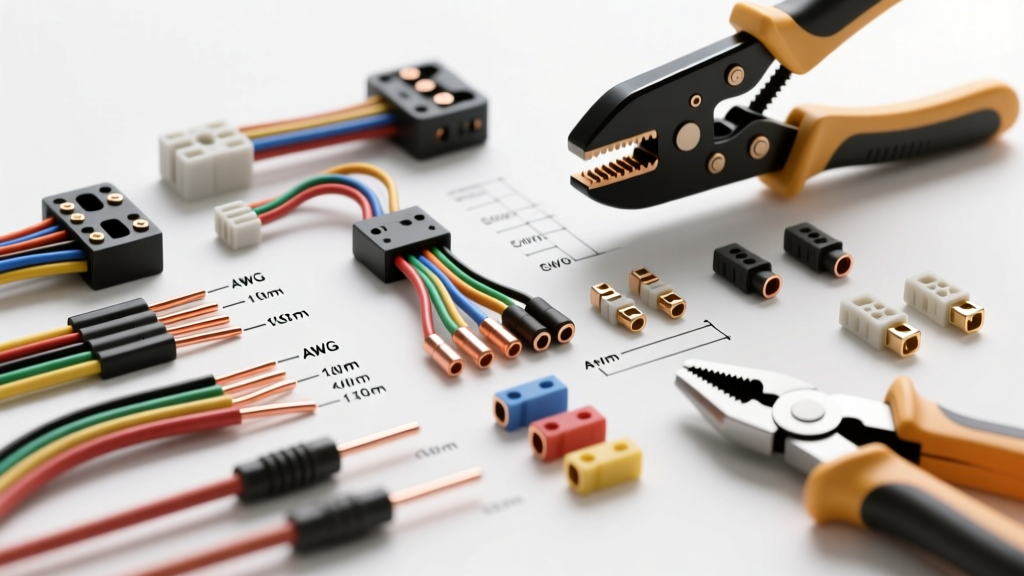
The Hidden Costs of Mixing AWG and Metric Wiring Systems
When integrating North American AWG harnesses with JDM or European chassis, understanding the exact wire gauge to mm conversion is only the first step. The true bottleneck lies in the tooling and material costs required to properly terminate and protect these mixed-standard circuits. For automotive electrical experts and DIY builders alike, miscalculating the financial and logistical requirements of a cross-standard rewire can lead to blown budgets, high-resistance joints, and dangerous electrical faults under the hood.
Why Wire Gauge to MM Conversions Matter in Modern Swaps
North American vehicles rely on the American Wire Gauge (AWG) system, standardized under the SAE J1128 Automotive Wire Standard. Conversely, Japanese (JIS) and European (DIN/ISO) manufacturers use metric cross-sectional areas (mm²), governed by ISO 6722-1 Metric Wire Specifications. A 16 AWG wire has a cross-section of 1.31 mm², but the nearest metric equivalent is 1.25 mm². While the ampacity difference is negligible for low-draw sensors, attempting to crimp a 1.25 mm² metric terminal onto 16 AWG wire (or vice versa) results in improper deformation. This causes the crimp wings to splay, reducing pull-out force below the required minimum and leading to catastrophic voltage drops in critical circuits like fuel injectors or ignition coils.
Comprehensive Wire Gauge to MM Reference & Cost Chart
Below is a technical reference chart comparing standard AWG sizes to their metric equivalents, including real-world ampacity ratings for engine-bay temperatures (105°C) and estimated bulk material costs for high-quality automotive primary wire (GXL/TXL vs. FLRY-B/AVSS).
| AWG Size | Metric Equiv (mm²) | Actual Area (mm²) | Max Ampacity (105°C) | AWG Wire Cost / 100ft | Metric Wire Cost / 100ft |
|---|---|---|---|---|---|
| 18 AWG | 0.75 mm² | 0.82 mm² | 10 Amps | $14.00 | $28.00 |
| 16 AWG | 1.25 mm² | 1.31 mm² | 13 Amps | $16.00 | $32.00 |
| 14 AWG | 2.00 mm² | 2.08 mm² | 19 Amps | $21.00 | $41.00 |
| 12 AWG | 3.00 mm² | 3.31 mm² | 26 Amps | $28.00 | $55.00 |
| 10 AWG | 5.00 mm² | 5.26 mm² | 35 Amps | $42.00 | $78.00 |
| 8 AWG | 8.00 mm² | 8.37 mm² | 48 Amps | $65.00 | $115.00 |
Tool Requirements: Crimpers, Strippers, and Terminals
The most significant hidden cost in a mixed-standard rewire is the tooling. You cannot reliably use AWG crimp dies on metric terminals, nor can you use standard wire strippers on thin-wall metric insulation without risking strand damage.
Ratcheting Crimper Costs: AWG vs. Metric Dies
Metric terminals, such as the Yazaki 090 series or TE Connectivity Superseal 1.5 (detailed in TE Connectivity Automotive Crimp Tooling Guides), require specific die profiles that match the metric wire barrel dimensions. Using a standard AWG 22-10 crimper on a 1.25 mm² Yazaki terminal will over-compress the barrel, crushing the copper strands and creating a high-resistance bottleneck.
- Entry-Level AWG Crimper (e.g., Titan 11502): ~$25. Adequate for domestic Weather-Pack and Metri-Pack 150 terminals.
- Metric-Specific Ratcheting Crimper (e.g., IWISS SN-48B with metric dies): ~$45-$60. Essential for JDM/Euro harness repairs.
- Professional Interchangeable System (e.g., Rennsteig PEW 12): ~$250+. Features quick-swap die sets for both AWG and mm² profiles, ensuring perfect bell-mouth crimps every time.
Wire Stripping Tools for Thin-Wall Metric Wire
European FLRY-B and Japanese AVSS wires feature ultra-thin insulation to save weight and increase flexibility in tight engine bays. Standard automatic wire strippers often nick the copper strands of thin-wall metric wire, reducing the effective cross-section and ampacity. To strip 0.75 mm² to 2.00 mm² metric wire safely, you need precision manual strippers or high-end automatics.
- Standard Automatic Strippers: ~$20. High risk of nicking AVSS/FLRY-B insulation.
- Precision Manual Strippers (e.g., Knipex MultiStrip 10): ~$95. Automatically adjusts to the exact metric insulation thickness without cutting into the conductor.
Material Sourcing: GXL/TXL vs. FLRY-B vs. AVSS
Sourcing the correct wire type drastically impacts your budget. North American GXL (General Cross-Linked) and TXL (Thin-Wall Cross-Linked) wires are widely available at auto parts stores and bulk suppliers for roughly $0.15 to $0.30 per foot. However, if you are extending a factory JDM harness, splicing GXL into AVSS (Automotive Vinyl Shielded Slim) creates a stiffness mismatch that can lead to fatigue breaks at the splice joint over time due to differing vibration harmonics.
Sourcing genuine JIS AVSS or DIN FLRY-B wire usually requires specialized electronics distributors (like Mouser or Digi-Key) or dedicated import wiring shops. Expect to pay a 70% to 100% premium for metric-spec wire compared to domestic AWG equivalents. Furthermore, metric wire color codes do not align with SAE standards. For example, a factory Nissan ground wire is typically Black, while a GM ground is Black/White. You must budget extra for heat-shrink labeling or spiral wrap to maintain serviceability.
Real-World Case Study: LS-Swapping a Nissan 240SX (S14)
To illustrate the true cost of a wire gauge to mm conversion project, let us examine one of the most popular engine swaps: mating a GM LS1 V8 harness to a Nissan S14 chassis.
The Harness Mismatch
The GM LS1 harness utilizes 18 AWG and 16 AWG TXL wire with Delphi Metri-Pack 150 and 280 series connectors. The S14 chassis harness uses 1.25 mm² and 2.0 mm² AVSS wire with Yazaki 090 and 110 series connectors. You are not just adapting wires; you are adapting entirely different terminal retention and sealing philosophies.
Splicing vs. Adapter Harness Costs
Option A: Pre-Made Adapter Harness
Companies like Rywire or Specialty Z offer plug-and-play adapter harnesses that feature GM Metri-Pack connectors on one end and Yazaki connectors on the other, utilizing the correct step-down crimps internally.
Estimated Cost: $180 - $250.
Labor Time: 1 hour.
Option B: DIY Splicing and Repinning
If you choose to cut and splice the harnesses yourself, you must purchase metric Yazaki terminals, AWG Delphi terminals, and step-down crimp sleeves for the transitions. For example, merging the GM Tachometer signal (Dark Green, 18 AWG, ECU Pin 48) to the S14 Tach input (Black/White, 1.25 mm², Cluster Pin 14) requires an 18 AWG to 1.25 mm² step-down crimp sleeve to ensure the smaller metric terminal barrel is not crushed by the larger AWG wire.
Estimated Cost: $65 (Terminals, seals, metric wire pigtails, step-down sleeves, and heat shrink).
Labor Time: 8-12 hours of careful pin extraction, crimping, and continuity testing.
Failure Modes of Incorrect DIY Conversion
If a builder forces an 18 AWG wire into a 0.75 mm² Yazaki terminal without a step-down sleeve, the crimp wings will not fully close. Under hood vibration, the wire will back out of the terminal cavity. Because the S14 uses a capillary-style weather seal that rides directly on the wire insulation, an improperly seated wire will also compromise the silicone seal, allowing moisture to wick into the ECU via capillary action, eventually destroying the engine management system.
Summary: Budgeting for Your Harness Build
When planning a rewire that crosses international standards, do not rely solely on a basic wire gauge to mm conversion chart. The physical dimensions of the wire dictate the tooling you must buy, the terminals you must source, and the long-term reliability of the circuit. Budget an additional $100-$150 for metric-specific ratcheting crimpers and precision wire strippers if you do not already own them. Factor in the premium cost of JIS/DIN spec wire if you are extending factory harnesses, and always use step-down crimp sleeves when mating AWG conductors to metric terminal barrels. By respecting the mechanical differences between AWG and mm² systems, you ensure a safe, reliable, and professional-grade automotive electrical system.