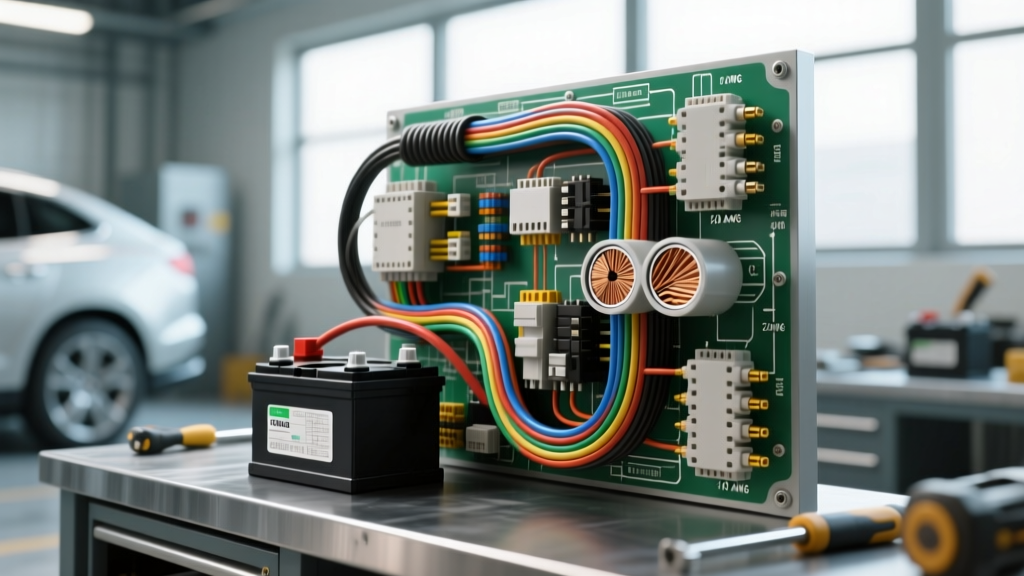
The Physics of Starter Current and Cable Sizing
When automotive technicians and DIY enthusiasts ask, "what gauge wire are battery cables," the answer is rarely a single number. Battery cables are the arterial pathways of a vehicle's electrical system, responsible for transferring massive transient currents from the battery to the starter motor, and subsequently managing the continuous charging current from the alternator. Unlike standard 18-gauge lighting circuits, battery cables must handle extreme amperage spikes—often exceeding 250 to 400 amps for several seconds during engine cranking—without suffering catastrophic voltage drop or thermal meltdown.
Undersizing these cables is one of the most common and dangerous electrical mistakes in automotive repair. A cable that is too thin acts as a resistor. According to Ohm's Law, as resistance increases under a high-amperage load, voltage drops and heat generation (I²R loss) spikes. This not only starves the starter solenoid of the voltage it needs to engage properly—resulting in the dreaded 'clicking' sound—but it can also melt insulation, ignite nearby combustible materials, or destroy sensitive alternator diode bridges due to voltage spikes.
What Gauge Wire Are Battery Cables? (By Vehicle Class)
To determine the correct American Wire Gauge (AWG), you must evaluate the maximum amperage draw of the starter and the total round-trip length of the cable. Note that 'round-trip' means the distance from the battery to the starter and back to the ground, which effectively doubles the physical length of a single cable for resistance calculations.
- Compact & Mid-Size Vehicles (4-Cylinder / V6): Typically require 4 AWG or 2 AWG pure copper cable. These starters generally draw between 120A and 180A under load.
- Full-Size Trucks & SUVs (V8 Gas): Require 1 AWG or 1/0 AWG (One-Aught). High-compression V8 engines demand 200A to 250A to overcome initial mechanical resistance.
- Heavy Duty & Diesel Applications (Cummins, Duramax, Powerstroke): Demand 2/0 AWG to 4/0 AWG (Two-Aught to Four-Aught). Diesel starters feature massive torque requirements and dual-battery setups, pulling 300A to over 500A during cold cranking.
Battery Cable AWG Specification & Ampacity Chart
The following reference chart outlines the minimum pure copper AWG requirements based on maximum amperage and cable length, adhering to a strict 3% voltage drop limit (approx. 0.36V on a 12V system) as recommended by the Pacer Group Wire Size Chart and marine/automotive electrical standards.
| Max Amperage | 0-5 ft Length | 5-10 ft Length | 10-15 ft Length | Metric Equiv. |
|---|---|---|---|---|
| 100A - 150A | 4 AWG | 2 AWG | 1 AWG | 16mm² - 25mm² |
| 150A - 200A | 2 AWG | 1 AWG | 1/0 AWG | 25mm² - 35mm² |
| 200A - 250A | 1 AWG | 1/0 AWG | 2/0 AWG | 35mm² - 50mm² |
| 250A - 300A | 1/0 AWG | 2/0 AWG | 3/0 AWG | 50mm² - 70mm² |
| 300A - 400A | 2/0 AWG | 3/0 AWG | 4/0 AWG | 70mm² - 95mm² |
Note: Always round up to the next largest wire gauge if your calculated length or amperage falls between categories.
Five Dangerous Battery Cable Sizing Mistakes
1. Sizing for Continuous Amps Instead of Surge (Cranking) Amps
A common failure mode is selecting a cable based on the alternator's output (e.g., 140A) rather than the starter's surge draw. A starter motor experiences 'locked rotor' amperage for a fraction of a second upon initial engagement, which can be double or triple its running amperage. If a cable is sized only for the alternator's continuous charge rate, the voltage drop during cranking will starve the ECU and fuel injectors, causing extended crank times or no-start conditions.
2. The CCA (Copper Clad Aluminum) Trap
Many budget-friendly replacement cables sold in big-box auto parts stores are made of Copper Clad Aluminum (CCA) rather than pure stranded copper. Aluminum has approximately 61% the conductivity of copper. Furthermore, aluminum is highly susceptible to galvanic corrosion when mated to copper battery terminals, leading to a high-resistance crust that mimics a dead battery. Always verify that the cable is stamped with SAE J1128 compliance and is 100% oxygen-free copper.
3. Ignoring the Ground Path
Technicians frequently upgrade the positive battery cable to 1/0 AWG but leave the factory 4 AWG negative ground cable intact. The electrical circuit is only as robust as its weakest link. A high-resistance ground path will force the starter to pull current through alternative, smaller ground paths, such as the transmission shift linkage or engine hoist brackets, instantly welding or melting those components.
4. Failing to Account for Heat and Bundling
The SAE J1128 Standard for low-tension primary cables dictates that ampacity ratings are based on a wire in free air at 20°C. In an engine bay, battery cables are often routed near exhaust manifolds and bundled inside corrugated loom. Heat increases the electrical resistance of copper. If a cable is routed near a heat source, you must upsize by at least one AWG tier to compensate for thermal resistance and prevent the PVC or XLPE insulation from melting and shorting to the chassis.
5. Using Incorrect Terminal Lugs and Crimping Methods
A 2/0 AWG cable is useless if the terminal lug is only crimped with standard pliers. High-amperage battery cables require a heavy-duty hex-crimp or indent crimp using a hydraulic or ratcheting 6-ton crimper. A loose crimp creates a microscopic air gap that will arc under 300A of load, generating immense heat and eventually causing a fire.
Safety Warnings: Fusing and Alternator Protection
One of the most severe safety warnings regarding battery cables involves overcurrent protection. The main positive battery cable runs directly from the battery to the starter and alternator. In the event of a collision or a chafed cable shorting to the engine block, an unfused battery cable can deliver thousands of amps of short-circuit current, instantly igniting the vehicle's wiring harness.
Mandatory Fusing: Modern automotive electrical standards require a high-amperage fuse or fusible link located within 18 inches of the positive battery terminal. For most V8 applications, a 250A to 300A ANL or Mega Fuse is required. This fuse is sized to blow only under a dead short, allowing the 400A transient cranking surge to pass without interruption, but protecting the vehicle from a catastrophic electrical fire if the main cable is severed.
Alternator Diode Destruction: If a battery cable is undersized or suffers from severe corrosion at the terminal, the alternator's voltage regulator will sense a low voltage at the battery. To compensate, the regulator will push the alternator to maximum field current, attempting to force voltage through the resistance. This prolonged high-output state generates excessive heat inside the alternator, frequently burning out the internal diode bridge and destroying the unit.
Terminal Torque and Corrosion Prevention Specifications
Proper mechanical connection is just as critical as the wire gauge itself. When installing heavy-duty lugs to side-post batteries or top-post clamps, precise torque is required to ensure maximum surface contact area without stripping the soft lead threads of the battery post.
- Top Post Clamps (M8 Bolt): Torque to 5-7 Nm (44-62 lb-in).
- Side Post Terminals (M8x1.25 Bolt): Torque to 10-13 Nm (89-115 lb-in).
- Starter Solenoid Stud (M8 or M10 Nut): Torque to 12-15 Nm, utilizing a star washer to bite through surface oxidation.
Finally, always seal the crimped terminal connection with dual-wall adhesive-lined heat shrink. Standard electrical tape will degrade under hood temperatures and allow moisture to wick into the copper strands via capillary action, turning the inside of your expensive 1/0 AWG cable green with copper oxide, effectively ruining its conductivity from the inside out. For further technical data on wire sizing and voltage drop calculations, refer to the Del City Electrical Resources database.