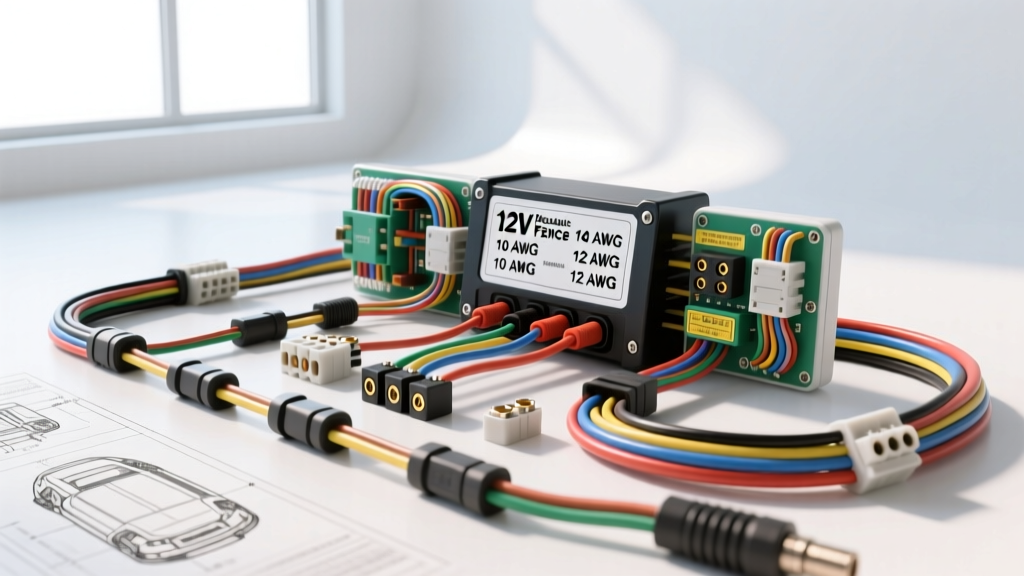
Mobile Agricultural Power: What Gauge Wire for Electric Fence Chargers?
When agricultural professionals, overlanders, and RV owners ask what gauge wire for electric fence systems, they are typically referring to the high-impedance steel, aluminum, or polywire strung along fence posts. However, from an automotive electrical perspective, the critical question is what gauge wire for electric fence energizer power and grounding when running off a 12V vehicle battery or auxiliary RV bank. Mobile fence chargers are essential for rotational grazing, horse containment, and off-grid agricultural work trucks. Powering these 12V DC energizers requires strict adherence to automotive wiring standards to prevent voltage drop, oscillator failure, and fire hazards.
In this cost and tool requirements analysis, we bridge the gap between agricultural fencing and automotive electrical systems. We will break down the exact SAE AWG specifications, connector pinouts, and tooling required to build a bulletproof, quick-disconnect mobile fence charger system for your truck bed or camper rig.
The AWG Reality: DC Input vs. High-Tension Fence Wire
Fencing wire is typically measured in Standard Wire Gauge (SWG) or millimeters (e.g., 2.5mm high-tensile steel). Automotive wiring, however, relies on the American Wire Gauge (AWG) system, specifically governed by the SAE J1128 standard for low-tension primary cables. The DC input side of a 12V fence charger is highly sensitive to voltage drops. While the energizer may only draw 1.5 to 3 Amps continuously, the internal oscillator circuit requires a stable 11.5V to 13.5V to properly step up the voltage to the 5,000+ joule output required to contain livestock. Undersizing the DC input wire based on continuous amperage alone—ignoring run length and inrush current—is the most common failure mode in mobile setups.
Cost Analysis: SAE Automotive Wire vs. Hardware Store Alternatives
When outfitting a work truck or RV for agricultural use, the temptation to use cheap, off-the-shelf hardware store wire is high. Here is a cost and reliability breakdown of your options:
| Wire Type | Insulation | Cost per 100ft (8 AWG) | Automotive Viability |
|---|---|---|---|
| SAE GXL / TXL | Cross-Linked Polyethylene (XLPE) | $45.00 - $60.00 | Excellent. Resists UV, manure chemicals, and high engine bay temps (up to 125°C). Thin-wall allows for easier routing. |
| THHN / THWN | PVC with Nylon Jacket | $30.00 - $40.00 | Poor. Designed for conduit. The nylon jacket degrades rapidly when exposed to UV and agricultural acids. |
| CCA (Copper-Clad Aluminum) | PVC | $15.00 - $25.00 | Dangerous. High resistance, prone to galvanic corrosion at crimp terminals, and snaps under vehicle vibration. |
Verdict: SAE GXL (General Cross-Linked) is the only acceptable choice for mobile fence charger wiring. The upfront cost is roughly 30% higher than THHN, but it eliminates the hidden costs of premature failure and voltage-induced charger burnout.
Essential Tool Requirements for Mobile Fence Installations
Executing a professional-grade mobile wiring job requires specific automotive electrical tooling. Standard pliers and electrical tape will fail in the vibration-heavy, moisture-rich environment of a truck bed.
- Ratcheting Wire Crimper: Required for heavy-gauge terminals (8 AWG to 4 AWG). A ratcheting mechanism ensures the exact compression ratio needed for a gas-tight crimp, preventing moisture ingress.
- Adhesive-Lined Heat Shrink (Marine Grade): 3M or equivalent 3:1 shrink ratio tubing with internal polyamide hot-melt adhesive. This seals the wire barrel against water and fertilizer chemicals.
- Wire Strippers with AWG Gauges: To prevent nicking the copper strands, which reduces the effective cross-sectional area and creates a localized hot spot.
- Digital Multimeter (DMM): Essential for measuring voltage drop under load at the charger terminals.
12V DC Energizer Wiring Specification Chart
Use the following chart to determine the correct SAE AWG size based on your specific energizer's joule rating and the physical distance from your vehicle's battery or auxiliary power distribution bus. Calculations assume a maximum 3% voltage drop (0.36V on a 12V system) for optimal oscillator performance.
| Energizer Output (Joules) | Max Continuous Draw | Recommended SAE AWG (Up to 10ft) | Recommended SAE AWG (10ft - 25ft) | Inline Fuse (ATC/ATO) |
|---|---|---|---|---|
| 0.5 - 1.5 J | 1.5 Amps | 14 AWG | 12 AWG | 5A |
| 2.0 - 5.0 J | 3.0 Amps | 12 AWG | 10 AWG | 10A |
| 6.0 - 15.0 J | 5.5 Amps | 10 AWG | 8 AWG | 15A |
| 15.0+ J (Low Impedance) | 8.0+ Amps | 8 AWG | 6 AWG | 20A |
Quick-Disconnect Integration: Anderson SB50 Pinouts & Wiring
For work trucks and RVs, hardwiring the fence charger directly to the battery is impractical. We recommend installing an Anderson Power SB50 quick-disconnect receptacle in the truck bed or bumper. This allows you to plug in the fence charger only when needed, drawing power from the vehicle's dual-battery isolator or auxiliary AGM/LiFePO4 bank.
Anderson SB50 Assembly Specifications
- Housing: Gray SB50 (Part 6368G1) - Color-coded to prevent cross-plugging with 12V winch circuits.
- Contacts (8-10 AWG): Part 6812G1 (Crimp barrel accommodates SAE 8-10 AWG GXL).
- Contacts (6 AWG): Part 6813G2 (For high-joule 15A+ setups).
- Pin Configuration: Pin 1 (Left): Red Wire (12V+ Battery Feed). Pin 2 (Right): Black Wire (Chassis Ground).
- Crimp Pull-Out Force: A proper ratcheting crimp on an Anderson 6812G1 terminal using 10 AWG GXL wire should withstand a minimum pull-out force of 75 lbs before mechanical failure.
Always route the 12V+ feed from an auxiliary fuse block (such as a Blue Sea Systems ST-Blade) rather than directly to the positive battery terminal, ensuring the circuit is protected by a relay controlled by the ignition switch to prevent parasitic drain when the truck is parked.
Grounding: The Hidden Cost of Voltage Drop
The most misunderstood aspect of mobile electric fencing is the ground return. While the vehicle's steel chassis is an excellent ground for automotive lighting, it is highly susceptible to paint, rust, and bed-liner interference. Furthermore, the fence charger's 'Earth' terminal requires a dedicated ground rod driven into the soil, separate from the vehicle's chassis ground.
To connect the SAE GXL wire to the galvanized steel ground rod, do not use solid copper wire, which will snap if the rod is bumped. Instead, use a braided automotive ground strap (typically 4 AWG or 2 AWG flat braid) terminated with a heavy-duty ring terminal and a stainless steel hose clamp or dedicated bronze ground rod clamp. This ensures high-strand flexibility and maximum surface area contact, minimizing resistance in the soil return path.
Troubleshooting Mobile Fence Charger Electrical Faults
When your mobile agricultural setup fails, use this symptom-cause-fix decision tree to diagnose the electrical fault:
- Symptom: Energizer indicator light flashes, but fence tester reads less than 2,000V.
- Cause: Severe voltage drop on the 12V DC input side due to undersized wire, corroded Anderson SB50 contacts, or a failing auxiliary battery.
- Fix: Connect a DMM directly to the energizer's input terminals while the unit is clicking. If voltage drops below 11.2V during the pulse cycle, upgrade the SAE GXL wire to the next thickest AWG and clean the SB50 contacts with electrical contact cleaner.
- Symptom: Fence charger clicks normally, but shock is weak; vehicle dashboard lights flicker in sync with the fence pulse.
- Cause: Ground fault. The charger's Earth terminal is improperly bonded to the vehicle chassis instead of a dedicated earth rod, causing high-voltage pulses to backfeed into the truck's CAN-bus or lighting ground.
- Fix: Isolate the charger's Earth terminal completely from the vehicle. Run a dedicated 8 AWG Black SAE wire from the charger's Earth terminal to a minimum 4-foot galvanized ground rod driven into moist soil at least 10 feet away from the vehicle's tires.
- Symptom: Inline ATC fuse blows immediately upon connecting the Anderson plug.
- Cause: Short circuit in the DC input wiring, often caused by non-adhesive heat shrink failing and allowing the Red 12V+ wire to short against the truck bed metal.
- Fix: Inspect the entire wire loom. Replace damaged sections with SAE GXL and seal all terminations with 3M adhesive-lined marine heat shrink. Verify the fuse rating matches the specification chart above; do not simply install a larger fuse.
By treating your mobile electric fence energizer with the same rigorous electrical standards as your vehicle's EFI or CAN-bus systems, you ensure reliable livestock containment regardless of how far off-grid your agricultural operations take you. For further reading on heavy-duty agricultural energizer specifications, refer to the engineering guidelines provided by Gallagher Fencing Systems.