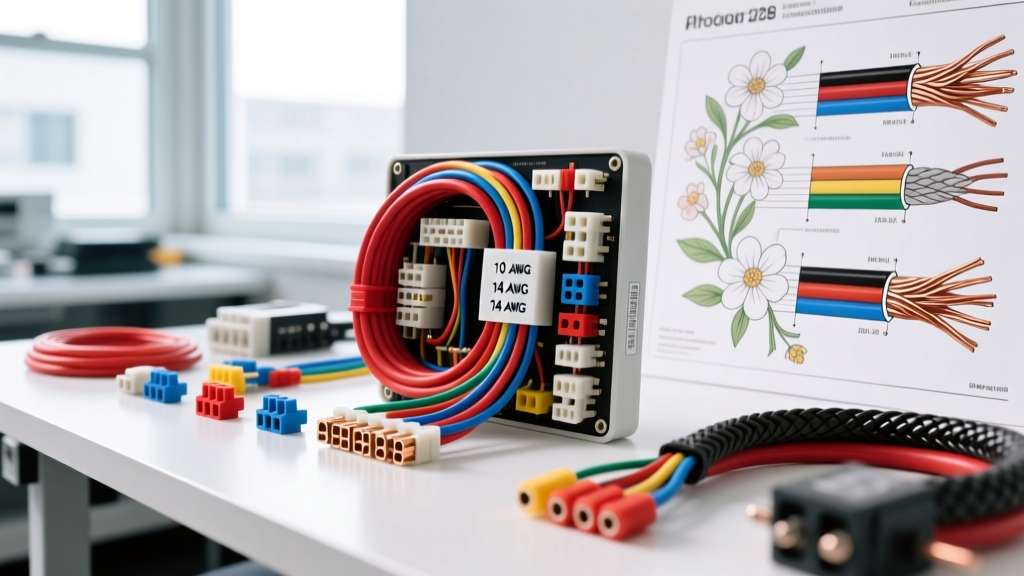
The Hidden Danger of Craft Wire in Vehicle Harnesses
In the world of custom automotive builds, show cars, and intricate interior upholstery, fabricators frequently encounter tight routing constraints. This leads some hobbyists to search for alternatives to standard harness wire, occasionally landing on craft or floral wire due to its low cost and high malleability. However, misunderstanding flower wire gauge measurements and substituting craft wire for automotive-grade conductors is a severe fire hazard. This technical reference breaks down the metallurgical, dimensional, and insulation discrepancies between floral wire and SAE-certified automotive cable, explaining exactly why craft wire has no place in a 12-volt or 24-volt vehicle electrical system.
Dimensional Discrepancies: SWG vs. AWG
The most critical error builders make is assuming a gauge number is a universal constant. It is not. Automotive electrical systems in North America rely strictly on the American Wire Gauge (AWG) standard, which dictates specific diameters, stranding requirements, and direct current resistance (DCR) limits. Conversely, much of the imported craft, jewelry, and flower wire utilizes the Standard Wire Gauge (SWG), also known as Imperial Wire Gauge, or the Birmingham Wire Gauge (BWG).
For example, an 18-gauge floral wire measured in SWG has a physical diameter of 1.219 mm. An 18 AWG automotive wire has a diameter of 1.024 mm. While the SWG flower wire is physically thicker, it is often manufactured from steel or aluminum with a microscopic copper flash, rather than pure electrolytic tough pitch (ETP) copper. This means the 18 SWG flower wire possesses a significantly higher electrical resistance per foot than 18 AWG copper. When pushed to the ampacity limits of a standard 18 AWG circuit, the high-resistance floral wire will experience catastrophic voltage drop and thermal runaway, melting its decorative outer coating and igniting surrounding upholstery materials.
Technical Specification Comparison Chart
The table below illustrates the severe performance gaps between standard automotive chassis wiring and typical craft-grade floral wire. Note the drastic differences in maximum current capacity and thermal limits.
| Nominal Gauge | Standard Type | Core Material | Stranding | Max Ampacity (Chassis) | Temp Rating |
|---|---|---|---|---|---|
| 18 Gauge | AWG (SAE J1128) | Pure ETP Copper | 16-Strand | 16 Amps | 125°C (XLPE) |
| 18 Gauge | SWG (Floral/Craft) | Steel/Copper-Clad | Solid Core | 4 Amps (Severe Drop) | 60°C (Degrades) |
| 22 Gauge | AWG (SAE J1128) | Pure ETP Copper | 7-Strand | 9 Amps | 125°C (XLPE) |
| 22 Gauge | SWG (Floral/Craft) | Aluminum Alloy | Solid Core | 2 Amps | 50°C (Enamel Melt) |
| 24 Gauge | AWG (MIL-SPEC) | Silver-Plated Copper | 19-Strand | 6 Amps | 150°C (Tefzel) |
| 24 Gauge | BWG (Floral/Craft) | Brass/Zinc Alloy | Solid Core | 1.5 Amps | 45°C (Paper Wrap) |
Insulation and Thermal Breakdown Limits
Automotive wire insulation is engineered to survive extreme environments. According to the SAE International J1128 Standard, automotive primary cable must utilize specialized insulation like Cross-linked Polyethylene (XLPE) or high-grade Polyvinyl Chloride (PVC). These materials are rated for continuous operation at 90°C to 125°C, resist absorption of petroleum-based fluids (oil, brake fluid, transmission fluid), and possess built-in flame retardants that self-extinguish if a short circuit occurs.
Enamel, Paper, and Thin PVC Failures
Flower wire is typically sold bare, enameled, or wrapped in decorative, non-fire-retardant materials like thin paper, silk, or low-density plastic. Enamel coatings, commonly found on craft wire meant for jewelry making, begin to blister and melt at temperatures as low as 60°C. In an automotive engine bay or even inside a closed door panel exposed to summer sunlight, ambient temperatures can easily exceed this threshold. Once the enamel fails, the bare metal shorts against the vehicle chassis. Because floral wire lacks the structural integrity to hold a standard automotive blade fuse in a proper fuse block, the circuit often bypasses overcurrent protection entirely, resulting in an uncontrolled electrical fire.
Vibration Fatigue: Solid Core vs. Multi-Strand
Another fundamental difference lies in the physical construction of the conductor. Automotive wire is heavily stranded to withstand the constant, high-frequency vibrations of an internal combustion engine and road surface impacts. The Alpha Wire Technical Resources documentation highlights that multi-strand copper distributes mechanical stress across dozens of individual filaments, preventing work hardening and metal fatigue.
Flower wire is almost exclusively solid core. When a solid core wire is routed through a vehicle door jamb, steering column, or trunk hinge, the repeated bending and vehicle vibration cause the metal to work-harden. Within weeks, the solid floral wire will develop microscopic fractures, eventually snapping completely. This creates a high-resistance arcing point inside the wire insulation, generating intense localized heat that will scorch surrounding headliners and carpeting long before a fuse blows.
Crimping and Termination Incompatibilities
Modern automotive harnesses rely on open-barrel crimp terminals (such as Delphi/Packard or Yazaki connectors). These terminals are engineered with specific crimp wings designed to bite into and compress multi-strand copper, creating a gas-tight, cold-welded connection. If you attempt to crimp an open-barrel terminal onto a solid-core steel or aluminum flower wire, the crimp wings will either slice entirely through the soft craft metal or fail to deform properly. This results in a loose connection that introduces massive electrical resistance. Under a 10-amp load, this poor crimp will act as a heating element, melting the plastic connector housing and causing intermittent electrical failures in critical systems like fuel injectors or ignition coils.
Real-World Failure Modes in Custom Builds
When fabricators ignore the realities of flower wire gauge specifications, specific failure modes inevitably emerge in custom vehicles:
- LED Halo Ring Meltdowns: Builders use 22-gauge floral wire to route power to custom headlight halos. The thin enamel scrapes off against the sharp metal edges of the headlight housing. The resulting short circuit grounds out the entire front lighting module, blowing the main body control module (BCM) driver.
- Galvanic Corrosion in Upholstery: Copper-clad steel floral wire is sewn into custom leather seats for heated seat elements or integrated lighting. The moisture from passenger humidity reacts with the dissimilar metals, creating severe galvanic corrosion that turns the wire to dust and causes open circuits.
- Audio System Noise: Using craft wire for low-level RCA or remote turn-on signals introduces massive electromagnetic interference (EMI) and voltage drop, resulting in alternator whine and popping sounds in high-end aftermarket audio amplifiers.
Proper Automotive Alternatives for Delicate Routing
If your project requires extremely thin, highly flexible wire for tight spaces like gauge cluster backlighting, custom switch panels, or delicate sensor routing, do not compromise with craft wire. Instead, specify MIL-W-22759/16 (Tefzel) wire. Tefzel insulation is incredibly thin, allowing for a smaller overall outer diameter than standard SAE PVC, but it is rated for 150°C and is completely impervious to chemicals and abrasion. Furthermore, it utilizes proper AWG sizing and high-strand-count silver-plated copper, ensuring that your custom build remains safe, reliable, and compliant with automotive electrical engineering standards. Always verify your wire specifications against the Engineering Toolbox AWG Standards before terminating any circuit in a vehicle.