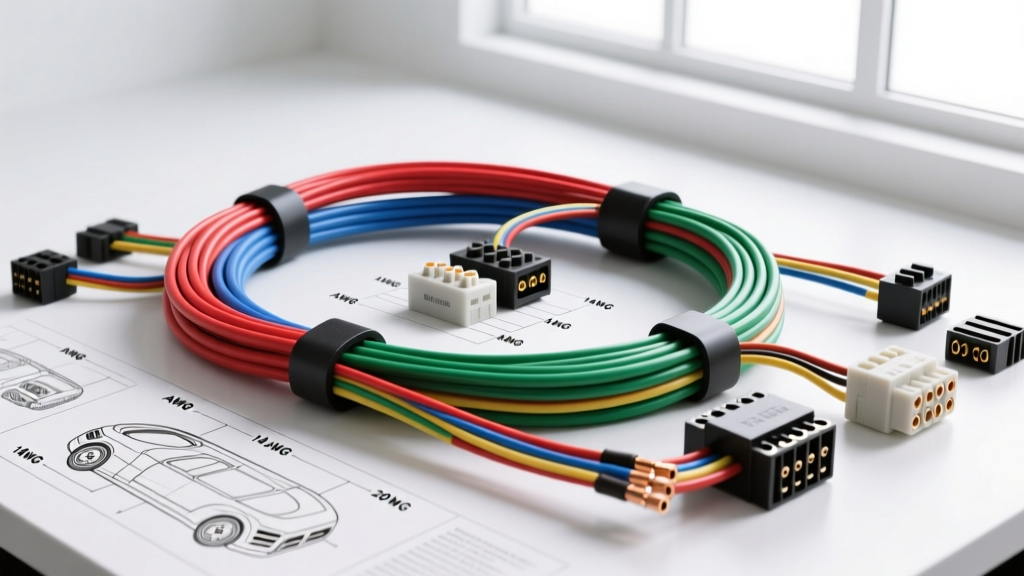
The Garage Trap: Understanding Guitar Wire Gauge
Welcome to the garage. You are wiring up a new aftermarket head unit, patching a flickering taillight, or grounding an amplifier. Digging through your toolbox, you find a spool of leftover wire from an electric guitar or pedalboard project. It is shiny, copper, and bends easily. 'Wire is wire, right?' Wrong. Understanding why guitar wire gauge is fundamentally incompatible with 12-volt automotive DC systems is a crucial rite of passage for beginner auto electricians.
When hobbyists ask about guitar wire gauge, they are usually referring to the 22 AWG or 24 AWG solid-core, tinned-copper hookup wire used inside Fender Stratocasters, Les Pauls, and effects pedals. This wire is engineered for high-impedance, low-current AC audio signals measured in milliamps. Automotive electrical systems, however, operate on 12V to 14.4V DC and demand high-current capacity measured in Amps. Using audio wire in a vehicle is not just a performance mistake; it is a severe fire hazard.
Solid Core vs. Stranded: The Vibration Factor
The most critical difference between guitar wire and automotive wire lies in the copper stranding. Guitar wire is almost exclusively solid core. Automotive wire, governed by the SAE J1128 Low-Tension Primary Cable Standard, must be multi-stranded.
Why Solid Core Snaps Under the Hood
A vehicle is a high-vibration environment. Engine harmonics, chassis flex, and road impacts constantly shake the wiring harness. Solid core wire suffers from metal fatigue and 'work hardening.' When a solid 22 AWG wire is subjected to continuous vibration, the copper crystallizes and eventually snaps inside the insulation. This creates an intermittent open circuit or, worse, a dead short if the broken ends arc against the chassis.
Furthermore, standard automotive ratcheting crimpers (like the IWISS SN-28B or Titan 11477) feature dies designed to compress stranded copper into a terminal barrel. Solid core wire does not compress; it gets sheared or deformed by the crimp die. This results in a loose connection inside a Metripack 280 or Packard 56 connector, leading to voltage drop, arcing, and melted housings.
Ampacity Showdown: Guitar Wire vs. Automotive GXL
Ampacity is the maximum amount of electric current a conductor can carry before the insulation melts or the wire acts as a fuse. Because guitar wire is typically 22 AWG or 24 AWG, its cross-sectional area is far too small for most automotive circuits. Below is a comparison chart detailing the dangers of substituting audio wire for automotive GXL (General Cross-Linked) wire.
| Wire Type | Gauge (AWG) | Max Ampacity (Chassis) | Resistance (Ohms/1000ft) | Insulation Material |
|---|---|---|---|---|
| Guitar Hookup Wire | 22 AWG (Solid) | ~3 to 5 Amps | 16.14 Ω | PVC / Cloth Braid |
| Automotive GXL | 22 AWG (Stranded) | ~7 Amps | 16.46 Ω | XLPE (125°C) |
| Automotive GXL | 18 AWG (Stranded) | ~16 Amps | 6.51 Ω | XLPE (125°C) |
| Automotive GXL | 14 AWG (Stranded) | ~32 Amps | 2.58 Ω | XLPE (125°C) |
Source: Prowire USA AWG Ampacity Charts & SAE J1128 Guidelines.
The Voltage Drop Reality Check
Let us apply Ohm's Law to a real-world scenario. You decide to use 10 feet of 22 AWG guitar wire to power a pair of 1157 dual-filament taillights (drawing roughly 2.5 Amps on the running light circuit, and 4.2 Amps on the brake circuit). The total circuit length (power + ground return) is 20 feet. At 16.14 ohms per 1000 ft, your 20-foot run has a resistance of 0.32 ohms.
When you hit the brakes (4.2 Amps), the voltage drop is V = I × R (4.2 × 0.32 = 1.34 Volts). Your 14.4V alternator output drops to 13.06V at the bulb. While the bulb will still light, the wire is operating near its thermal limit. If the solid core work-hardens at the crimp, resistance spikes, heat builds up, and the thin PVC insulation melts.
Insulation Ratings: When PVC Melts
Guitar wire insulation is typically thin Polyvinyl Chloride (PVC) or a decorative cloth braid over PVC. PVC has a maximum continuous operating temperature of roughly 105°C (221°F). Under the hood of a car, ambient temperatures near the exhaust manifold or firewall can easily exceed this, especially when combined with the resistive heat generated by the wire itself.
Automotive wire uses Cross-Linked Polyethylene (XLPE). GXL, TXL, and SXL wires are rated for 125°C to 150°C. XLPE is chemically cross-linked, meaning it will not melt or flow when exposed to a soldering iron or engine heat; it will only char. Furthermore, automotive wire insulation is highly resistant to battery acid, brake fluid, and automotive grease—chemicals that will instantly dissolve the PVC on guitar wire.
The Beginner’s Guide to Proper Automotive AWG
Instead of raiding the musical instrument drawer, invest in a proper spool of SAE J1128 stranded GXL or TXL wire. Use the following reference table to select the correct gauge, color code, and fuse size for common beginner automotive wiring projects.
| Circuit Application | Recommended AWG | SAE Wire Color | Inline Fuse (ATC/ATO) | Connector Type |
|---|---|---|---|---|
| Head Unit Constant 12V (Memory) | 16 AWG to 14 AWG | Yellow | 10A - 15A | Metripack 150 / Posi-Tap |
| Head Unit Ignition (Switched 12V) | 18 AWG to 16 AWG | Red | 10A | Metripack 150 |
| Amplifier Remote Turn-On | 18 AWG | Blue | 2A - 5A | Spade Terminal / Deutsch DT |
| LED Taillights (Running/Brake) | 18 AWG | Brown / Green | 5A - 7.5A | Packard 56 / Weather-Pack |
| Halogen Headlights (H4 60/55W) | 12 AWG (Relay Circuit) | White / Green | 20A - 25A | H4 Ceramic Pigtail |
| Main Amplifier Power (Up to 600W) | 4 AWG OFC | Red (Non-SAE) | 60A ANL Fuse | Ring Terminal (3/8' Stud) |
Real-World Troubleshooting: The 'Ground Hum' Mistake
One of the most common issues beginners face when installing car audio is alternator whine (ground loop hum). Desperate to fix it, a beginner might strip the thick, stiff 8 AWG ground wire off the amplifier and replace it with a thin piece of 22 AWG guitar wire because it 'fits easier into the small ring terminal.'
This is a catastrophic mistake. Audio RCA grounds require a zero-impedance path to the vehicle chassis to prevent the alternator's AC ripple from bleeding into the audio signal. A thin 22 AWG wire introduces high resistance, exacerbating the ground loop and potentially causing the amplifier's internal protection circuitry to fail.
Fixing the Audio Ground Loop Properly
- Remove the paint: Use a wire brush or sandpaper to scrape away all paint, primer, and rust from the chassis ground point until you see bare, shiny steel.
- Use the right wire: Run a dedicated 8 AWG or 4 AWG stranded OFC (Oxygen-Free Copper) ground wire from the amplifier to the chassis. Never use CCA (Copper-Clad Aluminum) or guitar wire.
- Hardware & Torque: Use a stainless steel M6 or M8 bolt with a star washer to bite into the bare metal. Torque the M6 bolt to 10 Nm (7.4 lb-ft) to ensure a gas-tight, vibration-proof connection.
- Protect against corrosion: Coat the exposed bare metal and terminal with dielectric grease or battery terminal spray to prevent galvanic corrosion, which will slowly increase resistance over time.
Summary: Leave the Guitar Wire in the Amp
Guitar wire gauge is a highly specialized specification designed for low-voltage, low-current, stationary AC audio environments. Automotive electrical systems demand high-current DC capacity, extreme temperature resistance, and vibration-proof stranded construction. By understanding the fundamental differences in AWG ampacity, insulation chemistry, and SAE J1128 standards, you will ensure your vehicle's electrical modifications are safe, reliable, and built to last. For further reading on automotive harness design, consult the Mouser Automotive Wire Harness Guidelines and always prioritize stranded GXL or TXL wire for your next garage project.