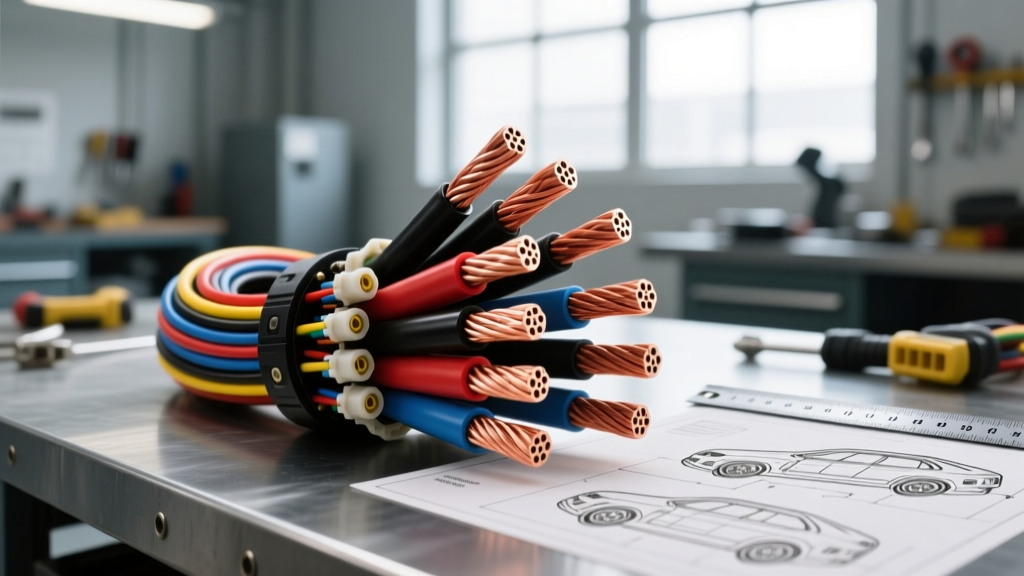
The Short Answer: Is 10 Gauge Wire Bigger Than 12?
When building custom harnesses, upgrading charging systems, or installing high-draw accessories, selecting the correct conductor size is critical for safety and performance. A common question among DIY mechanics, off-road builders, and junior technicians is: is 10 gauge wire bigger than 12? The definitive answer is yes. In the American Wire Gauge (AWG) system, a lower numerical value indicates a physically larger, thicker wire with a greater cross-sectional area and higher current-carrying capacity. Therefore, 10 AWG is significantly larger, heavier, and more robust than 12 AWG.
Understanding why this inverse relationship exists requires a brief look into wire manufacturing. The AWG system is based on the number of drawing dies a solid copper rod must pass through to reach its final diameter. A 12 AWG wire is pulled through more dies than a 10 AWG wire, stretching it further and making it thinner. Because 10 gauge wire is thicker, it has less electrical resistance per foot, allowing it to carry higher amperage loads with minimal voltage drop and heat generation.
Understanding the American Wire Gauge (AWG) Inverse Scale
The AWG standard, established in 1857, is a logarithmic stepped system. This means that a change of just three gauge numbers (e.g., from 12 AWG to 9 AWG, or 10 AWG to 7 AWG) represents a doubling or halving of the wire's cross-sectional area. Furthermore, a change of ten gauge numbers (e.g., 12 AWG to 2 AWG) represents an exact ten-fold increase in cross-sectional area and a ten-fold decrease in electrical resistance.
According to the Copper Development Association Wire Tables, the physical differences between these two common automotive sizes are substantial. A 10 AWG wire possesses roughly 60% more copper cross-section than a 12 AWG wire, which directly translates to its superior thermal dissipation and ampacity ratings.
10 AWG vs. 12 AWG: Technical Specification Chart
The following table outlines the precise physical and electrical properties of standard bare copper wire at 20°C (68°F). These metrics are foundational for calculating voltage drop and determining harness weight in custom automotive builds.
| Specification Property | 10 AWG Wire | 12 AWG Wire |
|---|---|---|
| Diameter (Inches) | 0.1019 in | 0.0808 in |
| Diameter (Millimeters) | 2.588 mm | 2.053 mm |
| Cross-Sectional Area (mm²) | 5.261 mm² | 3.309 mm² |
| Area (Circular Mils / kcmil) | 10,380 kcmil | 6,530 kcmil |
| Resistance (Ω per 1,000 ft @ 20°C) | 0.9989 Ω | 1.588 Ω |
| Weight (lbs per 1,000 ft) | 31.43 lbs | 19.77 lbs |
Automotive Ampacity: SAE J1128 vs. NEC Standards
When researching wire sizing, you will often encounter conflicting ampacity charts. This discrepancy usually stems from the difference between building codes and automotive standards. The National Electrical Code (NEC) rates wire based on its use in residential walls, where ambient temperatures rarely exceed 30°C (86°F). Automotive environments, however, are far more hostile.
The SAE International J1128 Standard governs low-tension primary cables used in vehicles. Modern automotive wire utilizes cross-linked polyethylene (XLPE) insulation, commonly referred to as TXL or SXL wire. This insulation is rated for continuous operation at 125°C (257°F) and can withstand engine bay ambient temperatures that regularly exceed 100°C (212°F).
SAE J1128 Ampacity Ratings (Single Wire in Free Air)
- 10 AWG (TXL): Rated for approximately 40 to 45 Amps continuous.
- 12 AWG (TXL): Rated for approximately 25 to 30 Amps continuous.
Expert Note: If you are bundling multiple wires into a tight loom or conduit (such as running a harness through a frame rail), you must apply a derating factor of 20% to 30% to account for trapped heat. In a tightly bundled harness, 10 AWG should be limited to ~30A, and 12 AWG to ~20A to prevent insulation meltdown and voltage sag.
Real-World Automotive Applications: Where to Use Each Gauge
10 AWG Automotive Use Cases
Because 10 gauge wire is bigger than 12, it is reserved for high-current primary feeds and heavy accessories. Common applications include:
- Alternator B+ Feeds: For stock or mildly upgraded alternators producing 100A to 120A, 10 AWG (often run in parallel or upgraded to 8 AWG) is used to connect the alternator output stud to the battery positive terminal or main distribution block.
- High-Draw Cooling Fans: Dual 16-inch aftermarket SPAL fans can pull 25+ amps combined. 10 AWG is required from the battery to the high-amperage relay, and from the relay to the fan motors.
- Aftermarket Fuel Pumps: High-performance inline pumps (like the Walbro 450 or Deatschwerks DW300) draw significant current under high fuel pressure. 10 AWG ensures the pump receives full voltage, preventing lean conditions under wide-open throttle.
- Standard Wire Colors: Red (main B+ power), Black (high-amp chassis ground), Orange (switched high-amp ignition feed).
12 AWG Automotive Use Cases
12 AWG is the workhorse of the secondary automotive electrical system, perfect for moderate-draw accessories and relay-controlled circuits.
- Trailer Brake Controllers: In a standard 7-way RV connector, Pin 2 (Electric Brakes) and Pin 4 (Auxiliary 12V Power) should be wired using 12 AWG to handle the 15A-20A loads of trailer brake magnets and breakaway systems without excessive voltage drop over the 20-foot run to the rear bumper.
- Headlight Relay Harnesses: When upgrading from factory halogen to high-draw HID or off-road LED pods, 12 AWG is ideal for the main power feed from the battery to a Bosch-style 5-pin relay block, and from the relay (Pin 87) to the headlight connectors.
- Power Windows and Seat Motors: OEM power seat tracks and window regulators typically peak between 15A and 25A during stall conditions, making 12 AWG the factory standard.
- Standard Wire Colors: Dark Blue (trailer brakes), Red/White stripe (OEM switched accessory), Pink (OEM EFI relay feed).
Calculating Voltage Drop in 12V Systems
Knowing that 10 gauge wire is bigger than 12 is only half the battle; you must also understand how size affects voltage drop. In a 12-volt automotive system, sensitive electronics (like ECUs, MAF sensors, and fuel injection drivers) require a maximum voltage drop of 3% (0.36V). Lighting and resistive heaters can tolerate up to a 5% drop (0.60V).
The formula for calculating voltage drop in a DC circuit is:
Voltage Drop = (Current x Resistance per 1000ft x Total Circuit Length) / 1000
Scenario: You are wiring an electric water pump drawing 25 Amps. The total circuit length (positive wire to the pump + negative wire back to the battery) is 20 feet.
- Using 12 AWG: (25A x 1.588Ω x 20ft) / 1000 = 0.794 Volts dropped. This is a 6.6% drop, which will result in the pump running slower and the wire heating up.
- Using 10 AWG: (25A x 0.9989Ω x 20ft) / 1000 = 0.499 Volts dropped. This is a 4.1% drop, safely within the acceptable range for a high-draw motor.
For comprehensive resistance metrics across all sizes, the Madsen Wire & Cable Reference provides excellent baseline data for both copper and aluminum conductors in varying temperatures.
Connector Compatibility and Crimping Standards
The physical size difference between 10 AWG and 12 AWG dictates the terminals and tools you must use. Attempting to crimp a 10 AWG wire into a terminal designed strictly for 14-16 AWG will result in stranded copper being cut, frayed, or left outside the crimp barrel, leading to arcing and fires.
- Insulation Colors: Standard vinyl or heat-shrink insulated terminals use a color-coding system. Yellow insulation denotes the 12-10 AWG range. Blue denotes 16-14 AWG, and Red denotes 22-18 AWG.
- Terminal Types: For 12 AWG, standard Metri-Pack 280 series or Weather-Pack connectors are common. For 10 AWG, you often step up to larger ring terminals (sized for #10 or 1/4-inch studs) or heavy-duty Deutsch DT series contacts if building sealed harnesses.
- Crimping Tools: Never use cheap, non-ratcheting plier crimpers for 10 or 12 AWG wire. The high strand count requires immense, evenly distributed pressure to achieve a gas-tight cold weld. Use a dedicated ratcheting crimper (such as the Titan 11477 or an IWISS equivalent) calibrated for 12-10 AWG terminals, followed by marine-grade adhesive-lined heat shrink to seal out moisture and prevent galvanic corrosion.
Summary
To reiterate, 10 gauge wire is unequivocally bigger than 12 gauge wire. It boasts a 2.588mm diameter compared to the 2.053mm diameter of 12 AWG, yielding a vastly superior cross-sectional area of 5.261mm². When planning your next automotive wiring project, always default to the thicker 10 AWG for high-amp primary feeds, heavy relays, and long harness runs to minimize voltage drop. Reserve 12 AWG for secondary accessories, trailer circuits, and relay-switched outputs to save on harness weight and bulkhead space. Always adhere to SAE J1128 standards and use high-temp TXL insulation for any wire routed through the engine bay.