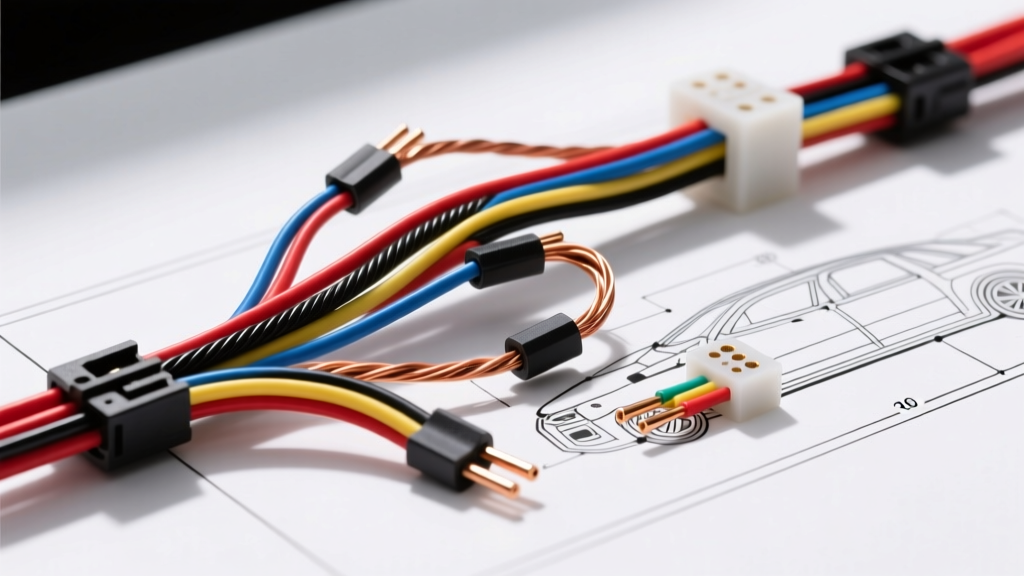
Understanding the AWG Scale: Where Does 36 Gauge Fit?
When beginners enter the world of automotive wiring, they typically focus on heavy-duty gauges like 10, 12, or 16 AWG for power distribution, lighting, and ground circuits. However, modern vehicles are essentially rolling computer networks. They rely on highly sensitive micro-sensors to monitor everything from combustion chamber temperatures to steering wheel clock spring continuity. This is where 36 gauge wire enters the picture.
The American Wire Gauge (AWG) system operates on an inverse scale: the higher the number, the thinner the wire. At just 0.0050 inches (0.127 mm) in diameter, 36 AWG is remarkably thin—often comparable to or slightly thicker than a single strand of human hair. Because of its microscopic cross-sectional area, 36 gauge wire is never used for power transmission in a vehicle. Instead, it is strictly reserved for ultra-low current signal transmission, specialized thermocouples, and internal micro-electronics where space and thermal mass are at an absolute premium.
36 Gauge Wire Technical Specifications
Before attempting to repair or integrate 36 AWG wire into an automotive harness, you must understand its physical and electrical limitations. According to the ASTM B258 Standard Specification for AWG, the tolerances for micro-wire are incredibly tight. Below is the definitive reference chart for 36 AWG copper and specialized alloy wire.
| Specification Metric | 36 AWG Value |
|---|---|
| Diameter (Inches) | 0.0050" |
| Diameter (Millimeters) | 0.127 mm |
| Cross-Sectional Area (Circular Mils) | 25.0 CM |
| Cross-Sectional Area (mm²) | 0.0127 mm² |
| Resistance (Annealed Copper @ 20°C) | 415.0 Ω / 1,000 ft |
| Max Ampacity (Chassis Wiring) | ~0.05 Amps (Signal Only) |
| Typical Insulation Types | PTFE (Teflon), Kapton, Fiberglass Braid |
Expert Note on Ampacity: Attempting to push even 0.5 amps through a 36 AWG copper wire will result in immediate resistive heating, melting the insulation, and vaporizing the conductor. This wire is designed for millivolt and milliamp signal reading only.
Real-World Automotive Applications for 36 AWG
You will not find 36 gauge wire in a standard headlight harness or ECU power supply. You will, however, find it in highly specialized diagnostic and monitoring circuits. Here are the most common automotive applications:
1. Exhaust Gas Temperature (EGT) Thermocouples
In high-performance, diesel, and turbocharged applications, monitoring EGT is critical to prevent engine meltdown. Type K thermocouples, which are widely used in automotive EGT probes, rely on ultra-thin wire to minimize thermal mass. This allows the sensor to react to temperature changes in milliseconds. Per Omega Engineering Thermocouple Color Codes, a standard Type K thermocouple utilizes a Yellow outer jacket, with internal 36 AWG solid-core wires made of Chromel (Red) and Alumel (Yellow). Because the wire is so thin, it can be fed directly into the microscopic tip of the Inconel probe.
2. Piezoelectric Knock Sensor Internals
While the external pigtail of an engine knock sensor is usually 18 or 20 AWG shielded wire, the internal connection from the piezoelectric crystal to the sensor's base often utilizes ultra-fine 36 AWG stranded or solid wire. This micro-wire must survive intense engine block vibration while carrying high-impedance, low-voltage AC signals generated by engine detonation.
3. Airbag Clock Spring Micro-Sensors
Modern steering wheel clock springs contain not only the main airbag squib wires (which are thick, usually 16 AWG, and yellow) but also micro-ribbon cables and fine-gauge wire wraps for steering angle sensors and heated wheel thermistors. 36 AWG wire is sometimes used in the internal winding mechanisms of these rotary sensors due to its extreme flexibility and fatigue resistance when properly stranded.
The Beginner’s Guide to Handling and Terminating Micro-Wire
The most common mistake beginners make with 36 gauge wire is treating it like standard automotive primary wire. Standard wire strippers, crimpers, and heat shrink tubing will instantly destroy a 36 AWG conductor.
- Stripping: Do not use mechanical blade strippers. The blades will nick the 0.127mm core, causing it to snap under the slightest tension. Use thermal wire strippers (which melt PTFE insulation) or precision micro-scraping tools under a magnification lamp.
- Crimping: Standard automotive terminals (like Deutsch or Packard) do not support 36 AWG. You must use specialized micro-connectors, such as TE Connectivity Micro-Connector Solutions or Molex PicoBlade systems, though even these often bottom out at 32 AWG. For 36 AWG, direct micro-soldering to a PCB pad or using a specialized wire-wrap terminal is usually required.
- Soldering: Use a temperature-controlled soldering station with a micro-pencil tip (e.g., 0.4mm chisel). Apply liquid flux sparingly. The thermal transfer is nearly instantaneous; if you hold the iron on the wire for more than a second, the heat will travel down the conductor and melt the insulation inches away from your joint.
Troubleshooting 36 AWG Sensor Circuits
When diagnosing an issue involving 36 gauge wire—such as an erratic EGT gauge reading or a phantom P0325 Knock Sensor Circuit code—standard testing methods must be adapted.
Testing for Continuity vs. Resistance
Because 36 AWG copper wire has a resistance of roughly 415 Ohms per 1,000 feet, a standard 5-foot automotive sensor harness will inherently possess about 2.07 Ohms of resistance. If you are using a standard automotive multimeter's continuity beep function, it may not trigger, leading a beginner to falsely believe the wire is broken. Always test using the precise Ohms (Ω) setting on a high-quality digital multimeter (like a Fluke 88V). Measure the known-good length of the wire first to establish a baseline, then compare it to the installed harness.
Vibration Fatigue and Intermittent Breaks
Solid-core 36 AWG wire is incredibly brittle. In high-vibration environments like an engine bay or exhaust tunnel, solid-core micro-wire will work-harden and snap internally, even if the outer PTFE or fiberglass insulation looks perfectly intact. The Fix: If an internal break is suspected, use your multimeter's 'Min/Max' recording mode. Wiggle the harness aggressively while the probes are connected. If the meter catches an 'OL' (Open Loop) spike, the conductor has suffered a fatigue fracture and the entire sensor pigtail must be replaced. You cannot reliably splice 36 AWG solid-core thermocouple wire in the field; splicing introduces dissimilar metals that will create a secondary thermocouple junction, ruining your temperature readings.
EMI Shielding: The Invisible Enemy of Micro-Wire
At 36 AWG, the wire acts less like a conductor and more like an antenna. The millivolt signals traveling through an EGT or knock sensor wire are easily overwhelmed by Electromagnetic Interference (EMI) from ignition coils, alternator ripple, and modern high-voltage EV inverters. Whenever routing or replacing 36 gauge signal wire, it must be part of a Shielded Twisted Pair (STP). The twisting cancels out common-mode noise, while the outer braided copper shield (which must be grounded to the ECU sensor ground, not chassis ground) absorbs high-frequency alternator whine. Never route 36 AWG sensor wires parallel to fuel injector harnesses or ignition coil power feeds; always cross them at a 90-degree angle to minimize inductive coupling.