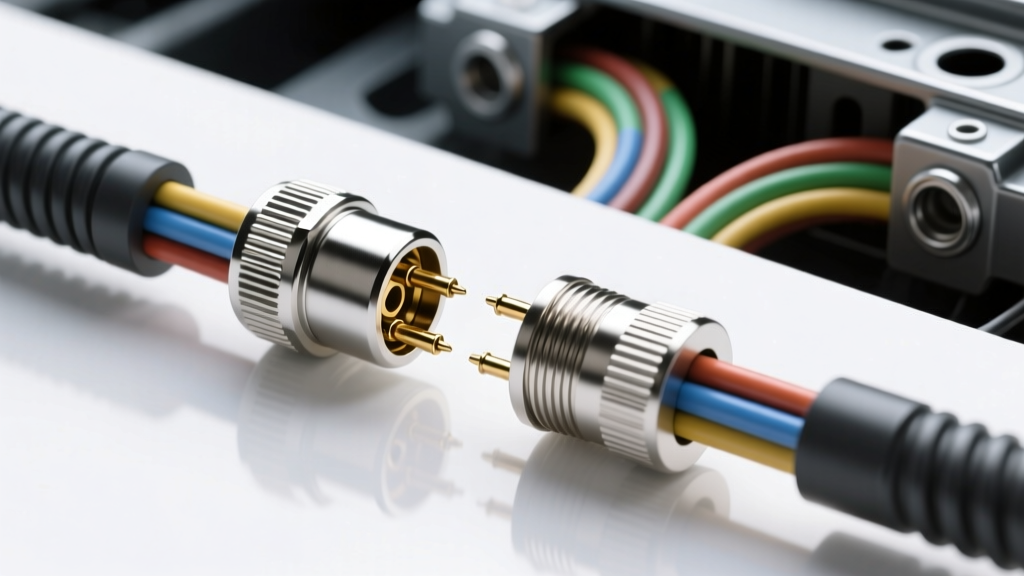
Introduction to High-Current 8 AWG Automotive Circuits
When building or upgrading high-draw automotive electrical systems—such as winch feeds, dual-battery isolators for overlanding, car audio amplifier power lines, or EV battery management system (BMS) relays—8 AWG wire is the standard for safely transmitting 40 to 70 amps of continuous current. However, the wire itself is only as reliable as its termination points. The selection and installation of 8 gauge wire connectors male and female mating pairs dictate the safety, efficiency, and longevity of the entire circuit. A poor connection at this gauge will rapidly generate thermal runaway, melt PVC insulation, and potentially cause an electrical fire in the engine bay or chassis.
This guide examines the most critical safety warnings, common installation mistakes, and technical specifications required when working with heavy-duty 8 AWG male and female connector assemblies, referencing SAE and OEM automotive standards.
The Anatomy of 8 AWG Male and Female Connector Systems
In high-amperage DC applications, traditional spade or push-on connectors are entirely inadequate. Instead, automotive electricians rely on robust mechanical mating systems. Common configurations include:
- Anderson Powerpole / SB Series: Genderless housings, but often colloquially referred to by their pin orientation. The 120-Amp series is standard for 8 AWG battery quick-disconnects.
- Heavy-Duty Ring Terminals: While not strictly 'male/female', they mate a male stud (e.g., 5/16-inch or 3/8-inch busbar post) to a female ring barrel.
- Deutsch DT / DTM Series: Requires specialized 8 AWG adapted contacts, featuring male pins and female sockets with silicone wedge locks and secondary retention.
Understanding the mechanical retention and electrical contact surface area of these male and female interfaces is the first step in preventing catastrophic failure.
5 Critical Safety Mistakes When Terminating 8 AWG Connectors
Mistake 1: Using Indent Crimpers Instead of Hex-Crimp Dies
The most frequent and dangerous mistake made by DIYers is using a standard indent-style crimping tool on 8 AWG closed-barrel terminals. Indent crimpers push a wedge into the barrel, which can cut through the copper strands and create a high-resistance void inside the terminal. For 8 gauge wire connectors male and female assemblies, you must use a ratcheting hex-crimp tool. A hex crimp uniformly compresses the 133 to 1680 copper strands into a solid, cold-welded mass, ensuring maximum surface contact and eliminating air pockets where oxidation begins.
Mistake 2: Mismatching Strand Count to Barrel Length
Automotive wire comes in varying strand counts. Standard SAE J1128 8 AWG wire typically features 133 strands of 22 AWG copper, while high-flex marine or EV wire may feature 1,680 strands of 30 AWG. High-flex wire has a larger overall outer diameter (OD) for the same AWG rating. Forcing high-flex 8 AWG wire into a standard stamped male or female connector barrel will result in splayed strands outside the crimp zone. These exposed 'whiskers' can short against adjacent chassis grounds or connector housings.
Mistake 3: Ignoring Polarity and Gender Locking Mechanisms
When mating modular connectors (like Anderson SB50 or Powerpole 120A), relying solely on color-coding (Red for positive, Black for ground) without utilizing the factory male/female locking dovetails is a severe safety hazard. Under heavy vibration—such as in an off-road vehicle or a truck bed winch setup—unlocked housings will experience 'fretting.' Fretting is the microscopic wearing away of the tin or silver plating on the male and female contacts due to vibration, leading to rapid oxidation, voltage drop, and extreme heat generation.
Mistake 4: Inadequate Environmental Sealing and Heat Shrink
Wrapping an 8 AWG ring terminal or spade connector in vinyl electrical tape is unacceptable for under-hood or chassis applications. The adhesive on electrical tape degrades at temperatures above 175°F (80°C), which is easily exceeded near exhaust headers or alternators. You must use dual-wall adhesive heat shrink tubing (often referred to as marine-grade heat shrink). The inner layer of thermoplastic adhesive melts and flows into the wire strands and connector barrel, creating a waterproof, airtight seal that prevents galvanic corrosion between the copper wire and the tin-plated brass terminal.
Mistake 5: Over-Torquing Busbar and Ring Terminal Connections
When securing a female ring terminal to a male busbar stud or battery post, many assume 'tighter is better.' Over-torquing a 5/16-inch or 3/8-inch stud can stretch the copper ring terminal, thinning the metal and reducing its cross-sectional area, which paradoxically increases resistance. According to Delphi Automotive Electrical Systems Guidelines, the recommended torque for an 8 AWG ring terminal on a standard steel stud is between 10 and 12 Nm (88 to 106 in-lbs). Always use a calibrated inch-pound torque wrench and a flat or split lock washer to maintain clamping force under thermal cycling.
Technical Specification Chart: 8 AWG Connector Tolerances
Use the following reference chart to ensure your male and female connector components match the physical dimensions of your 8 AWG wire. These specifications align with SAE J1123: Terminals, Electrical Connector standards.
| Parameter | Specification / Tolerance | Safety Warning / Note |
|---|---|---|
| Wire Strip Length | 5/8' to 3/4' (15.8mm - 19mm) | Too short causes high resistance; too long exposes bare copper to shorting. |
| Barrel Inner Diameter (ID) | 0.165' to 0.175' (4.2mm - 4.4mm) | Must accommodate SAE J1128 standard 8 AWG outer diameter. |
| Crimp Pull-Out Force | Minimum 120 lbs (534 N) | Terminal must withstand mechanical shock without wire separation. |
| Contact Plating | Tin or Silver over Copper/Nickel | Silver is preferred for high-amp EV and winch applications to reduce contact resistance. |
| Heat Shrink Size | 3/8' or 1/2' (Adhesive-Lined) | Must shrink to at least 50% of original diameter to activate inner adhesive. |
Real-World Failure Modes: What Happens When 8 AWG Connections Fail
Understanding the physics of a failing connection helps underscore the importance of proper installation. When 8 gauge wire connectors male and female interfaces are improperly crimped or mated, the following failure cascade occurs:
- Micro-Void Formation: An improper crimp leaves microscopic air gaps between the copper strands and the terminal barrel.
- Galvanic Corrosion: Moisture and road salt infiltrate the voids. Because the terminal is usually tin-plated brass and the wire is bare copper, a galvanic cell forms, creating copper oxide (a semiconductor/insulator).
- Resistance Spike & Thermal Runaway: As resistance increases at the joint, the connector begins to dissipate power as heat (P = I²R). At 50 amps, even a minor 0.05-ohm increase in resistance generates 125 watts of localized heat.
- Insulation Melt & Fire: The heat melts the PVC wire insulation and the plastic connector housing. Exposed, glowing copper strands eventually arc to the chassis, igniting nearby plastics, fuel lines, or sound deadening materials.
To prevent this, always perform a voltage drop test across the male-to-female connection under full load. A healthy 8 AWG connection should exhibit a voltage drop of less than 0.05V (50 millivolts) across the terminal interface.
Authoritative References & Best Practices
For further technical validation and safety protocols, consult the following industry standards before designing high-current automotive harnesses:
- SAE J1123: Terminals, Electrical Connector - Governs the mechanical and electrical testing requirements for automotive crimp terminals.
- Anderson Power Products: Powerpole & SB Datasheet - Provides exact torque, crimp, and mating tolerances for heavy-duty modular male/female connectors.
- NFPA 70 (National Electrical Code) Article 250 - While primarily for residential/industrial, the grounding and bonding principles apply to heavy-duty vehicle chassis grounding via 8 AWG ring terminals.
By treating 8 AWG terminations with the precision they demand, you ensure your vehicle's high-draw accessories operate safely, efficiently, and reliably in the harshest environments.