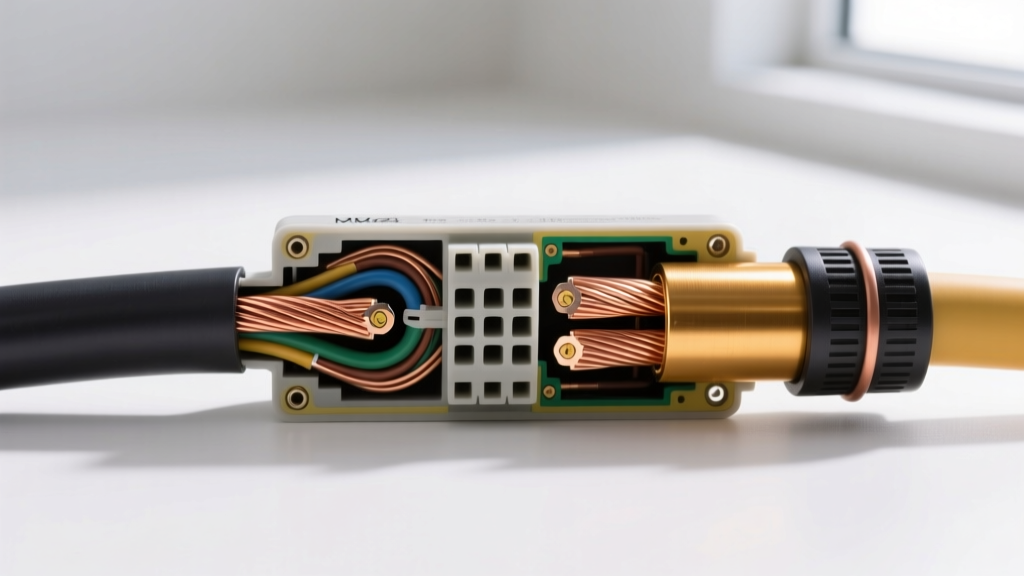
Understanding the NEMA 14-50 in Automotive and EV Applications
When upgrading a home garage for Level 2 Electric Vehicle Supply Equipment (EVSE) or heavy-duty automotive tools like MIG welders and plasma cutters, selecting the correct nema 14 50 gauge wire is the most critical electrical decision you will make. The NEMA 14-50 configuration provides 240V split-phase power rated for 50 amps, utilizing two hot legs, a neutral, and a dedicated equipment grounding conductor. While historically used for RV hookups and electric ranges, this receptacle has become the de facto standard for high-speed residential EV charging. However, not all 50-amp circuits are treated equally under the National Electrical Code (NEC), especially when continuous loads like EV charging are introduced. This guide compares wire gauges, materials, and insulation types to ensure your automotive garage setup is safe, code-compliant, and optimized for maximum charging throughput.
The Core Dilemma: 6 AWG vs. 4 AWG for Continuous Loads
The most common debate in garage electrical upgrades is whether to use 6 AWG or 4 AWG wire for a 50-amp NEMA 14-50 circuit. The answer depends entirely on the duty cycle of your equipment. According to the NFPA 70 National Electrical Code (NEC) Article 210.20(A), continuous loads (defined as operating for 3 hours or more) must be calculated at 125% of their maximum draw. Since charging an EV easily exceeds the 3-hour threshold, a 40-amp continuous EVSE draw requires a 50-amp breaker, but the wire must handle 125% of the continuous load without thermal degradation.
6 AWG Copper (THHN/THWN-2)
In the 75°C column (which governs most standard receptacle terminations), 6 AWG copper is rated for 65 amps. Technically, 65 amps is greater than the 62.5 amps required for a 50-amp continuous load (50A x 1.25). Therefore, 6 AWG THHN in conduit is legally permissible in many jurisdictions. However, many local inspectors and EVSE manufacturers mandate 4 AWG due to the notorious thermal issues associated with residential 14-50 receptacles.
4 AWG Copper (THHN/THWN-2)
4 AWG copper is rated for 85 amps in the 75°C column. This provides a massive thermal buffer, significantly reducing voltage drop and heat generation at the receptacle lugs during multi-hour EV charging sessions. For automotive professionals running high-draw diagnostic servers, battery thermal management systems, or Level 2 EVSEs like the Tesla Wall Connector or ChargePoint Home Flex, 4 AWG is the undisputed premium choice.
Material Comparison: Copper vs. Aluminum Conductors
While copper is the gold standard for automotive wiring and low-voltage SAE J1772 EV communication lines, high-voltage garage feeders often utilize aluminum to save costs. Here is how they compare for NEMA 14-50 installations:
- Copper (THHN): Superior conductivity, smaller physical footprint, and highly resistant to thermal creep. Requires no special anti-oxidant compounds. Best for runs under 100 feet where budget allows.
- Aluminum (XHHW-2 or SER): Significantly cheaper but requires upsizing. To achieve the same ampacity as 4 AWG copper, you must use 2 AWG aluminum. Aluminum is prone to thermal expansion and contraction, which can loosen terminal screws over time. If using aluminum, applying a Noalox anti-oxidant paste to the stripped wire ends and torquing to exact manufacturer specifications is mandatory to prevent arcing.
Insulation and Jacket Types: NM-B vs. THHN vs. SER
The outer jacket of your chosen wire gauge dictates where and how it can be installed in your garage.
NM-B (Romex) - The Hidden Trap
Standard NM-B cable is limited to the 60°C ampacity column per NEC 334.80. In the 60°C column, 6 AWG copper is only rated for 55 amps. Because 55 amps is less than the 62.5 amps required for a continuous 50-amp EV load, 6 AWG NM-B is a code violation for continuous EV charging. If you must use Romex, you are forced to upsizing to 4 AWG NM-B, which is incredibly stiff and difficult to route through standard wall cavities.
Individual THHN/THWN-2 in Conduit
Pulling individual 4 AWG THHN wires through 3/4-inch EMT or PVC conduit is the professional standard. It allows for the 90°C rating of the wire (derated to 75°C at terminations), superior heat dissipation, and easier future upgrades. According to the Copper Development Association (CDA), conduit fill limits for 3/4-inch EMT easily accommodate four 4 AWG THHN wires (two hots, one neutral, one ground).
NEMA 14-50 Pinout, Color Codes, and Torque Specifications
Improper termination is the leading cause of melted NEMA 14-50 receptacles in EV applications. The SAE International J1772 Standard relies on stable AC voltage to maintain the proximity pilot and control pilot communication loops; voltage sags caused by loose lugs will trigger EVSE fault codes.
| Pin / Terminal | Function | Standard Wire Color | AWG Size | Target Torque (Leviton 279-S00) | Target Torque (Hubbell 9450A) |
|---|---|---|---|---|---|
| X (Brass) | Hot Leg 1 (120V to Neutral) | Black | 4 AWG / 6 AWG | 45 in-lbs | 75 in-lbs |
| Y (Brass) | Hot Leg 2 (120V to Neutral) | Red | 4 AWG / 6 AWG | 45 in-lbs | 75 in-lbs |
| W (Silver) | Neutral (Current Carrying) | White | 4 AWG / 6 AWG | 45 in-lbs | 75 in-lbs |
| G (Green) | Equipment Ground | Bare / Green | 8 AWG (Min) / 6 AWG | 35 in-lbs | 45 in-lbs |
Note: Always use a calibrated inch-pound torque screwdriver. Strip insulation exactly to the manufacturer's gauge (usually 5/8' to 3/4'). Do not tin stranded wire with solder before inserting into screw terminals, as solder cold-flows and causes catastrophic loosening.
Voltage Drop Calculations for Long Garage Runs
Automotive diagnostic equipment and EVSEs are sensitive to voltage drop. The NEC recommends a maximum 3% voltage drop for branch circuits (7.2V on a 240V system). If your main panel is on the opposite side of the house from your garage, wire gauge selection becomes a function of distance, not just ampacity.
| One-Way Run Distance | 6 AWG Copper (240V @ 40A) | 4 AWG Copper (240V @ 40A) | 2 AWG Aluminum (240V @ 40A) |
|---|---|---|---|
| 50 Feet | 1.04% (Excellent) | 0.65% (Excellent) | 1.03% (Excellent) |
| 100 Feet | 2.08% (Acceptable) | 1.31% (Excellent) | 2.06% (Acceptable) |
| 150 Feet | 3.12% (Fails 3% Rule) | 1.96% (Acceptable) | 3.09% (Borderline) |
| 200 Feet | 4.16% (Fails) | 2.61% (Acceptable) | 4.12% (Fails) |
Real-World Failure Modes and Troubleshooting
When wiring a NEMA 14-50 for automotive use, be aware of these common failure modes:
1. Thermal Creep and Melted Receptacles
Symptom: The EVSE stops charging midway through a session; the receptacle face feels hot to the touch; visible brown scorch marks on the plug pins. Cause: Under-torqued terminal screws combined with 6 AWG wire operating at its absolute thermal limit. The repeated heating and cooling cycles cause the metal to expand and contract, loosening the grip on the wire. Fix: Replace the receptacle with an industrial-grade Hubbell 9450A or Bryant 9450FR. Upgrade the wire to 4 AWG THHN and torque to exact specifications.
2. EVSE Proximity Pilot Faults
Symptom: The EV plug clicks into the car, but the charging never initiates, or the EVSE flashes a red ground-fault error. Cause: A shared or improperly bonded neutral-to-ground at a subpanel, or a high-resistance connection on the ground pin causing the J1772 control pilot to read an invalid voltage state. Fix: Verify the neutral and ground bars are strictly isolated in the garage subpanel. Test the ground pin continuity back to the main service entrance ground rod.
3. Breaker Nuisance Tripping
Symptom: The 50-amp breaker trips after 2-3 hours of charging, but the wire feels cool. Cause: Using a standard thermal-magnetic breaker that is overly sensitive to the ambient heat of the garage, or a loose connection at the breaker lug causing localized heating that transfers to the bimetallic trip strip. Fix: Ensure the breaker lugs are torqued to 45 in-lbs. If the garage exceeds 100°F in summer, apply NEC 310.15 temperature correction factors, which may necessitate upsizing to 3 AWG or 2 AWG wire.
Final Selection Verdict
For automotive technicians and EV owners, the marginal cost savings of 6 AWG wire are entirely negated by the thermal risks associated with continuous 40-50 amp loads. The optimal, future-proof selection for a NEMA 14-50 circuit is 4 AWG Copper THHN/THWN-2 pulled through 3/4-inch EMT conduit, terminated on an industrial-grade receptacle using a calibrated torque screwdriver. This setup guarantees compliance with NEC continuous load rules, minimizes voltage drop for sensitive automotive diagnostic computers, and ensures your Level 2 EVSE operates at peak efficiency for years to come.