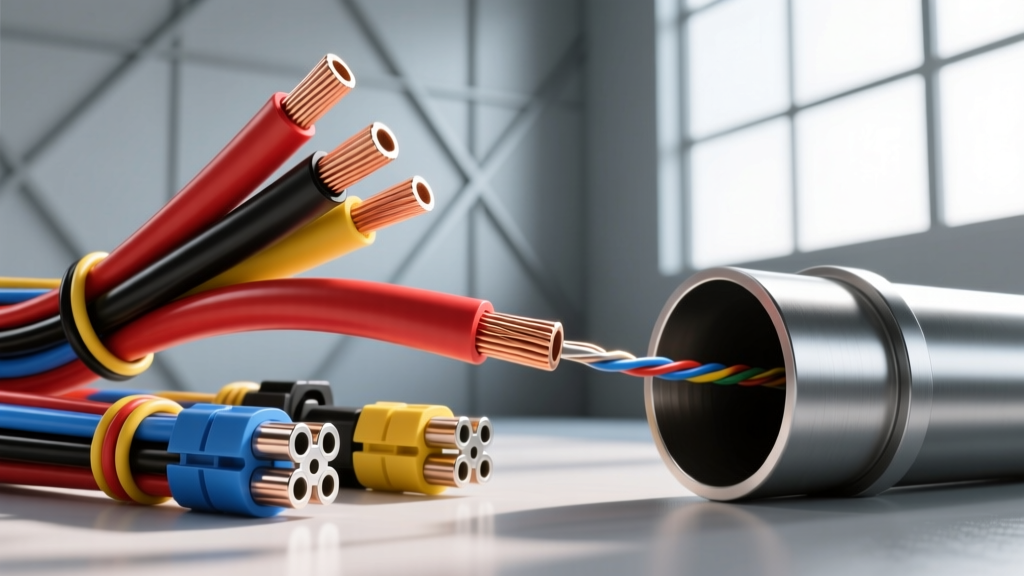
The Role of 18 AWG Wire in Modern Vehicle Electrical Systems
When building, repairing, or modifying automotive electrical systems, selecting the correct conductor is critical for safety and signal integrity. The 18 awg gauge electrical wire is arguably the most versatile and frequently utilized size in modern vehicle harnesses. With a nominal cross-sectional area of 0.823 mm² and a diameter of 0.0403 inches (1.024 mm), 18 AWG strikes the perfect balance between flexibility, current-carrying capacity, and physical footprint.
In OEM applications, 18 AWG is the standard for low-current power circuits, sensor signal transmission, and communication buses. However, not all 18 AWG wire is created equal. The primary differentiator in automotive wiring is the insulation jacket material, which dictates temperature tolerance, abrasion resistance, and chemical resilience. This guide compares the leading 18 AWG wire variants to help you select the exact specification for your project.
Insulation Showdown: TXL vs. SXL vs. GXL vs. Standard PVC
The SAE J1128 standard governs low-voltage primary cable in automotive applications. Under this standard, Cross-Linked Polyethylene (XLPE) has largely replaced Polyvinyl Chloride (PVC) in professional and OEM harnesses due to its superior thermal and mechanical properties.
| Wire Type | Insulation Material | Max Temp Rating | Wall Thickness | Outer Diameter (18 AWG) | Best Application |
|---|---|---|---|---|---|
| TXL | Cross-Linked PE (XLPE) | 125°C (257°F) | 0.23 mm (Thin) | 1.40 mm | High-density ECU connectors, tight looms |
| GXL | Cross-Linked PE (XLPE) | 125°C (257°F) | 0.28 mm (General) | 1.50 mm | General chassis wiring, engine bay routing |
| SXL | Cross-Linked PE (XLPE) | 125°C (257°F) | 0.33 mm (Specialty) | 1.60 mm | High-abrasion areas, near exhaust/brackets |
| Primary (PVC) | Polyvinyl Chloride | 105°C (221°F) | 0.58 mm (Thick) | 2.10 mm | Interior cabin, low-temp aftermarket audio |
Why XLPE Beats PVC in the Engine Bay
Standard PVC primary wire is acceptable for interior cabin lighting or trunk-mounted audio amplifiers. However, under the hood, PVC becomes brittle in extreme cold and softens dangerously near exhaust manifolds. XLPE (TXL, GXL, SXL) is chemically cross-linked, meaning it will not melt even if exposed to a soldering iron tip or resting against a 110°C engine block. For any under-hood 18 AWG application, TXL or GXL is mandatory.
Ampacity, Resistance, and Voltage Drop Calculations
Understanding the electrical limits of 18 AWG wire prevents voltage drop issues that can trigger false ECU diagnostic trouble codes (DTCs) or dim lighting.
- Resistance: 6.385 Ohms per 1,000 feet at 20°C (68°F).
- Chassis Wiring Ampacity: ~14 Amps to 16 Amps (single wire in free air).
- Bundle Derating: When bundled with 10+ other current-carrying wires, ampacity drops to approximately 8 Amps due to trapped thermal energy.
Real-World Voltage Drop Scenario: O2 Sensor Heater Circuit
Consider an aftermarket wideband O2 sensor heater circuit drawing 4 Amps, with a total wire run (power + ground) of 12 feet using 18 AWG wire.
Voltage Drop = (2 × Length × Current × Resistance per ft)
V_drop = 12 ft × 4 A × 0.006385 Ω/ft = 0.306 Volts.
A 0.3V drop on a 14.4V charging system leaves 14.1V at the heater—perfectly acceptable. However, if that same 18 AWG wire is used for a 5-Volt Reference (VREF) signal to a MAP sensor drawing 50mA, the drop is negligible (0.003V). But if the sensor ground is also 18 AWG and shares a noisy chassis ground point, ground-offset errors can skew the ECU's fuel mapping. This is why OEMs use dedicated 18 AWG or 20 AWG signal grounds routed directly back to the ECU header.
Automotive Applications: Where to Use 18 AWG
The 0.823 mm² cross-section of 18 AWG is the backbone of vehicle data and low-power distribution. Specific use cases include:
- CAN Bus Networks: ISO 11898 High-Speed CAN typically utilizes 18 AWG or 20 AWG twisted pair. OEM color coding varies; for example, Chrysler often uses Orange/Black for CAN High and Orange/Brown for CAN Low, while Ford may use White/Blue and White/Purple.
- Engine Sensors: Signal wires for Mass Air Flow (MAF), Intake Air Temperature (IAT), and Throttle Position Sensors (TPS). These carry low-amperage 5V analog or digital square-wave signals.
- LED Lighting: Modern LED marker lights, license plate lamps, and interior dome lights draw less than 1 Amp, making 18 AWG ideal for minimizing harness weight and bulk.
- Relay Control Coils: The low-current trigger wires (pins 85 and 86 on standard ISO mini relays) that activate the electromagnetic coil.
Termination and Crimping Best Practices
An 18 AWG wire is only as reliable as its terminal. Using the wrong crimp profile or connector housing will lead to micro-fretting, increased resistance, and eventual circuit failure.
Connector Ecosystem Compatibility
According to TE Connectivity and Aptiv engineering specs, 18 AWG wire pairs with several industry-standard connector families:
- Aptiv (Delphi) Weather-Pack 150 Series: Accepts 14-18 AWG. Ideal for external lighting and transmission solenoids. Requires specific open-barrel crimpers and weather seals (cable seals must be crimped simultaneously).
- Aptiv Metri-Pack 150 Series: Designed specifically for 18-22 AWG. The standard for ECU body connectors and sensor pigtails.
- Deutsch DT Series: Uses Size 16 contacts, which securely accept 18 AWG wire. Excellent for off-road, marine, and high-vibration environments due to the rear grommet seal and positive terminal retention.
The Open-Barrel Crimp Imperative
Never use insulated, closed-barrel ring terminals (the cheap red/blue/yellow PVC-insulated crimps) for OEM-style automotive harnesses. You must use open-barrel terminals (F-crimps) where the wire crimp wings and insulation crimp wings are formed around the bare copper and the jacket independently. A properly crimped 18 AWG open-barrel terminal should withstand a minimum pull-force of 15 lbs without the wire slipping.
Common Failure Modes and Troubleshooting
When diagnosing electrical faults in circuits utilizing 18 AWG wire, look for these specific failure modes:
| Symptom | Root Cause | Diagnostic Fix |
|---|---|---|
| Intermittent Sensor DTCs (e.g., P0101 MAF Rationality) | Micro-fretting corrosion inside the Metri-Pack 150 terminal due to engine vibration. | Inspect terminal tension. Replace with silver-plated terminals and apply dielectric grease to prevent oxidation. |
| Melted Insulation / Short to Ground | Standard PVC wire routed too close to exhaust components or EGR tubing. | Cut out damaged section. Splice in SXL (Specialty XLPE) wire and wrap in Tesa 51036 PET cloth tape. |
| Dim LEDs or Slow Window Roll-Up | Voltage drop from excessive 18 AWG wire length or poor chassis ground. | Upgrade power feed to 16 or 14 AWG. Clean ground ring terminal with a wire brush to bare metal. |
| CAN Bus Communication Errors (U-Codes) | 18 AWG CAN wires routed parallel to high-current ignition coils, causing EMI interference. | Ensure CAN twisted pair maintains at least 2 twists per inch and is routed away from coil-on-plug harnesses. |
Final Selection Verdict
For professional automotive wiring, standard PVC 18 AWG wire should be permanently retired from your toolkit. When sourcing 18 awg gauge electrical wire, default to GXL for general under-hood chassis routing due to its balance of flexibility and abrasion resistance. Use TXL when packing multiple wires into tight, high-pin-count ECU connectors where space is at a premium. By matching the correct XLPE insulation to the proper open-barrel termination, you ensure a harness that will outlast the vehicle itself.
For further reading on connector retention and sealing standards, refer to the Aptiv Weather-Pack and Metri-Pack technical documentation to ensure your terminal selections match your wire gauge precisely.