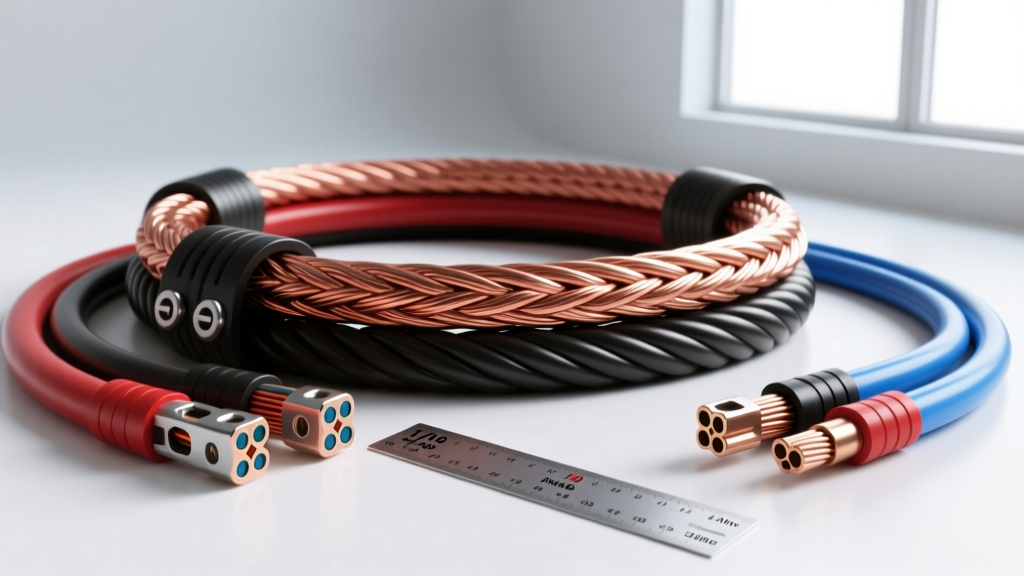
The AWG Paradox: Why the 'Largest' Wire Has the Smallest Number
When beginners enter the world of automotive electrical upgrades, one of the most common points of confusion is the American Wire Gauge (AWG) system. If you are searching for the largest gauge wire for a heavy-duty battery cable or a massive winch upgrade, you must first understand the inverse nature of the AWG scale. In this system, the smaller the numerical value, the physically larger and thicker the wire. Therefore, a 4 AWG wire is significantly thicker than a 10 AWG wire.
Once you drop below the single digits, the sizing transitions into 'aught' measurements. The largest standard AWG wire commonly available for automotive and industrial applications is 4/0 AWG (pronounced 'four-aught' and written as 0000). This massive conductor is the absolute heavyweight champion of DC automotive wiring, capable of handling extreme amperage loads with minimal voltage drop. Understanding when and how to deploy these heavy-gauge cables is critical for vehicle safety, electrical efficiency, and preventing catastrophic thermal failures.
When Do You Actually Need the Largest Gauge Wire?
Standard passenger vehicles typically rely on 4 AWG to 1 AWG cables for primary battery-to-starter routing. However, specific high-amperage applications demand the largest gauge wire sizes to prevent voltage starvation and insulation meltdown.
1. High-Amperage Battery Cables (1/0 AWG to 4/0 AWG)
Heavy-duty diesel trucks, such as those equipped with the Cummins 5.9L or 6.7L engines, require massive cranking amperage. The grid heater system and high-compression starter motors can draw upwards of 800 to 1,200 amps during cold cranking. Upgrading to 1/0 AWG or 2/0 AWG pure copper battery cables ensures that the starter receives adequate voltage, drastically improving cold-weather starting reliability.
2. Winch and Recovery Equipment (2 AWG to 4/0 AWG)
If you are mounting a 12,000 lb winch on a Jeep Wrangler or Ford Super Duty, you are looking at a peak current draw of 400 to 500 amps under maximum stall load. Using undersized wire will result in severe voltage drop, causing the winch motor to overheat and the solenoid contacts to weld shut. For winch leads exceeding 10 feet in total circuit length, 2 AWG is the absolute minimum, with 1/0 AWG or 4/0 AWG being the recommended standard for optimal performance.
3. High-Output Alternator and EV Conversions
Custom off-road vehicles running multiple lighting arrays, or EV (Electric Vehicle) conversions utilizing high-voltage DC-DC converters, often require 2/0 AWG or 4/0 AWG welding cable to route power from the rear-mounted battery banks to the front distribution buses. The flexibility of SAE J1127 compliant welding cable makes it the superior choice for routing through tight chassis pathways.
Technical Reference: Large Gauge Automotive Wire Specifications
The following table outlines the physical dimensions and chassis-wiring ampacity ratings for the largest standard AWG sizes. Note that 'Chassis Wiring' ampacity assumes single conductors in free air or engine bay routing, per standard automotive electrical guidelines. Always reference the SAE J1128 Standard for low-tension primary cable specifications.
| AWG Size | Diameter (in / mm) | Strand Count (Flexible) | Max Ampacity (Chassis) | Resistance per 1000ft (Ω) | Common Automotive Application |
|---|---|---|---|---|---|
| 4 AWG | 0.2043 in / 5.19 mm | 133 | 160 Amps | 0.2485 | High-end audio, secondary battery |
| 2 AWG | 0.2576 in / 6.54 mm | 665 | 210 Amps | 0.1563 | Winches, heavy-duty alternator feeds |
| 1/0 AWG (0) | 0.3249 in / 8.25 mm | 1064 | 285 Amps | 0.0983 | Main battery cables, diesel trucks |
| 2/0 AWG (00) | 0.3648 in / 9.26 mm | 1330 | 330 Amps | 0.0779 | High-output alternators, EV conversions |
| 4/0 AWG (0000) | 0.4600 in / 11.68 mm | 2107 | 455 Amps | 0.0490 | Welding cable, massive winches, custom grounds |
Calculating Voltage Drop for Long Runs
When utilizing the largest gauge wire, length is your enemy. Voltage drop is calculated using the formula: VD = (2 × L × I × R) / 1000, where L is the one-way length in feet, I is the current in amps, and R is the resistance per 1000 feet. For example, running a 400A winch with 15 feet of 2 AWG wire (R=0.1563) results in a voltage drop of 1.87 volts. While acceptable, upgrading to 1/0 AWG (R=0.0983) drops the loss to just 1.17 volts, ensuring your winch motor operates at peak RPM and torque.
Terminal Crimping and Connector Best Practices
Working with the largest gauge wire requires specialized tooling. You cannot simply twist and tape a 1/0 AWG cable. Improper terminations are the leading cause of electrical fires in high-amperage automotive circuits.
Heavy-Duty Ring Terminals and Adhesive Heat Shrink
Always use pure copper, tin-plated closed-barrel ring terminals. Avoid copper-clad aluminum (CCA) terminals, as the differing thermal expansion rates between aluminum and copper will cause the connection to loosen over time, creating a high-resistance hot spot. After crimping with a hydraulic or heavy-duty hex-die ratchet crimper, you must seal the connection. Use 3:1 ratio adhesive-lined heat shrink tubing. When heated, the inner meltable adhesive sealant flows into the wire strands, creating a completely waterproof and vibration-proof seal that prevents copper oxidation.
Torque Specifications for Battery and Starter Lugs
Over-tightening heavy-gauge lugs is a frequent beginner mistake that strips threads and cracks battery posts. Adhere to these general torque specifications:
- Standard Battery Post (M8 / 8mm nut): 10 to 12 Nm (89 to 106 in-lbs). Never exceed this, as battery posts are made of soft lead-tin alloys.
- Starter Motor Lug (Typically 3/8' or 10mm stud): 9 to 12 ft-lbs. Ensure the factory insulator washer is in place to prevent the lug from arcing against the starter housing.
- Heavy-Duty Bus Bars and Solenoids (M10 / 10mm nut): 15 to 20 Nm (132 to 177 in-lbs).
Common Beginner Mistakes with Heavy Gauge Wiring
Even when you select the correct largest gauge wire for your application, installation errors can negate the benefits of the heavy copper. Avoid these critical failure modes:
- Using CCA (Copper Clad Aluminum) Wire: CCA wire is cheaper and lighter, but it has a significantly higher resistance than pure copper. Under heavy winch or cranking loads, CCA wire will heat up rapidly and can melt its insulation. Always verify your wire is 100% pure oxygen-free copper (OFC).
- Ignoring Ground Path Upgrades: Upgrading your positive battery cable to 1/0 AWG is useless if your engine block ground strap is still a frayed, corroded factory 4 AWG wire. The ground path must be equal to or greater than the positive path. Use a dedicated 1/0 AWG ground cable from the engine block directly to the chassis or negative battery terminal.
- Chafing and Abrasion: The largest gauge wires are thick and stiff. When routing through firewalls or along chassis rails, they will vibrate and rub against sharp metal edges. Always use split-loom corrugated tubing, braided sleeving, or rubber grommets to protect the insulation from wearing through and shorting against the chassis.
Authoritative Sources & Further Reading
For further technical data on automotive wire sizing, ampacity derating, and crimping standards, consult the following industry resources: