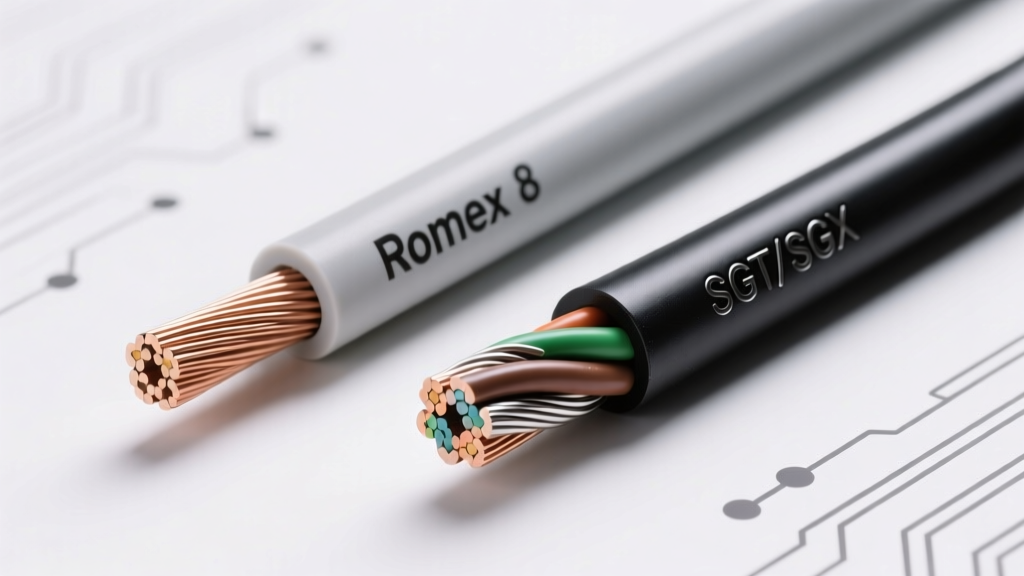
The Romex 8 Gauge Wire Misconception in Automotive Wiring
When wiring high-amperage circuits in camper vans, RVs, off-road rigs, or car audio builds, DIYers often look at leftover residential wiring and ask: Can I use Romex 8 gauge wire for my vehicle? The short answer is no. While NFPA 70 (National Electrical Code) approves 8 AWG NM-B (Romex) for 50-amp residential circuits like electric ranges or EV chargers, the automotive environment introduces variables that residential wire simply cannot survive.
This selection guide compares standard Romex 8 gauge wire against proper automotive 8 AWG cable (SAE J1128 SGT/SGX), breaking down strand counts, insulation chemistry, ampacity, and termination methods to ensure your high-current vehicle circuits are safe, reliable, and compliant with SAE J1128 Low Tension Primary Cable standards.
Material Anatomy: NM-B vs. SAE J1128 SGT/SGX
To understand why product selection matters, we must look at the physical construction of the copper and the insulation jacket.
Romex 8 AWG (NM-B) Construction
Contrary to popular belief, 8 AWG NM-B is rarely a single solid wire; it is typically constructed of 7 thick, compacted strands of bare copper wrapped in individual THHN/THWN-2 (90°C PVC/Nylon) insulation, all encased in an outer PVC jacket. While excellent for pulling through wooden studs and staples, this coarse 7-strand design lacks the flexibility required for moving vehicles. Furthermore, the outer PVC jacket is highly susceptible to UV degradation, becomes brittle in sub-zero temperatures, and will melt if routed too close to exhaust headers or engine blocks.
Automotive 8 AWG (SGT/SGX) Construction
Automotive wire is engineered for chassis wiring. An 8 AWG SGT cable features anywhere from 133 to 259 fine strands of 30 AWG copper, providing immense flexibility. The insulation is typically XLPE (Cross-Linked Polyethylene) in SGX variants, offering superior resistance to high heat (up to 125°C), automotive fluids (oil, grease, transmission fluid), and abrasion.
Head-to-Head Comparison Chart
| Specification | Romex 8 AWG (NM-B) | Automotive 8 AWG (SGT/SGX) | Marine 8 AWG (Tinned) |
|---|---|---|---|
| Strand Count | 7 Strands (Coarse) | 133 - 259 Strands (Fine) | 259+ Strands (Ultra-Fine) |
| Copper Type | Bare Copper | Bare Copper | Tinned Copper (Corrosion Resistant) |
| Insulation Material | PVC / Nylon (THHN) | PVC (SGT) or XLPE (SGX) | PVC / XLPE (Marine Grade) |
| Max Temp Rating | 90°C (Dry) / 75°C (Wet) | 105°C (SGT) / 125°C (SGX) | 105°C |
| Vibration Resistance | Poor (Work Hardens & Snaps) | Excellent | Excellent |
| Chemical Resistance | Low (Degrades with Oil/Gas) | High | High |
| Chassis Ampacity | 50A (NEC Residential) | 50A - 60A (SAE J1128 Free Air) | 50A - 60A |
Real-World Automotive Applications for 8 AWG
If you have selected the correct SAE J1128 8 AWG automotive wire, here is where it excels in vehicle electrical systems.
High-Output Alternator Charging Lines
When upgrading from a stock 80A alternator to a 150A Denso or Lester unit (common in Toyota Tacoma or Jeep Wrangler overland builds), the factory 10 AWG or 8 AWG charge wire may be insufficient for the full output. However, 8 AWG SGT is perfectly rated for a dedicated 50A secondary charge line running to a rear auxiliary battery bank (e.g., Odyssey PC1500DT) via a Littelfuse MEGA or ANL fuse. Always use a ring terminal with a 5/16" or 3/8" stud size to mate with the alternator B+ terminal.
Car Audio and Amplifier Power
For Class D mono amplifiers pushing 500W RMS at 12V, the system will draw roughly 45 to 50 Amps at peak. 8 AWG SGT wire is the minimum safe gauge for a 15-foot run from the battery to the amplifier. Note: Always use an AGU or ANL fuse within 18 inches of the positive battery terminal to protect the 8 AWG run.
Electric Winch Control and Solenoid Wiring
While the main power cables for a 12,000 lb winch require 2/0 AWG welding cable, the control circuits, solenoid triggers, and in-cab rocker switches often utilize 8 AWG to 10 AWG wire to handle the 40A+ inrush current of the contactor coils without suffering from voltage drop.
Termination: Crimping Coarse vs. Fine Strands
One of the most critical failures in DIY automotive wiring occurs at the termination point. The physical difference between Romex and automotive wire dictates how you must crimp them.
- Romex 8 AWG (7-Strand): If you attempt to use a standard automotive hex-crimp tool on 7-strand NM-B, the thick wires will splay, the copper will shear, and the connection will develop high resistance, leading to a thermal meltdown. You must use an indent crimp or a specialized compression lug designed for solid/coarse stranded wire.
- Automotive 8 AWG (Fine Strand): Requires a heavy-duty hex crimp die (often colored red for 8 AWG). The fine strands compress uniformly into a solid mass. For under-hood applications, always use adhesive-lined marine heat shrink over the barrel of the ring terminal to prevent capillary action from drawing battery acid or road salt into the copper strands.
Voltage Drop and Length Limitations
When selecting 8 AWG wire, length is just as important as ampacity. Automotive systems operate at a nominal 12.6V (resting) to 14.4V (charging). A voltage drop of more than 3% (0.38V) on a 50A circuit can cause relays to chatter, amplifiers to clip, or auxiliary fridges to trigger low-voltage cutoffs.
Voltage Drop Formula:
VD = (2 x K x I x L) / CM
Where K = 12.9 (Copper resistance), I = Current (Amps), L = One-way length in feet, CM = Circular Mils for 8 AWG (16,510).
Quick Reference for 8 AWG at 50 Amps:
- 5 Feet: 0.39V Drop (Excellent)
- 10 Feet: 0.78V Drop (Acceptable for most accessories)
- 15 Feet: 1.17V Drop (Marginal; consider upgrading to 6 AWG for continuous loads like inverters)
Final Verdict: Which Wire Should You Buy?
Do not use Romex 8 gauge wire in any automotive, marine, or RV application. The cost savings of using leftover residential NM-B are entirely negated by the risk of vibration-induced copper fatigue, insulation melting, and subsequent electrical fires. The coarse 7-strand construction is fundamentally incompatible with the dynamic, high-heat, and chemically harsh environment of a vehicle chassis.
The Selection Guide Recommendation:
- For Engine Bays & Undercarriages: Buy SAE J1128 SGX (Cross-Linked) 8 AWG. The XLPE insulation will survive radiant heat from exhaust manifolds and resist oil saturation.
- For Camper Vans & Marine Environments: Buy Tinned Copper 8 AWG Marine Wire (Type 3). The tinning prevents green corrosion (copper oxide) in high-humidity environments, ensuring your crimp joints remain electrically sound for decades.
- For Interior Car Audio: Standard SGT (PVC insulated) 8 AWG is perfectly adequate and cost-effective, provided it is routed through dry cabin areas and protected by grommets when passing through sheet metal bulkheads.