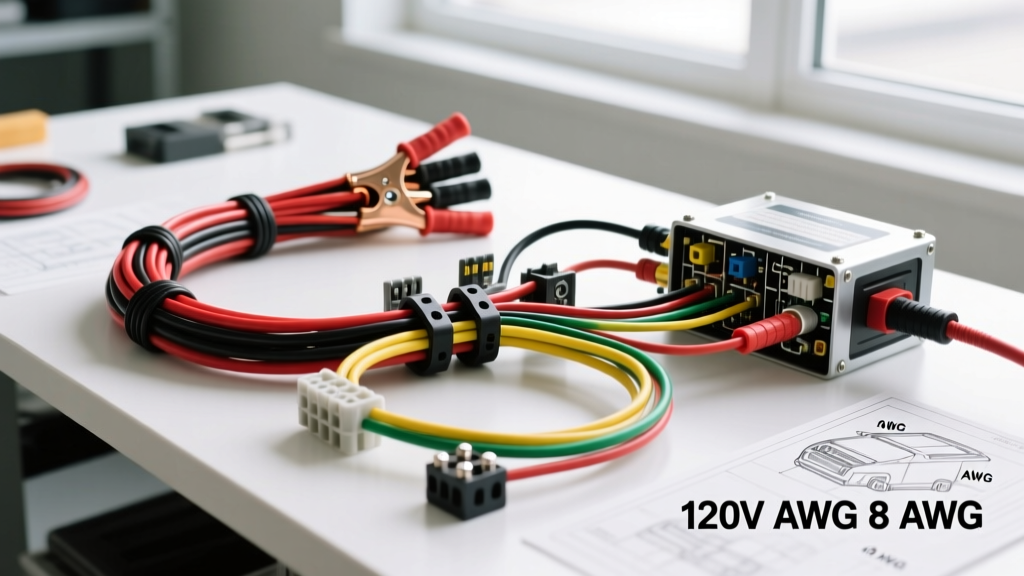
The High Stakes of 120V AC in Mobile Environments
When overlanders, van-lifers, and RV technicians ask, "what gauge wire for 120v applications," they are frequently met with standard residential advice that fails catastrophically in a mobile, high-vibration environment. Running 120V AC mains power through a Ford Transit camper conversion, a Winnebago chassis, or an overland truck requires a fundamental understanding of both ampacity and insulation breakdown voltages. Unlike standard 12V or 24V DC automotive circuits, a 120V AC system carries lethal voltage levels and introduces alternating current physics—such as the skin effect and peak voltage spikes—that demand specific wire types, gauges, and routing protocols.
In this comprehensive gauge-reference guide, we break down the exact AWG sizing requirements for 120V inverters and shore power inlets, while exposing the fatal wiring mistakes that lead to electrical fires, melted bulkheads, and lethal chassis shocks in automotive and RV builds.
What Gauge Wire for 120V? The Core Sizing Matrix
To determine the correct wire gauge for your 120V AC inverter output or shore power inlet, you must calculate based on the maximum continuous amperage of your overcurrent protection device (breaker), not just the nominal wattage of your appliances. Furthermore, mobile environments require a strict 3% maximum voltage drop to prevent damage to sensitive inverter compressors and electronics.
| Breaker Rating | Minimum AWG (Copper) | Max Continuous Load | Max Run Length (3% Drop) | Typical Application |
|---|---|---|---|---|
| 15 Amp | 14 AWG | 12 Amps | 45 Feet | Lighting circuits, small electronics |
| 20 Amp | 12 AWG | 16 Amps | 55 Feet | Standard AC outlets, microwave, TV |
| 30 Amp | 10 AWG | 24 Amps | 65 Feet | RV Shore Power (NEMA TT-30), Roof AC |
| 40 Amp | 8 AWG | 32 Amps | 75 Feet | Large 2000W-3000W Inverter hardwires |
| 50 Amp | 6 AWG | 40 Amps | 85 Feet | 50A Shore Power (NEMA 14-50), Dual AC |
5 Fatal Mistakes in Automotive 120V Wiring
Mistake 1: Using Standard Automotive DC Wire for AC Mains
The most dangerous mistake in mobile 120V wiring is repurposing standard automotive primary wire (such as TXL, GXL, or SXL per SAE J1128) for AC mains. SAE J1128 low-tension cables are typically rated for a maximum of 60V DC. However, 120V AC RMS actually peaks at roughly 170V per cycle. Using 60V-rated insulation in a 170V peak environment guarantees eventual dielectric breakdown, leading to arc faults inside your vehicle's walls. The Fix: You must use wire with a minimum 600V insulation rating. For mobile applications, use Marine-grade Type P cable (tinned copper, 600V rated, highly flexible) or SJOOW/SOOW portable rubber-jacketed cord, which resists vibration, oil, and moisture.
Mistake 2: Ignoring Inverter Surge Loads
Many builders size their inverter wiring based purely on continuous wattage. A 2000W inverter draws roughly 16.6A continuously at 120V AC, which technically fits within a 20A breaker and 12 AWG wire. However, when an AC compressor (like a rooftop RV air conditioner or a residential fridge) starts, it requires a surge current of 2 to 3 times the running wattage. A 2000W inverter can output 4000W (33A) for several seconds. If your wire and breaker are only sized for 20A, the breaker will nuisance-trip, or the wire insulation will overheat and soften. The Fix: Always size the inverter's main AC output trunk line for the inverter's maximum surge rating or a minimum of 10 AWG for 2000W systems, and 8 AWG for 3000W systems.
Mistake 3: Color Code Cross-Contamination
In 12V/24V DC automotive wiring, Red is positive and Black is ground. In 120V AC wiring, Black is Hot, White is Neutral, and Green (or bare) is Ground. Mixing these color codes in a hybrid RV or camper van build is a recipe for lethal electrocution for the next technician who works on the vehicle. The Fix: Strictly adhere to NFPA 70 (NEC) and ABYC E-11 color standards for the AC side of your build. Never use Red wire for 120V AC Hot. If you must use stranded wire that lacks standard AC colors, you must wrap the entire length in properly colored heat shrink or braided sleeving.
Mistake 4: Improper Termination and Vibration Loosening
Residential solid-core wire (THHN/THWN) is strictly prohibited in mobile environments. The constant vibration of a vehicle chassis will cause solid-core wire to work-harden, snap, or back out of terminal blocks. Furthermore, using uninsulated ring terminals or fork terminals on 120V AC breakers inside a cramped inverter bay invites accidental short circuits against the metal chassis. The Fix: Use finely stranded, flexible wire and terminate it using closed-end ferrules or fully insulated spade connectors. Torque all AC breaker lugs to the manufacturer's specification—typically between 1.2 Nm and 2.0 Nm (10 to 18 in-lbs) for 10-6 AWG wires. Under-torqued connections create high-resistance joints that generate immense heat and cause thermal runaway.
Mistake 5: Bonding Neutral to Ground in Sub-Panels
In a vehicle with both a shore power inlet and an onboard inverter, the AC distribution panel acts as a sub-panel, not a main service panel. A common mistake is leaving the neutral-to-ground bonding strap installed in the RV sub-panel. If the neutral and ground are bonded at the sub-panel, return current will travel back through the vehicle's metal chassis via the DC ground network, creating a severe shock hazard and causing GFCI outlets to trip constantly. The Fix: Ensure the inverter features an internal automatic transfer switch (ATS) and neutral-ground relay that only bonds neutral to ground when the inverter is actively powering the circuit, and isolates them when connected to shore power.
Shore Power Inlet Pinouts and Connector Specs
When wiring the 120V AC shore power inlet to your main distribution panel, the gauge of the wire must match the physical NEMA connector rating. Undersizing the wire between the inlet and the first breaker is a primary cause of melted inlet plugs.
- NEMA TT-30 (30 Amp RV Standard): A 3-prong plug providing 120V AC. Pinout: X (Hot/Black), W (Neutral/White), G (Ground/Green). Requires minimum 10 AWG wire. Torque terminal screws to 1.5 Nm.
- NEMA L5-30 (30 Amp Twist-Lock): Common on marine vessels and high-end overland builds to prevent the plug from vibrating loose. Pinout: X (Hot), W (Neutral), G (Ground). Requires minimum 10 AWG SJOOW or Type P marine cable.
- NEMA 14-50 (50 Amp RV Standard): A 4-prong plug providing split-phase 120V/240V AC. Pinout: X (Hot 1/Black), Y (Hot 2/Red), W (Neutral/White), G (Ground/Green). Requires minimum 6 AWG wire (4 AWG recommended for runs over 25 feet). Note: Standard RV 50A service only utilizes the two 120V legs and does not use the 240V potential.
Overcurrent Protection and Routing Safety
All 120V AC wiring in a vehicle must be protected by a DIN-rail mounted hydraulic-magnetic breaker or a fast-acting fuse located within 18 inches of the power source (the shore power inlet or the inverter AC output). Unlike DC fuses, AC breakers are specifically designed to extinguish the alternating current arc when tripping. Never use standard automotive ANL or Class-T DC fuses on the 120V AC side of your system; they are not rated to safely quench AC arcs and can result in an explosion inside your fuse block.
Finally, routing is critical. 120V AC cables must never be run in the same conduit or loom as 12V DC cables, CAN bus networks, or audio signal wires. The electromagnetic interference (EMI) generated by 120V AC will induce noise into sensitive automotive data lines, causing ECU faults and alternator whine in audio systems. Maintain a minimum separation of 4 inches between AC and DC wiring harnesses, crossing them only at strict 90-degree angles when necessary.