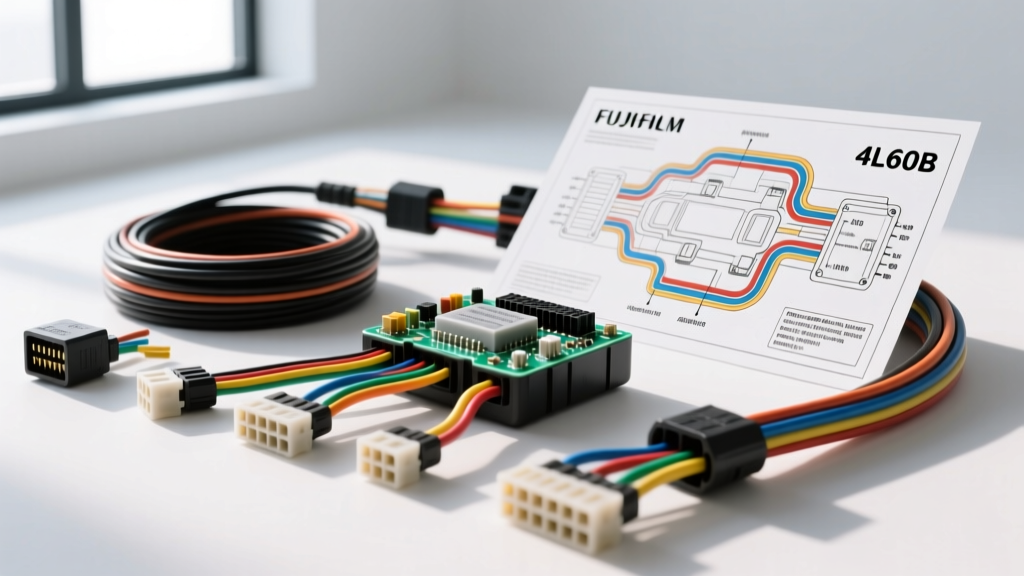
Decoding the 4L60E Transmission External Wiring Harness Diagram PDF
The GM 4L60E transmission relies on a complex network of solenoids and sensors to execute precise hydraulic pressure changes and shift timing. The external wiring harness serves as the critical bridge between the Powertrain Control Module (PCM) and the transmission's internal 16-way case connector. When technicians and restorers search for a 4L60E transmission external wiring harness diagram PDF, they are usually facing harsh shift complaints, limp-mode activation (DTC P0700), or total loss of torque converter clutch (TCC) lockup.
Unlike internal harnesses that are bathed in hot, corrosive transmission fluid, the external harness is subjected to extreme underbody environments: road salt, exhaust heat, engine vibration, and physical chafing against the bellhousing. In this comprehensive guide, we analyze the exact pinout configurations, evaluate the true cost of OEM versus aftermarket replacements, and detail the specialized tooling required to execute a lasting, factory-grade harness repair.
16-Way Case Connector Pinout and Wire Specifications
Before calculating repair costs, you must accurately interpret the wiring schematic. The 1998-2006 4L60E applications utilize a 16-way rectangular case connector (often referred to as a Metri-Pack or Weather-Pack hybrid depending on the specific OEM supplier). Below is the definitive pinout chart for the external case connector, referencing standard GM C/K truck and Tahoe wire color codes and AWG requirements.
| Pin | Component / Circuit | Wire Color (Typical) | AWG Size | PCM C1/C2 Pin |
|---|---|---|---|---|
| A | Shift Solenoid A (SSA) | Yellow | 18 AWG | C1-13 |
| B | Shift Solenoid B (SSB) | Light Blue | 18 AWG | C1-14 |
| C | Shift Solenoid C (3-2 Ctrl) | Brown | 18 AWG | C1-15 |
| D | TCC PWM Solenoid | Purple | 18 AWG | C1-16 |
| E | TCC On/Off Solenoid | Black/White | 18 AWG | C2-11 |
| F | Pressure Control (PC) High | Light Green | 18 AWG | C2-12 |
| G | Pressure Control (PC) Low | Dark Green | 18 AWG | C2-13 |
| H | Trans Fluid Temp (TFT) Signal | Yellow/Black | 20 AWG | C2-22 |
| J | TFT Sensor Ground | Black/Pink | 20 AWG | C2-23 |
| K | Output Speed Sensor (OSS) High | Purple/White | 20 AWG | C2-24 |
| L | OSS Low | Light Green/Black | 20 AWG | C2-25 |
| M | Input Speed Sensor (ISS) High | Tan | 20 AWG | C2-26 |
| N | ISS Low | Tan/Black | 20 AWG | C2-27 |
| P | Case Ground / Shield | Black | 18 AWG | Engine Block |
| R | 12V Ignition Feed (Solenoids) | Pink | 16 AWG | Fuse Panel |
| S | Drain Wire (Sensor Shield) | Bare Copper | 22 AWG | C2-30 |
Cost Analysis: OEM vs. Aftermarket vs. DIY Repair
When the external harness suffers from chafing, broken locking tabs, or capillary fluid wicking, technicians face three distinct repair routes. Understanding the cost-to-reliability ratio of each method is crucial for fleet managers, restoration shops, and DIY enthusiasts.
1. Complete OEM Harness Assembly Replacement
Purchasing a factory-original equipment (OE) harness from a GM dealer ensures perfect loom routing, exact wire lengths, and pre-applied dielectric grease. However, it is the most expensive route. For a 2004 Silverado 1500, the OEM external harness (Part # 24230242 or similar superseded numbers) typically retails between $240 and $380. Labor to route the harness through the firewall, along the frame rail, and past the exhaust crossover adds roughly 2.0 to 2.5 hours of shop time ($250-$400).
2. Aftermarket Pigtail and Universal Looms
Many aftermarket suppliers offer 'pigtail' connectors that include 12 inches of pre-crimped wire and a new case connector. These cost between $45 and $90. While cost-effective, splicing these pigtails into the existing harness introduces new failure points. Soldering is highly discouraged in high-vibration automotive environments; solder joints lack flexibility and will fatigue-crack over time, leading to high-resistance voltage drops that mimic failing solenoids.
3. DIY Terminal and Wire Reconstruction
For the purist or the shop focused on maximum reliability, rebuilding the harness using bulk automotive primary wire (meeting SAE J1128 specifications) and loose Delphi terminals costs under $40 in materials. This requires specialized tooling, which brings us to the capital expenditure required for professional-grade harness repair.
Essential Tool Requirements for Harness Repair
To properly execute a repair based on your 4L60E transmission external wiring harness diagram PDF, you cannot rely on standard hardware store tools. Automotive connectors utilize specific crimp profiles to ensure gas-tight connections that resist moisture and vibration.
| Tool Category | Specific Tool / Model | Estimated Cost | Purpose |
|---|---|---|---|
| Crimper | Delphi/GTI SGT-101 or equivalent Metri-Pack crimper | $110 - $160 | Creates the specific 'M' or 'B' crimp profile for 150/280 series terminals. |
| Extractors | Lisle 47900 Terminal Tool Set | $35 - $50 | Depins damaged terminals from the 16-way case connector without breaking locking barbs. |
| Strippers | Knipex 12-24 AWG Precision Stripper | $45 - $60 | Prevents nicking the copper strands on 20 AWG sensor wires. |
| Testing | Fluke 87V Automotive Multimeter | $350+ | Measures millivolt drops across the PC solenoid circuit under load. |
| Breakout | OTC 7000 Series GM Transmission Adapter | $85 - $120 | Allows inline amperage testing of shift solenoids without piercing wire insulation. |
Investing in a dedicated Metri-Pack crimper is non-negotiable. Standard electrical crimpers deform the terminal wings incorrectly, leading to a loose fit inside the connector cavity. This causes micro-arcing, which melts the plastic connector housing and triggers PCM codes for solenoid circuit malfunctions (e.g., P0740, P0751, P0756).
Real-World Failure Modes & Expert Troubleshooting
When referencing the wiring diagram to chase a fault, be aware of the 4L60E's most notorious external harness failure modes:
Capillary Fluid Wicking
If the internal transmission seal at the case connector fails, hot ATF can migrate past the rubber grommet. Due to capillary action, the fluid travels inside the stranded copper wire, beneath the PVC insulation. The fluid acts as a conduit, eventually reaching the PCM connector at the firewall. This causes catastrophic PCM failure. Expert Fix: Always inspect the PCM pins for a red/brown oily residue. If present, the entire harness must be replaced; flushing the wires is impossible. Apply dielectric grease (like Nyogel 760G) to the case connector during reassembly to block future migration.
Exhaust Heat Degradation
On C/K trucks and SUVs, the external harness routes dangerously close to the passenger-side exhaust manifold and catalytic converter. Over time, radiant heat bakes the corrugated plastic loom, making it brittle. The wires then chafe against the transmission bellhousing, shorting the 12V Ignition Feed (Pin R) to the Case Ground (Pin P). This blows the IGN 0 fuse in the underhood bussed electrical center, killing power to all transmission solenoids and triggering immediate limp mode (3rd gear only). Expert Fix: Wrap the repaired harness section in high-temp fiberglass sleeving and secure it with stainless steel zip ties, maintaining a minimum 4-inch clearance from exhaust components.
Summary and Authoritative References
Successfully repairing the 4L60E external wiring harness requires more than just downloading a schematic; it demands an understanding of material costs, precise crimping tooling, and environmental failure modes. By utilizing the correct 16-way pinout data and investing in Delphi-specific crimping tools, you can restore OEM-level shift quality and protect the vehicle's PCM from devastating electrical faults.
For further technical validation, consult the following resources:
- SAE J1128: Low Tension Primary Cable Standard - Defines the thermal and abrasion requirements for automotive primary wire used in transmission harnesses.
- Delphi Connection Systems Catalog - The definitive guide to Metri-Pack 150/280 terminal crimp profiles and extraction methods.
- Haynes Pro: Automotive Wiring Testing and Repair - Best practices for voltage drop testing on high-current solenoid circuits.