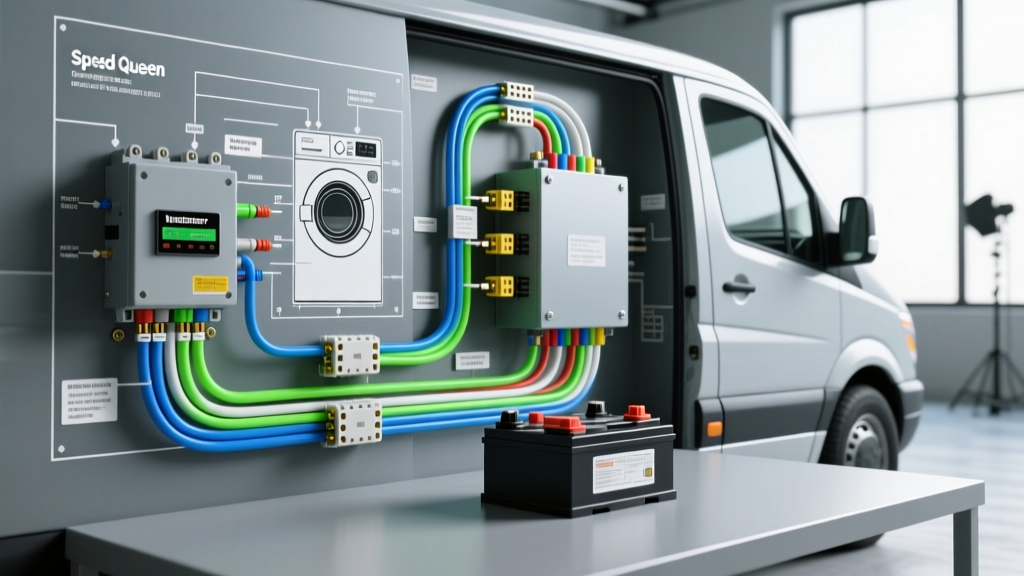
Integrating Commercial Laundry Loads into Automotive DC Systems
Mobile auto-detailing operations and high-end RV conversions frequently require commercial-grade laundry equipment to process microfiber towels and detailing rags on-site. When technicians search for a wiring diagram speed queen dryer schematic, they are typically looking at 120V or 240V AC appliance circuits. However, integrating this appliance into a vehicle—such as a 2015-2023 Ford Transit 350 upfit—requires translating those AC load requirements into a robust, heavy-duty automotive DC wiring architecture. This guide provides a step-by-step troubleshooting flow for the DC-to-AC power delivery system that drives the dryer, focusing on dual-alternator setups, continuous-duty solenoids, and inverter busbar configurations.
System Architecture: Ford Transit Dual-Alternator to Inverter
A standard Speed Queen commercial electric dryer heating element draws approximately 2,500W to 3,000W. On the AC side, this requires a dedicated 30-amp circuit. On the automotive DC side, powering a 3000W pure sine wave inverter demands roughly 260 amps at 12.8V under peak load. Standard OEM vehicle wiring cannot handle this continuous current. The upfit requires a secondary high-output alternator (e.g., 250A Nationally Available Alternator), a dedicated lithium house battery bank, and a battery isolator solenoid to protect the Transit's chassis starting battery from severe voltage sag.
Automotive DC Power Distribution Specifications
| Circuit Segment | AWG Size | SAE Spec / Insulation | Wire Color Code | Hardware & Torque |
|---|---|---|---|---|
| Alt 2 to House Battery (+) | 1/0 AWG | SAE J1128 SGX (XLPE) | Red | M8 Ring, 12 Nm |
| House Battery to Inverter (+) | 1/0 AWG | SAE J1128 SGX (XLPE) | Red | M10 Ring, 15 Nm |
| Inverter Chassis Ground | 1/0 AWG | SAE J1128 SGX (XLPE) | Black | M8 Bolt to Frame, 24 Nm |
| Isolator Solenoid Coil | 10 AWG | SAE J1128 GXL | Yellow / Blue | Spade Connector |
Step-by-Step Troubleshooting Flow: DC Delivery & Inverter Faults
When the dryer fails to operate in the mobile rig, technicians must determine if the fault lies in the appliance's internal AC wiring (requiring the OEM Speed Queen schematic) or the vehicle's DC power delivery network. Use the following decision trees to isolate the failure point.
Symptom 1: Inverter Shuts Down Immediately When Dryer Heater Engages
Cause Analysis: The inverter's internal low-voltage cutoff (LVC) is triggering due to severe voltage drop on the DC supply side. When the dryer's heating element energizes, the inverter draws over 250A. If the wiring or connections have high resistance, voltage at the inverter busbar drops below the 10.5V safety threshold.
- Step 1: Perform a loaded voltage drop test. Set a multimeter to DC Volts. Place the red probe on the house battery positive post and the black probe on the inverter positive busbar.
- Step 2: Start the Transit engine (ensure the upfitter relay is closed) and turn on the dryer. Acceptable voltage drop is less than 0.10V per connection point. A reading greater than 0.50V indicates a failing crimp or corroded busbar.
- Step 3: Inspect the 250A ANL fuse and copper ring terminals. SAE J1128 SGX wire requires a hex-die hydraulic crimp. If the heat shrink shows melt marks, the terminal was likely crimped with an improper indent die, causing micro-arcing under heavy load.
- Fix: Cut back the 1/0 AWG wire, strip with a rotary cable stripper, and re-crimp using a 3/8" copper tube terminal and hydraulic hex die. Seal with 3:1 dual-wall adhesive heat shrink to prevent moisture ingress.
Symptom 2: Dryer Motor Runs, But No Heat (Cross-Reference)
Cause Analysis: If the inverter remains stable but the dryer tumbles without heat, the issue may bridge the vehicle's AC output and the appliance's internal thermal fuses. Some mobile rigs use a 12V DC auxiliary heater, but assuming a standard Speed Queen AC unit, the inverter may be outputting a modified sine wave instead of pure sine, causing the dryer's electronic control board to reject the power or blow its internal 3-amp glass fuse.
- Step 1: Verify inverter output using an oscilloscope or a True-RMS multimeter. Ensure the waveform is a clean Pure Sine Wave (Total Harmonic Distortion less than 5%).
- Step 2: Consult the wiring diagram speed queen dryer service manual. Locate the centrifugal switch on the drive motor circuit. The heating element will not engage unless the motor reaches operational RPM and closes this switch to complete the 120V heating circuit.
- Step 3: Check the vehicle-side GFCI outlet. High-frequency harmonic distortion from cheap inverters can cause GFCI nuisance tripping specifically on the neutral-to-ground bond.
- Fix: If the GFCI trips, isolate the inverter's neutral-to-ground bonding relay. Ensure the vehicle's chassis ground is bonded to the house battery negative via a dedicated 1/0 AWG ground strap to prevent floating neutral faults that mimic ground-leakage events.
Symptom 3: Parasitic Draw Draining the Transit Chassis Battery
Cause Analysis: The battery isolator solenoid (Trombetta continuous-duty relay) is failing to open when the ignition is turned off, allowing the inverter's standby current and the dryer's electronic control board to drain the OEM starting battery overnight.
- Step 1: Locate the isolator solenoid, typically mounted in the Transit's driver-side B-pillar upfitter compartment or under the driver's seat base.
- Step 2: Identify the control pins. Pin 1 should receive 12V+ from the ignition-switched upfitter circuit (Blue wire). Pin 2 is chassis ground.
- Step 3: With the key OFF, measure voltage across the high-current terminals (Pins 3 and 4). If continuity exists, the solenoid contacts are welded shut due to the massive inrush current required to charge the inverter's internal capacitor bank upon startup.
- Fix: Replace the solenoid with a Trombetta 12V 200A continuous-duty model featuring a built-in coil economizer. Install a pre-charge resistor circuit or a soft-start relay to limit capacitor inrush current, preventing future contact welding and preserving the OEM chassis battery.
Thermal Imaging & Busbar Diagnostics
Because DC resistance increases exponentially with heat, visual inspections are often insufficient for diagnosing high-amperage inverter circuits. Utilizing a FLIR thermal imaging camera while the Speed Queen dryer is in its peak heating cycle is the most effective way to spot micro-arcing. Scan the 1/0 AWG crimps, the ANL fuse block, and the M8/M10 busbar nuts. A delta-T (temperature differential) of greater than 15°C above ambient on any single connection point indicates high resistance. This localized heat will eventually melt the SGX cross-linked insulation and cause a catastrophic short-to-ground against the van's sheet metal.
Grounding & Chassis Bonding Specifications
A common failure in mobile appliance upfits is relying on the vehicle's sheet metal for high-current DC returns. The Ford Transit's unibody construction utilizes high-strength boron steel and extensive seam sealants, which are highly resistive to DC current. To safely support the massive amperage required to run the dryer's inverter, you must establish a dedicated, low-impedance ground path.
Locate a heavy-duty structural crossmember beneath the van's floor pan. Remove all paint, powder coating, and E-coat using a wire wheel to expose bare steel. Apply Noalox (aluminum-to-copper anti-oxidant paste) to the contact patch to prevent galvanic corrosion. Bolt the 1/0 AWG black ground cable using a Grade 8 flange bolt, torqued to 24 Nm. Finally, seal the entire connection with fluid film or heavy-duty undercoating to prevent road salt intrusion, which rapidly accelerates copper oxidation. Furthermore, keep the DC ground strap length under 18 inches to minimize inductance, which can interfere with the high-frequency ripple generated by the inverter's switching transistors.
Authoritative References
- Ford Motor Company Upfitter Body Builder Layout Book (Transit) - Provides OEM guidelines for auxiliary battery isolation, upfitter relay pinouts, and alternator bracket torque specifications.
- SAE International J1128 Standard - Defines the thermal and physical requirements for SGX and GXL cross-linked polyethylene automotive battery cables used in high-amp inverter circuits.
- Speed Queen Technical Service Documents - Essential for cross-referencing the appliance's internal centrifugal switch, thermal cutoffs, and heating element resistance values during AC-side diagnostics.