Integrating Residential Window AC Units into Vehicular Power Systems
When engineering a 12V or 24V auxiliary power system for a Sprinter van, Class C RV, or expedition truck, integrating a standard 120V residential window air conditioner presents unique electrical challenges. Unlike native DC compressor systems, residential window units utilize AC induction motors that demand massive initial current surges to start. Understanding the correct diagram window AC wiring connection architecture is critical to prevent voltage sag, inverter faulting, or catastrophic wire fires. This guide serves as a comprehensive product comparison and selection reference for mobile HVAC electrical integration.
Product Comparison: Inverter Topologies for Compressor Loads
The most critical selection in your wiring diagram is the inverter. Window AC compressors are highly sensitive to power quality. Feeding an AC induction motor with a Modified Sine Wave (MSW) inverter causes severe harmonic distortion, leading to motor overheating, acoustic buzzing, and premature compressor failure. You must select a Pure Sine Wave (PSW) inverter. Below is a comparison of top-tier PSW inverters suited for a standard 5,000 BTU (approx. 500W running / 1500W surge) window AC unit.
1. Victron Energy MultiPlus 12/3000/120
Surge Capacity: 5,500W for up to 1 second.
Selection Verdict: The gold standard for mobile window AC wiring. Its robust transformer handles the Locked Rotor Amps (LRA) of a window AC compressor effortlessly. Features an integrated neutral-to-ground relay, which is essential for vehicular AC wiring diagrams to prevent GFCI trips.
2. Xantrex Freedom X 3000W
Surge Capacity: 6,000W.
Selection Verdict: Excellent high-surge capability, though it lacks the advanced programmable grid-assist features of the Victron. Requires careful attention to chassis grounding protocols in the wiring diagram.
3. AIMS Power 3000W Pure Sine
Surge Capacity: 9,000W (claimed).
Selection Verdict: A budget-friendly alternative. While the surge rating is high, continuous thermal management in enclosed van cabinets requires upgraded active cooling. Terminal connections require meticulous crimping to prevent resistance heating.
Understanding LRA vs. RLA in Mobile HVAC
To properly size the DC-side cabling in your diagram window AC wiring connection, you must calculate based on Locked Rotor Amps (LRA), not Running Load Amps (RLA). A typical 5,000 BTU window AC unit has an RLA of 4.5 Amps (approx. 540W at 120V). However, the LRA—the surge required to overcome the compressor's mechanical inertia—can spike to 18 Amps (2,160W) for a fraction of a second. On a 12V DC system, accounting for inverter efficiency losses (approx. 85%), a 2,160W AC surge demands roughly 211 Amps from the battery bank instantaneously. If your wire gauge is undersized, the voltage drop will trigger the inverter's Low Voltage Cutoff (LVC), stalling the compressor.
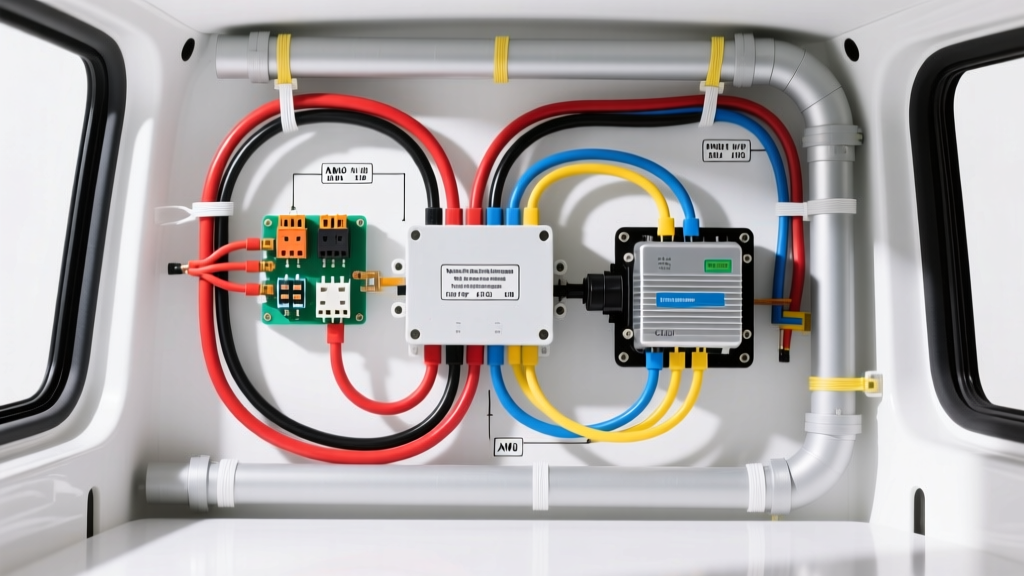
Diagram: Window AC Wiring Connection Architecture
The following structural breakdown details the exact physical routing, AWG sizing, and terminal connections required for a safe, high-amperage mobile installation.
Phase 1: DC Side (Battery Bank to Inverter)
- Wire Selection: Use SAE J1128 compliant flexible stranded copper wire. Never use solid core residential Romex on the DC side, as vehicle vibration will cause metal fatigue and strand fracture.
- Gauge Sizing: For a 3000W inverter on a 12V system, 4/0 AWG is mandatory for runs up to 10 feet to minimize voltage drop during compressor startup.
- Overcurrent Protection: Install a 400A Class-T fuse (e.g., Bussmann JJN-400) within 7 inches of the battery bank positive terminal. Class-T fuses offer the high interrupting capacity (AIC) required for lithium battery banks, unlike standard ANL fuses.
- Termination: Use heavy-duty copper lugs with adhesive-lined heat shrink. Torque M8 terminal nuts to 11-13 ft-lbs to prevent micro-arcing.
Phase 2: AC Side (Inverter to Window AC Receptacle)
- Wire Selection: 12 AWG THHN stranded wire routed through flexible split loom conduit.
- Color Code (per NFPA 70 Article 551): Black (Hot), White (Neutral), Green/Bare (Equipment Ground).
- Breaker Sizing: 20A GFCI breaker installed in a sub-panel. The window AC unit must be the sole load on this dedicated circuit.
Specification Chart: Inverter Cable & Component Selection
| System Component | Specification / Rating | Selection Rationale & Code Reference |
|---|---|---|
| DC Positive Cable | 4/0 AWG SAE J1128 (Red) | Handles 211A surge with less than 3% voltage drop. Reference: SAE J1128 Standard. |
| DC Main Fuse | 400A Class-T (Bussmann) | 20,000 AIC rating prevents arc flashes during hard shorts on high-C-rate lithium banks. |
| AC Output Wire | 12 AWG THHN (Black/White/Green) | Rated for 20A continuous. Compliant with NEC Article 551 for RVs. |
| Busbar | 600A Rated Lynx Distributor | Consolidates multiple DC loads while maintaining high-amperage structural integrity. |
| AC Receptacle | 20A Tamper-Resistant GFCI | Mandatory for mobile environments where condensation and humidity are prevalent. |
Grounding and Bonding Protocols
A frequent failure point in mobile window AC wiring is improper neutral-to-ground bonding. In a residential home, the neutral and ground are bonded at the main service panel. In a vehicle, the inverter acts as the source. If you are using an inverter/charger like the Victron MultiPlus, it features an internal relay that automatically bonds neutral to ground when operating in inversion mode, and separates them when connected to shore power. Manually bonding the neutral bus to the ground bus in your AC sub-panel will cause shore power GFCI breakers to trip immediately upon connection. Always bond the inverter chassis ground to the vehicle's main DC negative busbar using a minimum 2 AWG green wire to ensure fault currents have a low-resistance path back to the source.
Troubleshooting: Compressor Stalling and Inverter Faults
If your window AC compressor clicks, hums, and fails to start, or if the inverter throws a low-voltage alarm, diagnose the system using this decision tree:
- Measure DC Voltage at Inverter Terminals During Startup: Use a multimeter with a min/max hold feature. If the voltage at the inverter's DC input terminals drops below 10.5V during the compressor kick-on, your DC cabling is too long or undersized. Upgrade to 4/0 AWG or shorten the run.
- Check Battery BMS Limits: Many 12V 100Ah Lithium Iron Phosphate (LiFePO4) batteries feature a 100A BMS cutoff. A 2,160W AC surge requires roughly 180A DC. If the BMS trips, you must wire two identical batteries in parallel to double the continuous and surge discharge limits.
- Inspect AC Receptacle Connections: Vibration can loosen standard push-in wire connectors. Always use screw-terminal receptacles and torque the terminal screws to 12 in-lbs.
Advanced Integration: Soft Starters for Mobile AC
For larger window AC units (8,000 BTU and above) or smaller inverter setups (2000W), integrating a micro-air soft starter is highly recommended. A soft starter alters the phase angle of the voltage supplied to the compressor motor, ramping up the torque over a few hundred milliseconds rather than demanding an instantaneous LRA spike. This effectively reduces the startup surge by up to 70%, allowing a 2000W Pure Sine Wave inverter to reliably run an 8,000 BTU window unit. When wiring a soft starter, the capacitor bypass wires must be routed separately from the main 120V feed to prevent electromagnetic interference (EMI) with the vehicle's CAN bus networks. For deeper architectural planning, consult the Victron Energy Wiring Unlimited Guide for comprehensive mobile power schematics.
By adhering to these strict AWG sizing protocols, selecting the correct Pure Sine Wave topology, and respecting mobile grounding codes, your diagram window AC wiring connection will deliver reliable, efficient climate control in any off-grid vehicular environment.