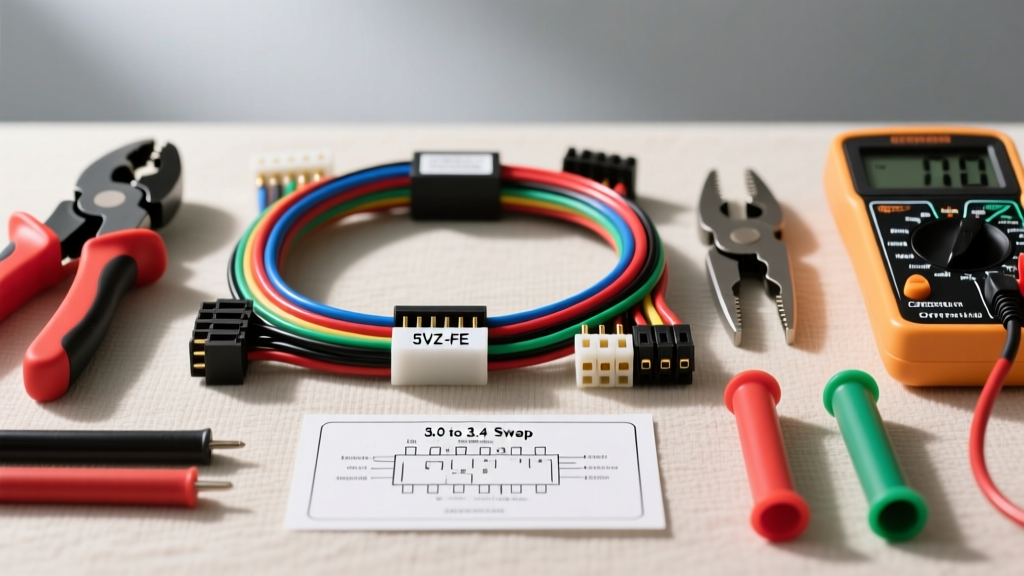
The 3VZ-E to 5VZ-FE Electrical Reality
Swapping the anemic 3.0L 3VZ-E for the robust 3.4L 5VZ-FE V6 in 1989-1995 Toyota 4Runners, Pickups, and T100s is a rite of passage for off-road enthusiasts. However, while motor mounts and exhaust fabrication often dominate the build thread, the 3.0 to 3.4 swap wiring harness is where most projects stall. The electrical architectures of these two engines are fundamentally different. The 3VZ-E relies on an older Denso ECU utilizing a flapper-door Air Flow Meter (AFM), whereas the 5VZ-FE uses a modern Hot Wire Mass Air Flow (MAF) sensor and a completely different ECU pinout topology.
To execute this swap reliably, you cannot simply splice wires together with twist-connectors and electrical tape. The under-hood environment demands automotive-grade terminations. This guide provides a comprehensive cost and tool requirements analysis for building or adapting a 5VZ-FE harness to communicate seamlessly with a 3VZ-E era body harness and dash cluster.
Cost Breakdown: OEM vs. Custom 3.0 to 3.4 Swap Wiring Harness
Budgeting for the electrical side of an engine swap requires looking beyond the initial purchase price. Brittle junkyard harnesses often lead to parasitic draws and misfires, costing more in diagnostic time than a proper build. Below is a comparative analysis of the three primary routing methods for this specific swap.
| Harness Strategy | Estimated Cost | Pros | Cons & Risks |
|---|---|---|---|
| Junkyard OEM 5VZ-FE Harness | $150 - $250 | Cheap upfront; factory molded loom. | 20+ year old PVC insulation is brittle; dash plugs do not mate to 3VZ body harness. |
| Custom Mil-Spec Adapter Harness | $450 - $650 | Plug-and-play; uses new TXL wire and OEM connectors. | Requires sourcing donor dash plugs; longer lead times. |
| Full Custom Mil-Spec Build | $700 - $1,100 | Optimized routing; Raychem DR-25 shielding; Deutsch firewall pass-throughs. | Highest material cost; requires advanced crimping and pinning skills. |
Note: Costs assume you already possess the 5VZ-FE ECU and MAF sensor. If you need to source OEM Toyota connector housings (e.g., part #90980-11660 for the MAF), add approximately $80-$120 to your budget.
Essential Tooling for 5VZ-FE Harness Fabrication
Building a harness that survives engine bay vibrations and 200°F+ ambient temperatures requires specialized tooling. Standard hardware store crimpers will deform open-barrel terminals, leading to high-resistance connections that trigger ECU limp modes.
1. Wire and Insulation Materials
Never use standard PVC hook-up wire. You must use SAE J1128 compliant TXL (Thin-wall Cross-linked) or GXL wire. TXL offers superior heat resistance and abrasion tolerance. For shielding, abandon corrugated plastic split-loom, which traps moisture and melts on exhaust manifolds. Invest in expandable braided PET sleeving and Raychem DR-25 heat shrink for ECU boots.
2. Precision Crimping Tools
The 5VZ-FE uses a mix of standard Denso micro-timers and larger waterproof connectors. Your tool kit must include:
- Open Barrel Crimper: TE Connectivity AMP Superseal or equivalent (e.g., IWISS SN-48B) for standard ECU and sensor pins.
- Deutsch DT Crimper: Essential if you are fabricating a bulkhead connector to pass the harness through the firewall cleanly.
- Weather-Pack Crimper: Required for the 5VZ-FE injector clips if you are replacing the brittle OEM housings with new pigtails.
3. Diagnostic & Verification Tools
Before applying 12V power to the ECU, every circuit must be verified. A digital multimeter (DMM) with a continuity and diode-test function is mandatory. Additionally, a terminal pin removal tool set specific to Toyota/Denso connectors is required to extract pins from the donor 3VZ-E body harness plugs without snapping the locking tangs.
Technical Specifications: Wire Gauge & Pinout Mapping
When fabricating the adapter harness between the 5VZ-FE ECU and the 3VZ-E dash plugs, wire gauge selection is critical. Undersized ground wires are the number one cause of erratic idle and O2 sensor codes in 3.4L swaps. The table below outlines critical ECU circuits and their required AWG specifications based on Toyota Technical Information System (TIS) standards.
| 5VZ-FE ECU Pin | Function | OEM Wire Color | Required AWG (TXL) | Routing Notes |
|---|---|---|---|---|
| E1 (Multiple) | ECU Logic & Sensor Ground | Brown | 14 AWG (Upgraded from 18) | Must ground directly to clean engine block, not chassis. |
| +B | Main EFI Relay Power | White/Red | 12 AWG | Route directly from EFI relay; keep away from ignition coils. |
| IGSW | Ignition Switch Signal | Black/Orange | 16 AWG | Verify 12V only in 'ON' and 'START' positions. |
| VG | MAF Sensor Signal | Yellow/Black | 18 AWG (Shielded) | Use shielded cable; ground shield at ECU end only to prevent noise. |
| THA | Intake Air Temp Sensor | White/Red | 18 AWG | Keep away from exhaust manifolds; high resistance alters fuel trims. |
The MAF vs. AFM Conversion Challenge
The most complex part of the 3.0 to 3.4 swap wiring harness is the air metering conversion. The 3VZ-E dash harness expects a 4-pin AFM signal (VC, VS, E1, THA). The 5VZ-FE MAF outputs a completely different frequency/voltage signal on a 3 or 4-pin connector (+B, E2G, VG). You cannot simply adapt these plugs. The 5VZ-FE ECU must be wired directly to the 5VZ-FE MAF sensor using the OEM MAF harness pigtail. The dash cluster tachometer and speedometer signals must then be intercepted from the 5VZ-FE ECU (Pins IGS and SPD) and routed to the 3VZ-E body plugs.
Hidden Costs: Connectors, Loom, and Shielding
Novice swappers often budget only for the wire and ECU, forgetting the "consumables" that dictate the longevity of the harness. Adhering to IPC/WHMA-A-620 wire harness standards requires specific materials:
- OEM Connector Housings & Seals: ~$120. Reusing 25-year-old rubber weather seals guarantees water intrusion and green corrosion on the ECU pins.
- Raychem DR-25 Heat Shrink: ~$85 per spool. Standard polyolefin heat shrink will crack under engine bay thermal cycling. DR-25 is elastomeric and flexes with the harness.
- TESA Fleece Tape: ~$25 per roll. Used to bind wire bundles before sleeving. It prevents the wires from rattling and wearing through the PET braided sleeving.
- Adhesive-Lined Heat Shrink (Dual Wall): ~$40. Mandatory for any splice or environmental seal where the harness transitions into the firewall.
Troubleshooting Decision Tree: 5VZ-FE Swap Electrical Gremlins
Even with a meticulously built 3.0 to 3.4 swap wiring harness, integration issues can arise. Use this diagnostic tree to isolate common swap-specific electrical failures.
- Symptom: Engine cranks but has no injector pulse and no fuel pump prime.
- Cause: Missing ECU ground or blown AM2 fuse in the 3VZ-E fuse box.
- Fix: Verify continuity between ECU Pin E1 and the engine block. Ensure the 3VZ-E EFI relay is triggering the 5VZ-FE +B circuit.
- Symptom: Erratic idle, hunting RPMs, and rich exhaust (Code 13 or 21).
- Cause: Ground loop on the MAF sensor or O2 sensor grounds.
- Fix: The 5VZ-FE E2G (MAF ground) and E01 (O2 ground) must share a common star-ground point on the engine block with the E1 pins. Do not ground these to the chassis or intake manifold.
- Symptom: Dash cluster tachometer reads zero or bounces erratically.
- Cause: Tach signal mismatch between 5VZ-FE IGT signal and 3VZ-E cluster expectations.
- Fix: The 3VZ-E cluster expects a specific voltage pulse. You may need to wire a tachometer signal filter or pull the tach signal directly from the negative terminal of Ignition Coil #1 rather than the ECU IGT pin.
Conclusion: Is the Custom Harness Worth the Investment?
When analyzing the cost and tool requirements for a 3.0 to 3.4 swap wiring harness, the data clearly favors building a custom Mil-Spec adapter or fully repinning a new harness over relying on degraded junkyard wiring. While the initial tooling investment (crimpers, heat shrink, TXL wire) may push the electrical budget past $800, it eliminates the catastrophic risk of an ECU-killing ground loop or a harness fire. By adhering to SAE wire standards and utilizing proper open-barrel crimping techniques, your 5VZ-FE swap will start on the first key turn and remain reliable on the harshest off-road trails.