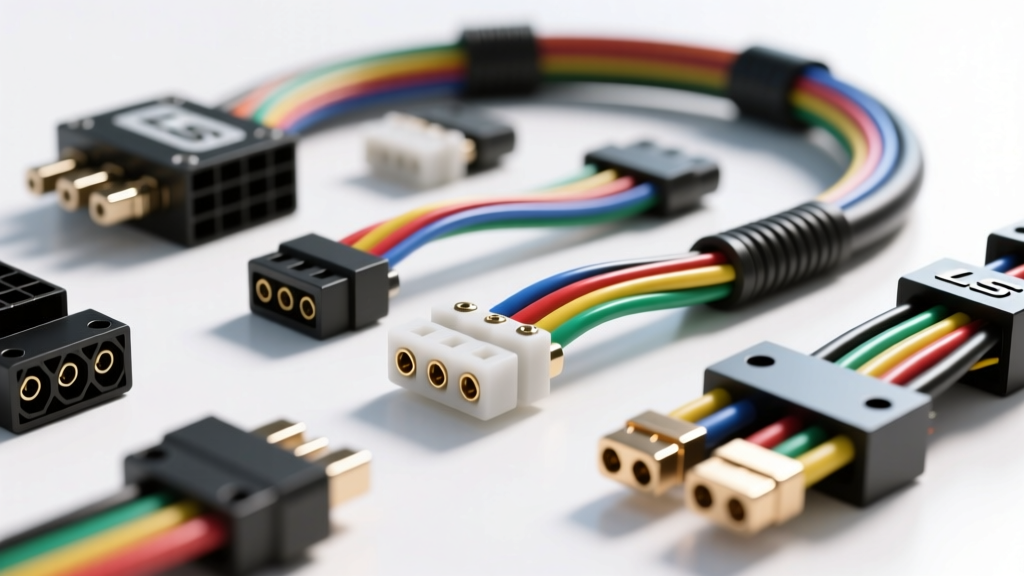
The Shift to the Mexico Automotive Wiring Harness Market
For decades, automotive modifiers and custom chassis builders relied heavily on domestic aftermarket wiring solutions or scavenged junkyard harnesses. However, as the mexico automotive wiring harness market has expanded to become a premier manufacturing hub for global Tier-1 suppliers like Yazaki, Sumitomo, and Leoni, a new avenue for high-quality, OEM-specification wiring has opened up for the aftermarket community. Facilities in regions like Chihuahua, Hermosillo, and Saltillo now produce millions of engine and chassis harnesses for North American vehicles. For builders executing complex LS V8 swaps or custom restomod projects, understanding how to source, verify, and integrate surplus or direct-run harnesses from these Mexican manufacturing plants is a massive advantage in achieving factory-level reliability.
Verifying OEM-Spec Wire Insulation Standards
When sourcing harnesses from the mexico automotive wiring harness market, the first step in quality assurance is verifying the wire insulation. True OEM harnesses do not use generic PVC (Polyvinyl Chloride) wire, which becomes brittle and melts under high under-hood temperatures. Instead, they utilize cross-linked polyethylene (XLPE) variants. According to the SAE J1128 Standard for Low Tension Primary Cable, cross-linked wires offer superior thermal resistance and thinner insulation walls, allowing for tighter harness bundling without sacrificing current capacity.
Wire Specification Chart: GXL vs. TXL vs. SXL
| Wire Type | AWG Range | Insulation Thickness | Max Temp Rating | Primary Application |
|---|---|---|---|---|
| TXL (Thin) | 24 - 18 AWG | 0.23 mm (0.009 in) | 125°C (257°F) | Sensor signals, CAN-bus, low-current 5V references |
| GXL (General) | 18 - 10 AWG | 0.38 mm (0.015 in) | 125°C (257°F) | Injector feeds, ignition coils, relay triggers |
| SXL (Special) | 10 - 4 AWG | 0.55 mm (0.022 in) | 125°C (257°F) | Main battery feeds, alternator outputs, starter circuits |
When inspecting a sourced harness, look for the printed ink-jet markings on the wire casing. Genuine Mexican-manufactured OEM wire will feature the supplier code, AWG size, and the specific insulation type (e.g., Yazaki GXL 14 AWG). If the wire feels overly stiff or the insulation is excessively thick for its gauge, it is likely a cheap PVC counterfeit that will fail in a high-heat engine bay.
Decoding the Connector Ecosystem
The mexico automotive wiring harness market heavily utilizes Delphi (now Aptiv) and TE Connectivity connector families. For an LS swap project, you will predominantly encounter the Metri-Pack and Weather-Pack series. The Metri-Pack 150 series is standard for low-current sensors like the MAP (Manifold Absolute Pressure) and TPS (Throttle Position Sensor), while the robust Metri-Pack 280 and 630 series are used for high-current draws like fuel injectors and cooling fans.
When adapting these harnesses, never reuse the internal rubber cavity plugs and terminal position assurance (TPA) locks if they show signs of UV degradation or heat cycling. Sourcing fresh TE Connectivity Automotive Connectors and TPA wedges is critical. A missing TPA lock on an LS engine's Crankshaft Position Sensor (CKP) connector will inevitably lead to a backed-out terminal, causing a random stall condition that is notoriously difficult to diagnose on a dyno or during track testing.
Integration Guide: Adapting a Sourced Harness for an LS P59 PCM
One of the most common upgrade projects utilizing these market-sourced harnesses is the Gen III/IV LS V8 swap using the ubiquitous P59 PCM (Powertrain Control Module). The P59 features three main connectors: C1 (Black, 80-way), C2 (Red, 80-way), and C3 (Blue, 73-way). When extending or modifying a Mexican-sourced chassis harness to mate with an aftermarket P59 standalone setup, precise pinout mapping is mandatory.
Critical P59 PCM Pinout and Extension Specifications
| Connector / Pin | Wire Color (OEM) | Function | Required AWG | Modification Notes |
|---|---|---|---|---|
| C1 - Pin 20 | Pink | Fused Ignition 12V | 14 AWG GXL | Must be triggered by ignition switch; do not share with high-draw accessories. |
| C1 - Pin 70 | Pink/Black | Battery 12V (Keep Alive) | 14 AWG GXL | Requires constant 12V. Connect directly to battery via a 15A maxi-fuse. |
| C2 - Pin 1 | Dark Green | Class 2 Serial Data | 20 AWG TXL | Highly sensitive to EMI. Must be routed away from ignition coils and alternators. |
| C3 - Pin 19 | Tan | 58X Crank Signal | 20 AWG TXL | Shielded cable recommended. Ground shield at PCM only to prevent ground loops. |
| C3 - Pin 21 | Purple/White | Camshaft Position Signal | 20 AWG TXL | Verify 12V pull-up resistor is intact if using aftermarket Hall-effect sensors. |
Splicing and Termination Best Practices
When extending the harness to reach a custom firewall location or a relocated battery box, the method of splicing dictates the longevity of the build. The Western Union splice and solder-only joints are strictly prohibited in modern automotive high-vibration environments. Solder creates a rigid point in the wire strand, leading to stress fractures and eventual open circuits just behind the solder joint.
The Correct Mechanical Crimp Procedure
- Strip the Wire: Use precision wire strippers calibrated for cross-linked insulation. TXL and GXL insulation is tougher than PVC and requires sharper blades to avoid nicking the copper strands. Strip exactly 5mm (0.20 inches) for standard Metri-Pack terminals.
- Select the Die: Use a ratcheting crimper with the correct die profile. For 18-22 AWG wires, use the red die (typically 0.5 - 1.5 mm²). The crimp should feature a distinct 'B' or 'F' shape, compressing the wire wings tightly around the copper without cutting into the strands.
- Insulation Crimp: The secondary crimp wings must grip the wire insulation firmly. Perform a pull-test; a properly crimped 18 AWG GXL wire should withstand a minimum of 15 lbs of pull force before the wire breaks or slips.
- Seal the Connection: Never use standard vinyl electrical tape. Seal all splices and terminations using 3:1 shrink ratio adhesive-lined polyolefin heat shrink. When heated, the inner meltable adhesive flows into the wire strands, creating a waterproof, corrosion-proof barrier that prevents capillary action from drawing moisture into the harness.
Troubleshooting Common Failure Modes in Sourced Harnesses
Even high-quality harnesses from the mexico automotive wiring harness market can suffer from integration failures when adapted for aftermarket V8 swaps. The most prevalent issue is chassis grounding degradation. OEM harnesses typically terminate ground wires using stamped steel ring terminals bolted to the engine block or chassis. In a swap scenario, builders often bolt these to painted or powder-coated surfaces, resulting in high-resistance grounds.
Voltage Drop Testing Protocol
To diagnose a suspected ground issue without tearing the harness apart, perform a voltage drop test under load:
- Set your digital multimeter to DC Volts.
- Connect the red probe to the negative terminal of the component (e.g., the fuel pump ground wire).
- Connect the black probe directly to the negative terminal of the battery.
- Activate the circuit. A healthy ground circuit should show a voltage drop of less than 0.10V (100mV). If the meter reads 0.5V or higher, the ground path has excessive resistance, which will rob the fuel pump of amperage and cause lean conditions or PCM reset faults.
Always sand down to bare metal, apply a conductive anti-oxidant compound (like Noalox), and use a star washer to bite through any residual surface oxidation before tightening the ground ring terminal to the manufacturer's specified torque setting.
Conclusion
Leveraging the mexico automotive wiring harness market provides builders with access to premium, OEM-grade wiring materials that far exceed standard aftermarket kits. By rigorously verifying GXL/TXL insulation standards, respecting Delphi connector TPA requirements, and executing flawless mechanical crimps with adhesive sealing, modifiers can build custom LS swap harnesses that offer true factory-level reliability and longevity.