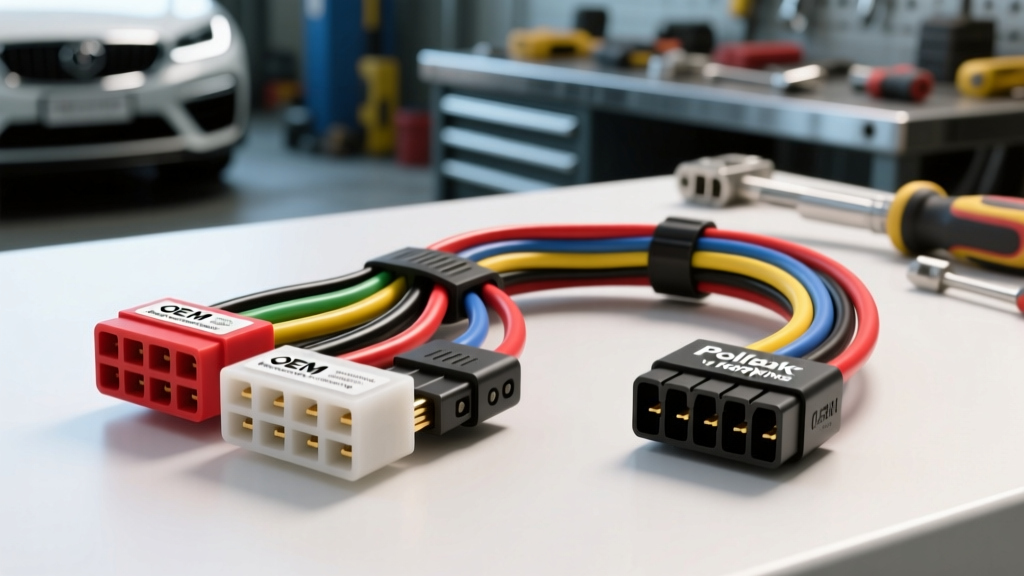
The Definitive Guide to Seven Pin Wiring Harness Selection
When towing heavy-duty trailers, fifth wheels, or enclosed car haulers, a standard 4-way flat connector is entirely insufficient. You require a dedicated seven pin wiring harness (commonly referred to as a 7-way RV blade) to safely distribute power to electric brakes, auxiliary 12V systems, and reverse lamps. However, not all 7-pin harness kits are engineered equally. Choosing between an OEM plug-and-play replacement and an aftermarket universal kit requires a deep understanding of wire gauge (AWG), connector metallurgy, and Body Control Module (BCM) integration.
This selection guide breaks down the technical specifications, material differences, and real-world failure modes of the leading seven pin wiring harness solutions on the market, ensuring your tow rig is wired for maximum safety and compliance.
SAE J286 Standard: The 7-Way RV Blade Pinout Chart
Before selecting a harness, you must understand the baseline architecture. The SAE International J286 standard dictates the physical layout and functional assignment of the 7-way blade connector. While aftermarket manufacturers occasionally deviate on wire jacket colors, the pin functions and minimum AWG requirements remain rigid to prevent voltage drop and overheating.
| Pin Position | Function | Standard Wire Color | Minimum AWG | Technical Notes |
|---|---|---|---|---|
| Pin 1 (10 o'clock) | Left Turn / Stop | Yellow | 14 AWG | Shares circuit with brake light filament. |
| Pin 2 (12 o'clock) | Reverse Lamps | Purple | 14 AWG | Often tied to reverse lockout for surge brakes. |
| Pin 3 (2 o'clock) | Ground (Chassis) | White | 10 AWG | Must handle return current for ALL circuits. |
| Pin 4 (4 o'clock) | Right Turn / Stop | Green | 14 AWG | Shares circuit with brake light filament. |
| Pin 5 (6 o'clock) | Electric Brakes | Blue | 10 AWG | High draw: up to 15A for multi-axle trailers. |
| Pin 6 (8 o'clock) | 12V Auxiliary Power | Black | 10 AWG | Used for RV battery charging and interior lights. |
| Pin 7 (Center) | Tail / Running Lamps | Brown | 14 AWG | Continuous draw; check for voltage drop over 25ft. |
OEM vs. Aftermarket Seven Pin Wiring Harness Kits
The primary fork in the road when replacing or upgrading your towing harness is choosing between Original Equipment Manufacturer (OEM) kits and aftermarket universal assemblies. Both have distinct advantages depending on your vehicle's age and your mechanical expertise.
OEM Replacement Harnesses (Ford, GM, RAM)
Modern heavy-duty trucks (2015 and newer) utilize a USCAR-standard 7-way socket that plugs directly into a factory-sealed rear junction block or bumper integration module.
- Pros: True plug-and-play installation. No wire splicing, soldering, or heat-shrinking required. The harness communicates directly with the truck's BCM, allowing the dash to display 'Trailer Connected' and monitor individual circuit faults (e.g., a blown trailer running light).
- Cons: High cost. An OEM Mopar or Ford Super Duty 7-pin harness can cost 3 to 4 times more than an aftermarket equivalent. Furthermore, OEM pigtails are often cut to exact factory lengths, offering zero slack for custom bumper builds or hitch extensions.
Aftermarket Universal Kits (Curt, Hopkins, Reese)
Aftermarket kits are the go-to solution for older trucks, custom flatbeds, or SUVs requiring a tow package retrofit. These kits typically feature a blunt-cut pigtail that must be spliced into the vehicle's tail light wiring or plugged into an aftermarket T-connector.
- Pros: Highly versatile. Available in extended lengths (up to 8 feet) for gooseneck routing. Significantly more affordable and widely available at local auto parts stores.
- Cons: Requires proper crimping or soldering. Poor splice connections are the leading cause of trailer lighting failures. They do not natively integrate with modern BCM trailer-detection algorithms without additional relay modules.
Wire Gauge (AWG) and Voltage Drop Considerations
One of the most critical, yet frequently overlooked, aspects of a seven pin wiring harness is the copper cross-section. Many cheap, imported aftermarket harnesses use 16 AWG wire for all seven circuits to save on manufacturing costs. This is a severe safety hazard.
According to Ohm's Law, pushing 12 amps of electric brake current through 25 feet of 16 AWG wire will result in a voltage drop of nearly 1.5 volts. By the time the current reaches the trailer's brake magnets, they are receiving only 10.5V, resulting in sluggish, asymmetric braking. When selecting an aftermarket harness, inspect the packaging or strip back a millimeter of the jacket. Ensure the Ground (White), Electric Brake (Blue), and 12V Aux (Black) circuits are a minimum of 10 AWG stranded copper. If the kit uses 14 AWG across the board, you must upgrade the pigtail or run a dedicated 10 AWG hot wire directly from the alternator to the 12V Aux pin via a 40-amp relay.
Connector Metallurgy: Pollak vs. Hopkins vs. Bargman
The vehicle-side socket takes a beating from road debris, moisture, and UV exposure. The internal pin design dictates the lifespan of the connection.
Pollak (Die-Cast Zinc & Spring-Loaded Pins)
The Pollak PK11720 is widely considered the gold standard for heavy-duty towing. The housing is machined from die-cast zinc, providing superior impact resistance and EMI shielding. More importantly, Pollak utilizes spring-loaded, split-blade pins. As the trailer plug is inserted, the pins compress and expand, creating a high-friction, gas-tight connection that resists vibration-induced arcing.
Hopkins & Bargman (ABS Plastic & Fixed Pins)
Brands like Hopkins and Bargman typically utilize UV-stabilized ABS plastic housings. While lighter and cheaper, plastic housings can crack if stepped on or struck by flying gravel. The internal pins are usually fixed brass or nickel-plated steel. Over time, repeated plugging and unplugging causes the fixed pins to splay outward, resulting in a loose connection that arcs under the heavy load of the electric brake circuit, eventually melting the plastic housing.
BCM Protection and Relay Kits
If you are installing an aftermarket seven pin wiring harness on a modern vehicle (2010+), you must protect the Body Control Module. Modern trucks use solid-state BCM drivers to power the tail and turn signal circuits. These drivers are designed to output a maximum of 3 to 5 amps. If your trailer has extensive LED marker lights or incandescent running lamps that draw more than this threshold, the BCM will detect an over-current event and shut down the circuit, throwing a 'Trailer Wiring Fault' code on the dash.
The Fix: Never splice a 7-way harness directly into the BCM-driven tail light wires on modern vehicles. Instead, use the factory tow package port if available. If retrofitting, you must use a ModuLite or relay-based converter kit. These kits use the vehicle's low-amp lighting circuits merely as a signal to trigger an internal relay, which then pulls heavy current directly from the vehicle's 12V battery to power the 7-pin harness.
Common Failure Modes and Troubleshooting
Even the best harness kits will fail if environmental sealing is ignored. Here is a diagnostic decision tree for the most common 7-pin harness failures:
- Symptom: Electric brakes pulse or fail entirely, but lights work.
Cause: Voltage drop on the Blue (Brake) or White (Ground) wire.
Fix: Check for corrosion at Pin 3 and Pin 5. Clean with electrical contact cleaner and apply dielectric grease. Verify the harness ground ring terminal is bolted to bare, unpainted frame metal. - Symptom: Trailer running lights flicker when hitting bumps.
Cause: Splayed pins in the vehicle-side socket or a loose crimp on the Brown wire.
Fix: Replace the vehicle-side socket with a Pollak die-cast unit. Inspect the blunt-cut pigtail for cold solder joints or failing butt-splices. - Symptom: 12V Aux pin reads 0V with a multimeter.
Cause: Blown under-hood trailer charge relay or missing OEM relay (common on GM Silverado/Sierra tow packages).
Fix: Locate the under-hood fuse block and install the required 40-amp square trailer charge relay and 30-amp fuse.
Final Selection Checklist
Before purchasing your next seven pin wiring harness, verify the following:
- Does the harness utilize 10 AWG wire for the Ground, Brake, and Aux circuits?
- Is the vehicle-side socket constructed of die-cast metal with spring-loaded pins?
- If installing on a post-2010 vehicle, does the kit include a BCM-protecting relay module?
- Is the jacket rated for cross-linked polyethylene (XLPE) or high-grade PVC to resist engine bay heat and road salt?