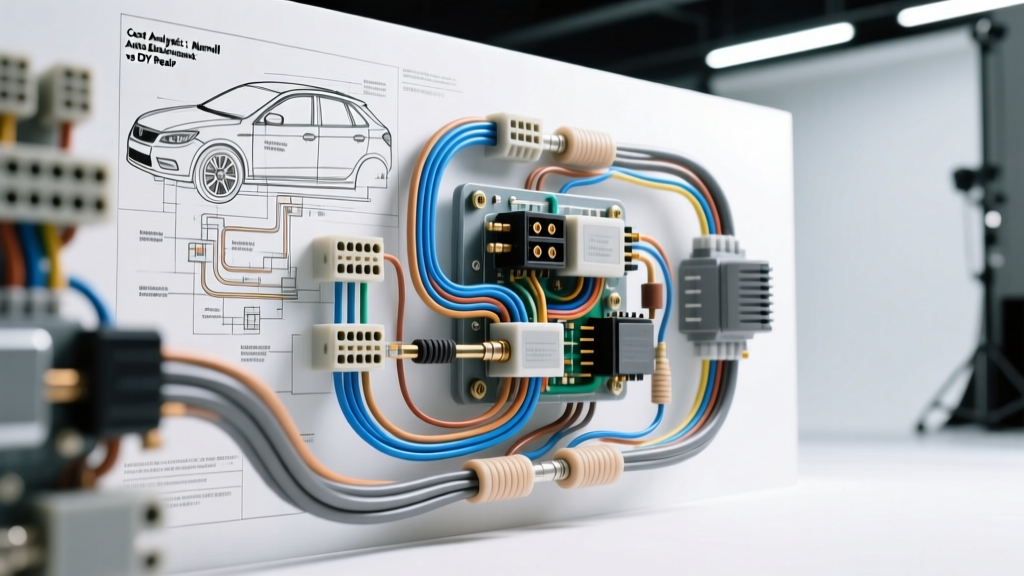
The True Cost of Automotive Electrical Diagnostics
Modern vehicle electrical architectures have evolved far beyond simple 12-volt analog circuits. Today's platforms rely on multiplexed communication networks (CAN, LIN, FlexRay), pulse-width modulation (PWM) for alternator control, and high-current 48-volt mild-hybrid systems. When electrical faults arise, vehicle owners face a critical decision: invest in professional-grade diagnostic tooling for a DIY approach, or rely on specialized facilities like Merrill Auto Electric Lakewood. This comprehensive cost and tool requirements analysis breaks down the financial and technical realities of automotive electrical troubleshooting, comparing the DIY investment against professional shop capabilities.
Essential DIY Tool Requirements & Cost Breakdown
To accurately diagnose modern electrical faults without causing module damage or misdiagnosing a simple wiring chafe as a failed control unit, a minimum threshold of tooling is required. Below is the baseline investment for a serious DIY automotive electrician.
| Tool / Equipment | Primary Application | Required Specifications | Estimated Cost |
|---|---|---|---|
| Digital Multimeter (DMM) | Voltage drop, resistance, continuity | CAT III rated, 10A fused, 0.1mV resolution | $350 - $450 |
| Automotive Oscilloscope | CAN bus decoding, sensor waveform analysis | 2-4 channels, 20MHz+ bandwidth, 100MS/s sample rate | $800 - $1,500 |
| Circuit Load Tester | Applying simulated loads to power/ground circuits | Variable resistance, built-in DMM, short-circuit protected | $200 - $300 |
| Terminal Crimping Kit | Repairing pigtails, Deutsch, and Metri-Pack connectors | Ratcheting dies for 10-22 AWG, wire seal insertion tools | $150 - $250 |
| Thermal Imaging Camera | Locating high-resistance connections and shorted modules | 120x90 resolution minimum, 0.10°C sensitivity | $300 - $500 |
Total Baseline DIY Investment: $1,800 - $3,000
Advanced Oscilloscopes vs. Standard Multimeters
A standard multimeter averages voltage over time, making it virtually useless for diagnosing fast-acting digital signals. For example, testing a CAN bus network requires observing a 5-volt differential signal transitioning thousands of times per second. According to SAE J1113 standards for electromagnetic compatibility and signal integrity, observing these waveforms requires an oscilloscope with a minimum sample rate of 100 mega-samples per second (MS/s). While a DIYer might spend $1,200 on a PicoScope 4225A, a professional shop utilizes scopes with advanced automated serial decoding triggers, instantly translating hex data into readable OBD-II PIDs without manual cursor calculations.
Professional Capabilities: The Merrill Auto Electric Lakewood Advantage
When evaluating a specialized facility like Merrill Auto Electric Lakewood, the cost analysis shifts from tool acquisition to labor efficiency and definitive diagnostics. Professional auto electricians possess OEM-level breakout boxes, carbon pile load testers, and proprietary module programming software that are financially unfeasible for home mechanics.
Bench Testing and Heavy-Duty Load Application
Alternator and starter diagnostics require more than a static voltage check. A failing voltage regulator or a worn starter commutator may perform adequately at idle but fail under thermal and electrical load. Professional shops utilize heated bench testers capable of applying a 500-amp carbon pile load while monitoring alternator output up to 250 amps at operating temperatures (180°F+). Furthermore, testing alternator ripple—the AC voltage leak caused by a failed rectifier diode trio—requires precise measurement. A healthy alternator should exhibit less than 50mV of AC ripple on the DC system. Exceeding this threshold indicates diode degradation, which can induce noise on the vehicle's audio system and corrupt sensitive CAN bus data.
Technical Deep Dive: Parasitic Draw & CAN Bus Diagnostics
To understand the value of professional diagnostics, we must examine the technical rigor required for common electrical faults.
The Voltage Drop Method for Parasitic Draws
The traditional method of testing parasitic draws involves breaking the circuit by disconnecting the battery and placing a multimeter in series. This is fundamentally flawed on modern vehicles, as breaking power triggers module wake-up sequences, resulting in false high-current readings. The industry-standard voltage drop method measures the millivolt (mV) drop across the blades of the vehicle's fuses while the circuit remains intact and the modules are asleep.
- Mini Fuses (10A - 30A): Typically exhibit a resistance of 0.0075 to 0.015 ohms. A 1mV drop across a 10A Mini fuse equates to approximately 0.13 Amps (130mA).
- ATO Fuses (10A - 30A): Generally have lower resistance. A 1mV drop across a 20A ATO fuse equates to roughly 0.25 Amps.
- J-Case Fuses (30A - 60A): Used for high-draw components like ABS pumps and cooling fans. These require specific calibration charts provided by OEM service manuals to convert mV drop to exact amperage.
Acceptable parasitic draw on modern vehicles is typically between 20mA and 50mA once all modules have entered sleep mode (which can take up to 45 minutes on complex luxury architectures). Identifying a specific module drawing 300mA requires methodical voltage drop testing across every fuse in the Body Control Module (BCM) and Power Distribution Center (PDC).
CAN Bus Termination and Wiring Specifications
When repairing damaged wiring harnesses, adhering to SAE J1292 automobile wiring standards is non-negotiable. The Controller Area Network (CAN) relies on a twisted-pair topology to reject electromagnetic interference (EMI).
- Wire Gauge & Type: CAN bus circuits typically utilize 18 AWG or 20 AWG GXL (Cross-linked polyethylene) wire. GXL offers superior thermal resistance (up to 125°C) compared to standard PVC wire, which is critical when routing near exhaust manifolds.
- Termination Resistors: The CAN network requires exactly two 120-ohm termination resistors placed at the physical ends of the bus. Measuring between CAN-High and CAN-Low with the battery disconnected should yield exactly 60 ohms (two 120-ohm resistors in parallel). A reading of 120 ohms indicates an open circuit in one of the terminating modules.
- Signal Voltages: Recessive state (idle) sits at 2.5V for both lines. During the dominant state (transmitting), CAN-High rises to ~3.5V while CAN-Low drops to ~1.5V, maintaining a 5V differential.
Splicing CAN bus wires using standard butt connectors introduces impedance mismatches and untwisted wire lengths, leading to signal reflection and intermittent U-codes (network communication faults). Professional shops use ultrasonic welders or specialized solder-sleeve splices with integrated heat-shrink environmental seals to maintain circuit integrity.
Cost-Benefit Matrix: When to DIY vs. When to Call the Pros
Determining whether to purchase the requisite tooling or outsource the repair to Merrill Auto Electric Lakewood depends on the fault's complexity and the vehicle owner's long-term intentions.
| Scenario | DIY Viability | Tool Requirement | Recommendation |
|---|---|---|---|
| Blown fuse / simple relay swap | High | Basic DMM, Test Light | DIY. Cost of tools is negligible; fault is isolated. |
| Starter motor replacement | Moderate | Socket set, Torque wrench | DIY if mechanically inclined. Electrical connection requires cleaning and applying dielectric grease to prevent voltage drop. |
| Intermittent parasitic battery drain | Low | Advanced DMM, Thermal Camera, OEM Wiring Diagrams | Professional Service. The time investment and risk of misdiagnosing a $1,200 BCM outweighs the cost of professional diagnostic time. |
| CAN Bus U-Code diagnostics | Very Low | Oscilloscope, Breakout boxes, PicoScope software | Professional Service. Requires deep understanding of multiplexed network topologies and module sleep/wake logic. |
Final Verdict on Automotive Electrical Investments
Automotive electrical systems are no longer analog afterthoughts; they are the central nervous system of the vehicle. While a dedicated enthusiast can justify the $2,000+ investment in Fluke multimeters, PicoScopes, and specialized crimping tools for continuous project cars, the average vehicle owner will find vastly superior ROI in leveraging the expertise of established professionals. Facilities like Merrill Auto Electric Lakewood amortize the cost of $50,000+ diagnostic suites across thousands of repairs, providing definitive, SAE-compliant solutions that prevent the costly 'parts cannon' approach often associated with DIY electrical troubleshooting. Whether dealing with a failed PWM alternator on a late-model truck or a corrupted LIN bus network on a luxury sedan, understanding the tool requirements ensures you choose the most efficient and economically sound path to a reliable repair.