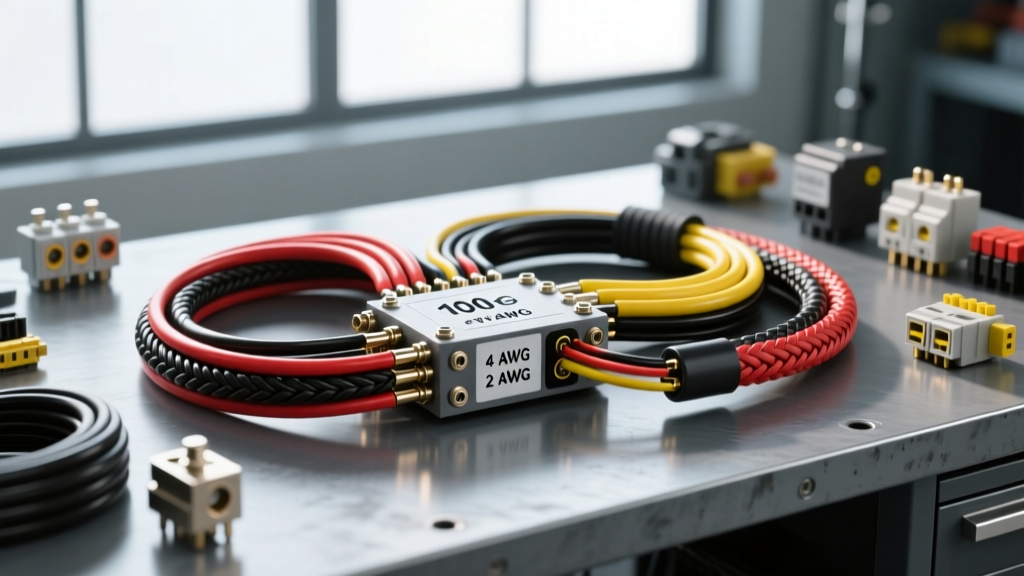
The 100-Amp Threshold: Why Sizing and Safety Matter
When building high-output automotive electrical systems, EV conversions, or heavy-duty RV inverter banks, the 100-amp mark is a critical threshold. At 100 amps, a 12V circuit is flowing 1,200 watts of continuous power. If this current encounters unexpected resistance due to undersized wiring, poor terminations, or incorrect fusing, the resulting thermal runaway can melt insulation, ignite chassis materials, or destroy sensitive ECUs.
Many DIYers and even seasoned mechanics ask, what wire gauge for 100 amps? The answer is not a single number. It depends on circuit length, ambient temperature, and the specific insulation rating of the cable. More importantly, knowing the gauge is only half the battle; avoiding the fatal installation mistakes detailed below is what keeps your vehicle from becoming a fire hazard.
Direct Answer: What Wire Gauge for 100 Amps?
For automotive and marine DC applications adhering to SAE J1128 standards, the following AWG (American Wire Gauge) sizes are required to safely carry 100 amps while maintaining a safe voltage drop (under 3%) and preventing insulation meltdown.
| Total Wire Length (Round Trip) | Recommended AWG Size | Max Voltage Drop @ 12V | Typical Application |
|---|---|---|---|
| 0 - 5 Feet | 2 AWG | 0.16V | Alternator to Battery, Short Winch Leads |
| 5 - 10 Feet | 1 AWG | 0.20V | High-Current Fuse Panels, EV Battery Links |
| 10 - 15 Feet | 1/0 AWG | 0.25V | RV Inverter Banks, Marine House Batteries |
| 15 - 20 Feet | 2/0 AWG | 0.28V | Long-run EV Conversions, Heavy Winching |
Note: Total wire length includes both the positive and negative/ground paths. If your battery is 5 feet from the load, your total circuit length is 10 feet.
Fatal Mistake #1: Sizing for NEC Instead of SAE J1128
The most dangerous mistake automotive electricians make is referencing the National Electrical Code (NEC) Table 310.15(B)(16) for vehicle wiring. The NEC is designed for residential and commercial building wiring using solid copper wire in open-air or conduit environments.
Why This Causes Fires
Automotive wire is highly stranded to withstand vibration. Stranded wire has less actual copper cross-section than solid wire of the same AWG due to the air gaps between the strands. Furthermore, engine bays routinely see ambient temperatures exceeding 100°C (212°F). According to SAE J1128, high-temperature automotive wire (like SXL or GXL) must be derated in high-heat environments. Using 3 AWG wire because an online 'NEC calculator' told you it handles 100 amps will result in melted insulation the first time you sit in stop-and-go traffic with the A/C and cooling fans running.
Fatal Mistake #2: Ignoring Ambient Temperature Derating
Wire ampacity is not static; it is heavily dependent on the temperature of the environment surrounding the cable. Standard TXL (thin-wall cross-linked) wire is rated for 125°C, while SXL (special cross-linked) is rated for 125°C continuous and up to 150°C for short-term spikes.
The Exhaust Manifold Danger Zone
If you are routing a 100-amp charge wire from an upgraded alternator on a V8 engine, and that 2 AWG cable passes within 4 inches of a cast-iron exhaust manifold or turbocharger downpipe, the localized ambient temperature can easily exceed 125°C. At this temperature, the wire's ability to shed heat drops to zero. The electrical resistance increases, generating more heat, leading to thermal runaway. Safety Fix: Always route 100A+ cables along the framerails or inner fenders. If engine-bay routing is unavoidable, use fiberglass fire-sleeving over the SXL wire and maintain a minimum 6-inch clearance from heat sources.
Fatal Mistake #3: Undersizing the Overcurrent Protection (AIC Ratings)
Knowing what wire gauge for 100 amps is useless if the fuse cannot safely interrupt a dead short. Many builders install a standard 100A ANL or AGU fuse at the battery. However, they ignore the Ampere Interrupting Capacity (AIC).
Understanding AIC in Automotive Shorts
If a 100A circuit dead-shorts to the steel chassis right next to the battery, the fault current is limited only by the battery's internal resistance and the first few inches of cable. A standard 1,000 CCA (Cold Cranking Amps) lead-acid battery can deliver over 3,000 amps of instantaneous fault current. Standard automotive fuses often have an AIC rating of only 1,000 to 2,000 amps. If a 3,000A surge hits a 1,000A AIC fuse, the fuse element will vaporize, but an electrical arc will sustain itself across the blown gap, effectively turning the fuse holder into a blowtorch.
The Safety Fix: Use Class T Fuses
For any circuit carrying 100 amps or more, especially within 18 inches of the battery positive terminal, use a Class T fuse or a high-AIC marine-rated ANL fuse with a minimum 20,000 AIC rating. Class T fuses are specifically designed to quench high-energy DC arcs instantly. Never use AGU (glass tube) fuses for 100A circuits; the glass can shatter under high-fault thermal shock, exposing live arcing elements to the engine bay.
Fatal Mistake #4: Soldering High-Amp Terminations
Solder is a terrible choice for terminating 100-amp automotive circuits. While solder is conductive, it has a relatively low melting point (around 188°C for standard 60/40 rosin-core). Under high continuous loads, or during a momentary voltage spike where the alternator pushes 14.8V and the cooling fans draw a massive surge, the terminal connection can heat up. If the resistance increases even slightly, the solder will melt, the wire will pull out of the terminal, and a high-amperage arc will ignite surrounding materials.
Proper Hex-Crimp Termination
For 2 AWG or 1 AWG wire, you must use a mechanical hex-crimp. This cold-welds the copper strands to the copper terminal under immense hydraulic pressure, creating a gas-tight seal that is immune to vibration and thermal expansion.
- Tooling: Use a hydraulic crimper with matching AWG hex dies (e.g., a #2 die for 2 AWG).
- Terminals: Use tinned copper, seamless ring terminals with a 3/8' stud hole for standard battery and alternator posts.
- Sealing: Slide dual-wall, adhesive-lined heat shrink (like 3M FP-301 or equivalent) over the wire before crimping. When heated, the inner meltable adhesive layer extrudes out the edges, sealing the copper strands from oxygen and preventing green corrosion (copper oxide), which is highly resistive.
Real-World Application: Upgrading to a 100A+ Alternator
A classic example of 100A wiring is upgrading an older GM vehicle (like a 1980s C10 squarebody with a 63A 10SI alternator) to a modern 105A or 140A CS130/AD230 alternator to support fuel injection and high-wattage lighting.
The Factory Wiring Trap
The factory charge wire on these vehicles is typically 10 AWG or 8 AWG, routed through the factory horn relay buss bar. If you bolt a 105A alternator to this factory harness and drive with the headlights, wipers, and heater on, the system will draw near 100 amps. The factory 10 AWG wire will glow red hot, melting the harness tape and potentially shorting against the exhaust manifold.
The Correct 100A Upgrade Protocol
- Delete the Factory Charge Wire: Cut and cap the original 10 AWG charge wire at the alternator and the horn relay.
- Run New Cable: Run a continuous length of 2 AWG (or 1 AWG for longer routes) SXL cross-linked wire directly from the alternator B+ output stud to the battery positive terminal.
- Install Overcurrent Protection: Install a 120A Class T or high-AIC ANL fuse within 7 inches of the battery positive terminal. (Sizing the fuse 120% above the max continuous expected load allows for transient alternator spikes without nuisance blowing).
- Upgrade the Ground: A 100A charge circuit requires a 100A ground path. Add a braided 1/0 AWG ground strap from the alternator casing directly to the engine block, and ensure the engine-to-chassis ground strap is clean, bare metal, and torqued to spec.
Pre-Flight Safety Checklist for 100-Amp Circuits
Before energizing any 100-amp automotive circuit, verify the following critical safety points:
- Battery Disconnect: Was the negative battery terminal removed before cutting, stripping, or routing the positive 100A cable?
- Chafing Protection: Is the cable protected by split-loom tubing or fire-sleeving anywhere it passes through a firewall, bulkhead, or metal bracket?
- Torque Specifications: Are the terminal nuts torqued to spec? A 3/8' battery or alternator stud nut should typically be torqued to 10-12 ft-lbs. Overtightening can snap the copper stud; undertightening creates micro-arcing and resistance heat.
- Fuse Proximity: Is the main overcurrent fuse located as close to the power source (battery or alternator) as physically possible to protect the entire length of the wire?
Understanding what wire gauge for 100 amps is only the first step. By respecting SAE standards, utilizing high-AIC fusing, and executing flawless mechanical crimps, you ensure your high-output electrical system delivers reliable power without compromising vehicle safety.